
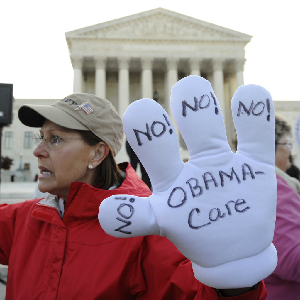
 We Don’t Need No Stinkin’ Judges!
And, we don’t need no stinkin’ permission from the courts to exercise our rights. We need to learn how to exercise our rights whether they the government – or the courts – want us to or not.
Thomas Jefferson had some advice for us today. In 1798, in response to a federal law criminalizing free speech, he wrote, “the several states comprising the United States…are not united on a principle of unlimited submission to their general government.”
He continued, “….whensoever the general government assumes undelegated powers…. nullification of the act is the rightful remedy”
With his advice, our message today to the supreme court is pretty straightforward. You may have your “opinion” – now come and enforce it!
WHAT DO WE DO ABOUT IT?
Now that the black dresses have ruled against our constitution, again, what do we do about it?
Do we march on Washington DC and demand that federal politicians limit their own power?
Do we try to file another lawsuit in the hopes that federal judges will limit federal power?
Do we vote the bums out in the hopes that the new bums will say – “oh, wow, yeah….you can have all that power back!” FYI, that never happens!
Thomas Jefferson and James Madison both warned us that if the federal government ever became the sole and exclusive arbiter of the extent of its own powers – that power would endlessly grow…regardless of elections, separation of powers, courts, or other vaunted parts of our system
They were right. For a hundred years, we the people have been suing, and marching, and lobbying, and voting the bums out – but yet…year in and year out, government continues to grow and your liberty continues to diminish – and it doesn’t matter who is the president, or what political party controls congress – the growth of power in the federal government never stops.
THE SOLUTION
Again, the question remains – what do we do about it? Jefferson told us that a “nullification of the act…is the rightful remedy.”
Madison went a similar direction – and said that the states are “duty bound to interpose…to arrest the progress of evil”
What does that mean?
Well, we’re not supposed to wait for the Federal government to correct itself. We’re not supposed to wait two or four or six years for some new bums to fix things for us. We’re not supposed to wait years for the politically connected lawyers on the Supreme Court to give us permission to be free. We’re supposed to exercise our rights whether the government wants us to our not.
So what IS nullification?
Nullification begins with a decision made by you that a particular law is unconstitutional. Then, in most situations, your state legislature would be pressured into resisting that particular law. This step usually involves a bill, which is passed by both states houses and is signed by your governor. In some cases, it might be approved by the voters of your state directly, in a referendum. It may change your state’s statutory law or it might even amend your state constitution. It is a refusal on the part of your state government to cooperate with, or enforce any federal law it deems to be unconstitutional.
At its very core, nullification is any action or set of actions which results in a Federal law being rendered null and void or just plain unenforceable.
SOME IMPORTANT HISTORY
In 1850, when President Millard Fillmore signed the second “Fugitive Slave Act,” due process was under serious attack by the federal government.
The law compelled people of all states to “assist” federal marshals and their deputies with the apprehension of suspected runaway slaves. It brought all trials involving alleged fugitive slaves under federal jurisdiction. It included large fines for anyone who aided a slave in their escape, even by simply giving them food or shelter.
The act also suspended habeas corpus and the right to a trial by jury for alleged “slaves,” and made their testimony inadmissible in court. The written testimony of the supposed slave master, on the other hand, which could be presented to the court by slave hunters, was given preferential treatment.
STATE RESISTANCE
In response, Northern States intensified efforts to pass what were known as “personal liberty laws.”
In Pennsylvania and Rhode Island, state officials were forbidden from assisting the feds in enforcing the law and refused the use of state jails for fugitive slaves.
Vermont passed a “Habeas Corpus Law,” requiring state judicial and law enforcement officials to actually help captured fugitive slaves there.
Massachusetts took a really strong stand – and actually passed a law that gave kidnapping charges to anyone trying to use these “indefinite detention” provisions of the fugitive slave act.
In that state, though, not a single federal agent was ever charged with kidnapping.
Was this because the law was passed by a bunch of politicians grandstanding – who had no intention of backing up their words with actions?
No. Not a single federal agent was arrested, because after the law passed – not a single person was kidnapped in Massachusetts and sent to slavery in the south.
Maybe the feds were scared – maybe they weren’t. Either way, the law was extremely effective.
In fact, Northern states were so successful overall, that when South Carolina seceded ten years later the people there named this northern resistance to the fugitive slave act as one of their primary reasons for leaving the Union. From their publicly-released “Declaration of Causes,” was this:
“The States of Maine, New Hampshire, Vermont, Massachusetts, Connecticut, Rhode Island, New York, Pennsylvania, Illinois, Indiana, Michigan, Wisconsin and Iowa, have enacted laws which either nullify the [Fugitive Slave Acts] or render useless any attempt to execute them…”
Bottom line? State and local non-compliance and resistance to unjust laws – this is not just a good idea. It works.
EXAMPLES TODAY
A little over a week ago, Governor Lynch of New Hampshire signed a bill making law there that the state will refuse to participate in setting of health exchanges.
Governor Walker in Wisconsin recently announced that his state would do the same. And other governors are following their lead.
In November, Ohio Passed Issue 3, which says the following:
“In Ohio, no law or rule shall compel, directly or indirectly, any person, employer, or health care provider to participate in a health care system.”
Ohio is now the tenth state to do this.
In Arizona and other states the past two years, bills have been considered to fully nullify the Affordable Care Act. The bill text includes the following:
“This state declares that the Patient Protection and Affordable Care Act is not authorized by the Constitution of the United States…; is declared to be invalid in this state, shall not be recognized by this state, is specifically rejected by this state and is considered void and of no effect in this state.”
But that’s not all…
“An official, agent or employee of the United States Government…who enforces or attempts to enforce an act, order, law, statute, rule or regulation of the United states Government in violation of this act is guilty of a Class 4 Felony.”
TWO PATHS AHEAD
We have two broad paths. Do what we’ve been doing…..voting bums out, hoping for repeal, maybe another lawsuit, or trying to get the entire country to agree on an amendment.
or,
We take Jefferson and Madison’s approach and nullify.
So how does this play out?
That brings me to the story of Roscoe Fillburn.
In the early 1940s, the FDR administration required American farmers to restrict production of wheat in order to raise prices.
As a farmer, Roscoe Filburn was told he could plant a little over 10 acres of wheat, which he did grow and sell on the market. He also decided that it was in his best interest – possibly because he had less revenue due to the production limitations – to plant another 10 or so acres. But, the excess wheat grown was used at home to feed his livestock, among other things. He never sold it, so he saw this as being outside the scope of Congressional power to regulate interstate commerce.
What did the federal government do? The expected – they ordered Roscoe to destroy his crops and pay a fine.
Roscoe sued, and the case went all the way to the Supreme Court. In Wickard v Filburn, the Court ruled against him and said that they could regulate as “interstate commerce” a plant grown in one’s backyard and consumed in one’s own home.
In response? People talked about voting the bums out, changing the makeup of the court, repealing the law, etc.
But none of that worked, because the principle still remained, that growing food in your backyard and consuming it in your home was “interstate commerce.”
If we fast forward to present times, we can see a similar situation.
ANGEL
In the 1990s, the People of California voted to legalize consumption of marijuana for medicinal purposes. Angel Raich, who had a huge cancerous tumor in her brain was told by her doctor that using marijuana to relieve some of the pain was acceptable.
Marijuana, though, is “illegal” on a federal level in all circumstances, so the feds decided to make an example. Federal agents destroyed Angel’s homegrown marijuana plants without much resistance.
Like Roscoe before her, Angel sued. The suit went all the way to the Supreme Court, and in Gonzales v Raich, Angel lost. The 2005 ruling made clear that the federal government did not recognize state laws authorizing the use of marijuana – in any situation.
In his dissent, Justice Clarence Thomas gave a stark warning:
“if the Federal Government can regulate growing a half-dozen cannabis plants for personal consumption then Congress’ Article I powers have no meaningful limits.”
WHAT THE…
Get the New Documentary Today!
So what happened? Did the weed activists take the same route as those who supported Roscoe decades earlier?
No!
They basically said….thanks for you opinion, now come and try to enforce it!
At the time the Raich ruling came down, there were ten states that had marijuana laws. But, how many repealed after that decision?
Zero.
Today, another seven are on board, defying the federal government and increasingly getting away with it.
What’s the lesson here?
When enough people say no to the federal government, including the supreme court, and enough states pass laws backing them up, it becomes nearly impossible for them to force their unconstitutional laws, regulations and mandates down our throats!

- Shots Fired, Ship Burned: The Sons of Liberty vs the HMS Gaspee - June 10, 2026
- Ignorance and Vice: The One-Two Punch for Tyranny - June 3, 2026
- It’s Not Just a Right. It’s a Duty. - May 15, 2026