
 Have you ever thought about what your relationship with your less savory neighbors might look like if you approached them the same way the United States handles its foreign policy?
Up until about a month ago, a couple lived in our neighborhood, and I’m relatively certain they dealt drugs out of their home. We saw many tell-tale signs, including people coming and going at odd hours. They didn’t keep the house up very well, and some unsavory looking characters tended to hang around. Then there was the occasional police activity. Needless to say, we didn’t consider those folks our best neighbors. And on more than one occasion, I considered the possibility that they could pose a danger to my property, or even my family. You just never know what might happen with those elements in the neighborhood.
So one night, I went over to the house and shot them both.
Call it a preemptive strike.
OK, I didn’t really go next door and shoot them. I just broke all of the windows out of their house and firebombed their car as a warning.
OK, obviously I didn’t do that either, evidenced by fact that I’m not typing this with the shadow of bars cutting across my desk.
Now a question: does the fact that I never shot my neighbors, or destroyed their property, make me a hermit?
Clearly not.
In fact, I was relatively friendly with my neighbors, in a neighborly sort of way. I said hello when I walked by. I brought their puppy back when it got loose. I offered to help them when their car was broken down. And despite my suspicions, I never personally experienced any problems relating to these particular neighbors. I maintained a vigilant, but friendly relationship with them, and we never had any issues. Basically, I treated them the same way I expected them to treat me.
Now let me be clear; had these folks threatened me in any way, I would have taken swift decisive action. If one of them attempted to break into my house uninvited, and threatened me or my family, I wouldn’t have hesitated to shoot to kill. But never encountering any actual threat, I pretty much left them alone. I didn’t bother them, and they apparently found no reason to bother me. I figured maintaining a level of friendliness couldn’t hurt either. I mean, if they viewed us as nice folks, it seemed less likely that they would bring any trouble to our doorstep.
Makes perfect sense, doesn’t it? Yet when applied at the foreign policy level, many Americans suddenly get all antsy and call it “isolationist.” Again, that’s a little like calling me a hermit because I didn’t go blow up my neighbor’s car. I did, in fact, interact with my neighbors. I just didn’t intervene unnecessarily in their affairs.
Non-interventionist seems a more appropriate term.
My relationship with these neighbors looked a lot like a small-scale version of the foreign policy advocated by Thomas Jefferson and George Washington. In his farewell address, Washington advised, “Observe good faith and justice towards all nations; cultivate peace and harmony with all.”
In his 1801 inaugural address, Jefferson echoed the ideas of the first president. “Peace, commerce, and honest friendship with all nations — entangling alliances with none.”
That was the approach I took toward my neighbors. Treat them as I hoped they would treat me. Interact to our mutual benefit when possible, and remain vigilant and prepared for any attack on my family or property.
Now, had I followed the current U.S. foreign policy model, I would have marked them as a threat and insisted that they quit selling drugs (even if I couldn’t really prove that they were). Then I would have blocked their driveway so they couldn’t leave to go to the grocery until they agreed to stop being “bad” neighbors. And if they still failed to conform to my standards, I would have enlisted the aid of some other neighbors and headed over to force them out physically – or perhaps just to lob a few molotov cocktails through their windows to encourage better behavior. And they would have resented me, probably retaliated, and we likely would have ended up in a full-fledged neighborhood war.
Non-intervention seems like a much better plan when you reduce it down to the personal level, doesn’t it?

Become a member and support the TAC!
Sure, it isn’t a prefect analogy. Relations between nations encompass different dynamics and added complexities. But do the basic concepts differ that much? Does the Golden Rule – treat others as you’d like to be treated – suddenly become invalid when applied on a larger scale?
I don’t think so.
And these things matter. Because the interventionist foreign policy the United States currently follows spirals us deeper into debt and expands government power. And when government power expands, liberties and freedoms contract. “Conservatives” who talk about shrinking government must come to grips with a basic reality. Smaller, less intrusive government will NEVER happen as long as the U.S. persists in playing world policeman and behaving like an imperial power.
James Madison understood the danger of this type of foreign policy and the accompanying never-ending state of war that goes along with it.
Of all the enemies to public liberty war is, perhaps, the most to be dreaded, because it comprises and develops the germ of every other. War is the parent of armies; from these proceed debts and taxes; and armies, and debts, and taxes are the known instruments for bringing the many under the domination of the few. In war, too, the discretionary power of the Executive is extended; its influence in dealing out offices, honors, and emoluments is multiplied; and all the means of seducing the minds, are added to those of subduing the force, of the people. The same malignant aspect in republicanism may be traced in the inequality of fortunes, and the opportunities of fraud, growing out of a state of war, and in the degeneracy of manners and of morals engendered by both. No nation could preserve its freedom in the midst of continual warfare.
Perhaps it’s time for the U.S. to think about how it can become a good neighbor instead of an aggressive busybody throwing its weight around. After all, a little Golden Rule goes a long way.
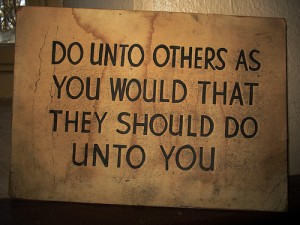
“Do unto others as you would have them do unto you.”

- 1761: When American Independence was Born - February 13, 2026
- Writs, Riots, and Redcoats: Hancock’s Spark of the Revolution - January 17, 2026
- The National Bank That Breached the Articles of Confederation - June 2, 2025