
The Untold History of Nullification: Resisting Slavery

Courage_to_ResistLast December, when Tennessee Rep. Susan Lynn, R-Mount Juliet, said she would introduce legislation which would declare null and void any federal law the state deems unconstitutional, some people were horrified. Rep. Lynn was specifically targeting the health-care reform legislation that was pending at that time. But the reaction that many people had to her language was not an expression of their support for Obamacare.

Too many Americans hear the terms “states’ rights” or the word “nullification” and immediately think of racial prejudice, Jim Crow laws and school segregation. Honestly, if all I had to rely on was what I remember being taught in public school, I would probably tell you the history of it all went like this:

The theory of nullification was first invented in the 1800s’ by advocates of slavery. They used nullification of tarrifs as a test run in the 1820s. Of course, what they really had in mind was maintaining the institution of slavery against any possible attempt by the federal government to abolish it. Then America fought the Civil War in order to end slavery, but the ideas of states’ rights and nullification were later revived in the 1950s’ by belligerent white southerners in an attempt to block the racial integration of schools. The Civil Rights Movement started and the feds had to step in and force the southern states to treat everyone equally. THE END.

That’s a rough, abbreviated version of the narrative that was handed to me, but it gives you an idea of what many Americans think they know about states’ rights and nullification. Fortunately, thanks to people like Tom Woods, Thomas DiLorenzo, and many others, I know today that this was a gross misrepresentation of the classical liberal states’ rights tradition. Then again, (and it’s not my intention to be prideful here), I’m not like most Americans. And If you’re reading this, you probably aren’t either.

Civic Illiteracy

In 1798, Jefferson and Madison articulated the concepts of nullification and interposition in the Kentucky and Virginia Resolutions, which were passed in response to to the hated Alienand Sedition Acts. But the ideas which support nullification and interposition were actually expressed earlier during the ratifying convention of Virginia by the Federalists themselves!

Given the fact, however, that most Americans cannot even correctly name all three branches of our federal government, it’s probably a safe bet that they have never heard of the Kentucky and Virginia Resolutions or the fact that nullification was used to assist runaway slaves.

So should it really come as any surprise that many people in Tennessee recoiled in horror at Rep. Susan Lynn’s comments about nullification? Rep. Mike Turner of Tennessee’s 51st District responded with a sarcastic and condescending comment that probably expressed the sentiment of many Tennessee’s left-liberal elites:

“Susan Lynn is yearning for times gone by,’ Turner said. “Maybe we could put the poor people back to sharecropping and slavery and let the people up at the big house have all the nice things. We’ve already had that fight about states’ rights.”

Lynn responded to Turner’s comment by saying:

“I can’t even imagine that’s a serious comment.’

Rep. Turner’s comments resemble some of the incredibly ignorant and / or vicious comments directed against today’s advocates of nullification that frequently appear in the bologoshpere. One particular blogpost I stumbled upon really embodies the either extremely ignorant or wholly deceptive attempt to associate today’s proponents of states’ rights and nullification with segregationists, white supremacists and domestic terrorists:

“Why is it that the extremist teabaggers are not called traitors even though they are basically calling for an overthrow of the democratically elected U.S. government? There latest stunt should seal it. They are calling for a long rejected theory called Nullification, and at least one treasonous..blogger and teabagger is pushing it.”

The Compromise of 1850 and How Abolitionists Used Nullification

In 1850, Congress compromised in order to hold the Union together against the divisive issue of slavery. Since the preservation of the Union (Northern control of the South’s economy), rather than the abolition of slavery was foremost in the minds of influential Republican bankers, manufacturers and heads of corporations, this compromise made perfect sense.

Part of this compromise was the passage of more stringent fugitive slave legislation that compelled citizens of all states to assist federal marshals and their deputies with the apprehension of suspected runaway slaves and brought all trials involving alleged fugitive slaves under federal jurisdiction. It included large fines for anyone who aided a slave in their escape, even by simply giving them food or shelter. The act also suspended habeas corpus and the right to a trial by jury for suspected slaves, and made their testimony non-admissible in court. The written testimony of the alleged slave’s master, on the other hand, which could be presented to the court by slave hunters, was given preferential treatment.

As would be expected, this new legislation outraged abolitionists, but also angered many citizens who were previously more apathetic. In 1851, 26 people in Syracuse, New York were arrested, charged and tried for freeing a runaway slave named William Henry (aka Jerry) who had been arrested under the Fugitive Slave Act. Among the 26 people tried was a U.S. Senator and the former Governor of New York! In an act of jury nullification, the trial resulted in only one conviction. “Jerry” was hidden in Syracuse for several days until he could safely escape into Canada.

The government of Wisconsin went even further and in 1854 officially declared the Fugitive Slave Act to be unconstitutional. The events that lead up to this monumental decision, which is a milestone in the history of the states’ rights tradition, is one of the best stories most Americans have never heard.
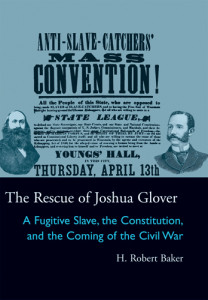
Layout 1In 2006, H. Robert Baker, assistant professor of legal and constitutional history at Georgia State University wrote a book called, “The Rescue of Joshua Glover: A Fugitive Slave, the Constitution, and the Coming of the Civil War“. In its review of the book, The Journal of American History wrote:

“Terribly conflicted about race, Americans struggled mightily with a revolutionary heritage that sanctified liberty but also brooked compromise with slavery. Nevertheless, as The Rescue of Joshua Glover demonstrates, they maintained the principle that the people themselves were the last defenders of constitutional liberty…”

Joshua Glover was a slave in Missouri who managed to escape from his master. In 1854, with the help of the Underground Railroad, he made his way north, all the way to Wisconsin. There he found work at a mill in Racine, a community in which anti-slavery sentiment ran high. Unfortunately for Glover, his former master, B.S. Garland eventually managed to find out where Glover had taken up residence.

Accompanied by two US Marshals, the three of them took Glover by surprise. In spite of his resistance, Glover was subdued with a club and handcuffed. Thrown into a wagon, he was surreptitiously transported to Milwaukee, where he was thrown in jail. Glover’s abduction was discovered somehow or another, however, and in no time one hundred or so men landed by boat in Milwaukee.

The men marched towards the courthouse, which was adjacent to the jail, and crowds of people began to join their ranks or follow along as spectators. An abolitionist named Sherman Booth, who published a local daily newspaper there called the “Free Soil Democrat” rallied the supporters of the citizen army shouting:

“All freemen who are opposed to being made slaves or slave-catchers turn out to a meeting in the courthouse square at 2 o’clock!”

When the meeting at the courthouse adjourned, those who had assembled eventually resolved that Joshua Glover was entitled to at least two things: A writ of habeas corpus and a trial by jury. A local judge concurred and delivered the writ to the US Marshals at the jail. As might be expected, the federal officers rejected the writ as invalid. After all, federal law trumps state judicial authority, does it not?

The assembly of citizens from Racine and Milwaukee must have decided that such was not the case in this instance. In fearless defiance, they broke down the doors of the jail and freed Joshua Glover. In an act that probably would have filled Sheriff Mack with joy, had he been there, the Racine County Sheriff arrested Glover’s former slave master and the two US Marshals who had kidnapped him. They were charged with assault and put jail. In the meantime, the Underground Railroad assisted Joshua Glover as he crossed the border into Canada.

Although Glover escaped to freedom, it was not without a price. Glover’s former master, B.S. Garland was released on a writ of habeas corpus and in the long run would sue Sherman Booth, turning him financially upside down.

In the short run, Booth and two other men were arrested and indicted by a grand jury. While Booth maintained that he had never incited the crowd to liberate Glover or that had helped Glover escape in any way, he did not mince words either. Speaking in his own defense in front of the US Commissioner, he proclaimed:

“..I sympathize with the rescuers of Glover and rejoice at his escape. I rejoice that, in the first attempt of the slave-hunters to convert our jail into a slave-pen and our citizens into slave-catchers, they have signally failed, and that it has been decided by the spontaneous uprising and sovereign voice of the people, that no human being can be dragged into bondage from Milwaukee.”

According to his account of these events, Henry E. Legler wrote in 1898:

“Byron Paine made an argument in behalf of Booth that attracted attention all over the country. It was printed in pamphlet form and circulated on the streets of Boston by the thousands. Charles Sumner and Wendell Phillips wrote the author letters of hearty approval and commended his force of logic and able presentation of argument. This pamphlet is now excessively rare; but half a dozen copies are now known to exist.”

Judge Smith of the Wisconsin Supreme Court made the following declaration, that ought to inspire and motivate champions of the Tenth Amendment and state sovereignty today. Speaking not only for Wisconsin, but of all the states, he said that they would never accept the idea that:

“..an officer of the United States, armed with process to arrest a fugitive from service, is clothed with entire immunity from state authority; to commit whatever crime or outrage against the laws of the state; that their own high prerogative writ of habeas corpus shall be annulled, their authority defied, their officers resisted, the process of their own courts contemned, their territory invaded by federal force, the houses of their citizens searched, the sanctuary or their homes invaded, their streets and public places made the scenes of tumultuous and armed violence, and state sovereignty succumb–paralyzed and aghast–before the process of an officer unknown to the constitution and irresponsible to its sanctions. At least, such shall not become the degradation of Wisconsin, without meeting as stern remonstrance and resistance as I may be able to interpose, so long as her people impose upon me the duty of guarding their rights and liberties, and maintaining the dignity and sovereignty of their state.”

The United States Supreme court eventually reversed the action of the Wisconsin’s courts. Booth and one other man accused of helping to liberate Joshua Glover were found guilty. Both spent months in jail in addition to having to pay stiff fines. This was the price that was paid for Joshua Glover’s freedom.
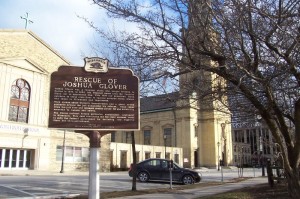
Wisconsin Historical Marker

Wisconsin Historical Marker

Rather than being deterred, however, Wisconsin, along with several other states, such as Connecticut (1854), Rhode Island (1854), Massachusetts (1855), Michigan (1855), Maine (1855 and 1857), and Kansas (1858) all went on to pass even more personal liberty legislation designed to neutralize federal enforcement of the Fugitive Slave Act of 1850.

It was no coincidence that the 1859 statement of the Wisconsin Supreme Court borrowed words directly from the Kentucky Resolutions of 1798:

“Resolved, That the government formed by the Constitution of the United States was not the exclusive or final judge of the extent of the powers delegated to itself; but that, as in all other cases of compact among parties having no common judge, each party has an equal right to judge for itself, as well of infractions as of the mode and measure of redress.

Resolved, that the principle and construction contended for by the party which now rules in the councils of the nation, that the general government is the exclusive judge of the extent of the powers delegated to it, stop nothing short of despotism, since the discretion of those who administer the government, and not the Constitution, would be the measure of their powers; that the several states which formed that instrument, being sovereign and independent, have the unquestionable right to judge of its infractions; and that a positive defiance of those sovereignties, of all unauthorized acts done or attempted to be done under color of that instrument, is the rightful remedy.”

The End, or Just the Beginning?

Few Americans have ever heard the heroic story of how the people of Wisconson and several other states stood up to the federal government’s tyrannical, unconstitutional slave laws with the help of their elected state officials.

Today state sovereignty and the Principles of 1798 are being invoked again, for a variety of reasons, just as they were invoked for a variety of reasons all throughout American history, in spite of what you may have been taught or are being told today.

States legislatures all over the Union today are standing up and re-asserting their sovereignty, which is guaranteed by the 10th Amendment. They are proposing and passing legislation which would nullify a whole host of unconstitutional federal laws including: The federally mandated national “REAL ID” card, restrictions on the use of Medical Marijuana, unconstitutional deployments of State National Guard units, federally mandated health insurance, unconstitutional regulations of state manufactured firearms and much more…

It is tragic that left-liberals have seemingly abandoned the classical liberal states’ rights tradition in favor of nationalism and the centralization of power. It is also shameful that they have made a concerted effort to associate nullification with slavery in the minds of average Americans. As Josh Eboch observes:

“Of course, even though activists on the left supported nullification for Real ID and also for medical marijuana, those calling for state sovereignty with regard to health care will have to deal with the standard cries of racism and references to the Jim Crow…But just because nullification was used [unsuccessfully] in the past to deny rights to certain groups doesn’t mean it can’t be used to regain our rights today. In the end, ‘for desperate people whose freedoms are being systematically usurped by all three federal branches and both political parties, nullification may be the key to restoring our republic’.”

About Derek Sheriff

Derek Sheriff [send him email] is a research analyst for the Tenth Amendment Center. His articles have appeared in various publications, and he writes regularly for the Center on issues related to state sovereignty and nullification. His blog and podcast "Principles of '98" can be found at www.PrinciplesOfNinetyEight.Com. View his Tenth Amendment Center blog archives here, and his article archives here.

Enjoyed This Post?

We cannot succeed without your help, as we will never accept government grants or handouts. Please help us by investing in the Constitution and freedom today!

Enjoyed This Post?

, ,

42 comments
TatianaCovington
TatianaCovington

That is how to get and keep your freedom: kill anyone in the way.


"Those who would survive, let them fight, and those who will not fight in this world of eternal struggle, do not deserve to live."

TatianaCovington
TatianaCovington

No laws have any authority at all. They are all only man-made documents: pieces of paper with ink on them. They are whatever people say they are and cannot do anything whatsoever!

WilliamSchooler
WilliamSchooler

This display of abuses could serve no better example of what I am about to point out. These abuses are life against life, these are acts that have verification. One of the things I have become aware of is most things under the legal system speak it terms of the person, an example would be a sovereign or person which is a perverted term and here is why.

When we look at life what is it we speak of? The deciding force in all decision making, the authority of self. So by stating person all the sudden it does not become the deciding factor or force, independence or Life or any of these things. What happens is now each entity General Government which is what? A Person or a life all on its own with its own authority upon itself and no more. Further more this extends to each state which is what? A life of its own, its own choice it’s own authority by its choice?

Then lets take each community does it have a life of its own, able to decide by its own authority and then we have the people, or public or politic or sovereign or Life which is able to decide for self in its own authority.

Where I noticed the perversion of this most loudly was in Corporations are listed as the person, to centralize authority in some perverse legalize so that only a few become the authorized or the authority over, In what words do they use to define Federal Government A sovereignty, a person? Then this extends to states as Sovereigns or as a person? So a few to authorize what will take place? Is this because legalize looks at its own authority as the authority over and over what, Life?

In the Declaration of Independence Life has no authority over other life each life has its own authority because it can be show to be so in the acts of life itself. This brings up very interesting questions I hope others will start to ask.

Isn’t the theory of nullification really the act of Life opposing other life of dominance against them? Again what is life?

CW Orange
CW Orange

Perhaps it might be more directly useful to champion the cause of States taxing their inhabitants first, and the states passing some limited funds along to the federal government. Should this be done under the tenth amendment, the feds would have a big problem. States should have first claim on taxation of their inhabitants. This has the ability to bring the federal government to its knees, and quickly. It could be fairly claimed that they are spending the US into oblivion, and as such an effort to control it by the states would be timely.
Congress and obummer would go nuts with this one.

NedNickerson
NedNickerson

States should also take responsibility for defending their borders, since they will have the tax resources.

Loki
Loki

I would also like to point out that when they fraudelently covered up the REAL 13th amendment with the fraudulent one, what they actually did was legalize slavery. The current 13th Amendment, of 1861, permits slavery, a term that did not previously appear in the Constitution. It reads: Neither slavery nor involuntary servitude, except as a punishment for crime whereof the party shall have been duly convicted, shall exist within the United States, or any place subject to their jurisdistion. This eventually empowered lawyers to "duly convict" someone beyond the scope of the Constitution. Now we have a fourth of the world's prison population with most of it "enslaved" without jury trial or by laws that are entirely unconstitutional.

Mark n the Old South

This article is incorrect on a major aspect of this Fugitive Slave act and the 1850 Compromise.__

See Article IV Section 2 of the Constitution__
(No Person held to Service or Labour in one State, under the Laws thereof, escaping into another, shall, in Consequence of any Law or Regulation therein, be discharged from such Service or Labour, But shall be delivered up on Claim of the Party to whom such Service or Labour may be due.) (This clause in parentheses is superseded by the 13th Amendment.)____
Here is the location on the web__
http://www.usconstitution.net/const.html#Article4...
This article was not striped until the 13Th amendment which passed in 1865. It was ratified by no less than 5 of the former Confederate States.__

DerekSheriff
DerekSheriff

Mark, have you by any chance read, "POWER OF THE GENERAL GOVERNMENT OVER SLAVERY." by Lysander Spooner? You can find it here:
http://www.lysanderspooner.org/Unconstitutionalit...

I admit I have not read it in its entirety yet. But if you have, I would love to hear your thoughts about it. Thanks for reading!

R Burnett
R Burnett

It seems to to have been nticed by anyone posting yet the disjunct between the Northern nullifiers, resisting the slave power of the South, with the South in control of the national government (see Leonard Richard's The Slave Power, a book that all good PIG readers are not supposed to read) and the Southern partisan's view that the North was in control of the national government, inflicting punishment upon the South, making it necessary for the South to nullify or seceed. According to such as Richards, the South had the reins from 1780 to that war, getting the best of the many compromises, lines and provisos, while such as those at the Abbeville Institute claim that it was the South that was the victim--and indeed, a lot of those supporting the inter-null-secesh position are of, by and for the Southern view.. I will be so interested to see how the Abbeville crowd respnd to the article.

Del Curtis
Del Curtis

The Ninth and Tenth Amendments couldn't be more clear. If we, the people, have not sepcifically granted a power or authority to the central government, that power rests with us, unless we have granted specific powers or authorities to our Commonwealth government.

No elected, appointed person, or bureaucrat employee has any power or authority from any other source.

Merry Colin
Merry Colin

Mr. Boldin, I don't need your "personal attention" and insults are certainly not going to aid in an exchange of ideas.

I agree with each of your points. I do not believe that the States created the "government"; I believe they created the Constitution under which government was formed by the People with their consent and direct participation.

Maybe I misunderstood your past comments which I pointed out in my first post. Then again maybe you misunderstood me then. I am uncertain. All I do know is that many American citizens can be led to believe that "the people created the Constitution" vs "the people consented to and created the government under the Constitution". I am a stickler with details and meanings of words; in my eyes, giving the People credit for the Constitution actually ignores the brilliance of those at the convention. It's that simple.

I have repeatedly read many liberal/progressive comments on blogs and forums that recite the former as fact when it is not. Unfortunately, based on this misguided thinking, they feel certain that they can interpret the Constitution "that the People created" in an effort to bend government to their will in their quest to create their utopia. The People did indeed give their consent to the Constitution, which in turn resulted in their creation of their government under it. You have no argument from me!

Bob Greenslade
Bob Greenslade

Merry-you may find this of interest. Michael referred to the "We the People" phrase in the preamble. Those words, as you mentioned, continue to cause confusion.

In his classic work of 1868, “The Federal Government, Its True Nature and Character,” Abel Upshur provided the following analysis of the preamble:

"The phrase is, WE, THE PEOPLE OF THE UNITED STATES, not the people of AMERICA. The very phrase shows the Federal Union to be a government of STATES, and not the act of the people of all America, as a consolidated body. * * The people of the United States in the preamble of the Constitution, has the same meaning as ‘the people of the several States.’ * * The qualifying adjective ‘united’ is annexed to the word STATES, and not to the word ‘people.’ It is precisely the same meaning as the phrase ‘Lex Etas Unis’ in the French language, i.e., the States united. "

In his 1878 book, The Republic of Republics, Bernard Janin Sage, a constitutional attorney, identified “the people:”

"And it may be stated here that generally when the (founding) fathers used the phrase ‘the people,’ constitutionally, they meant the people of the sovereign states, that were the actors in making the federative union. They could not have meant otherwise, for the simple reason that the people were the states, and the states were the people."

The people mentioned in the preamble are the people of the several States.

In his analysis of the preamble, Sage wrote:

"The title is ‘Constitution of the United States,’ and the preamble says:―‘We, the people of the united states, * * do ordain and establish this constitution for the united states of America.’ Whose constitution then is it? The title answers, ‘the constitution of the * states.’ Who is it for? The preamble answers, ‘this constitution for the * states.’ The states then are the important subjects of these sentences, while the word ‘united’―meaning associated―is a mere adjective. These phrases obviously refer to pre-existent states, united by compact. It was only as such bodies that the ‘people’ could become parties to the constitution, for each individual citizen was a member of a state, and had no right whatever to act politically, except in such body and as such member."

I think the phrase "people of the States or people of the several States," standing alone, causes confusion because most Americans, today, only see the people of all the States as one body of people or one nation. Unfortunately, the Pledge of Allegiance re-enforces this myth. I recently had a woman use the Pledge's "one nation" provision as a comeback when I attempted to explain the difference. It was only when I read her the title of the Declaration of Independence..."thirteen united States" did she begin to grasp the concept.

Bob Greenslade
Bob Greenslade

Merry-you may find this of interest. Michael referred to the "We the People" phrase in the preamble. Those words, as you mentioned, continue to cause confusion.

In his classic work of 1868, “The Federal Government, Its True Nature and Character,” Abel Upshur provided the following analysis of the preamble:

"The phrase is, WE, THE PEOPLE OF THE UNITED STATES, not the people of AMERICA. The very phrase shows the Federal Union to be a government of STATES, and not the act of the people of all America, as a consolidated body. * * The people of the United States in the preamble of the Constitution, has the same meaning as ‘the people of the several States.’ * * The qualifying adjective ‘united’ is annexed to the word STATES, and not to the word ‘people.’ It is precisely the same meaning as the phrase ‘Lex Etas Unis’ in the French language, i.e., the States united. "

In his 1878 book, The Republic of Republics, Bernard Janin Sage, a constitutional attorney, identified “the people:”

"And it may be stated here that generally when the (founding) fathers used the phrase ‘the people,’ constitutionally, they meant the people of the sovereign states, that were the actors in making the federative union. They could not have meant otherwise, for the simple reason that the people were the states, and the states were the people."

The people mentioned in the preamble are the people of the several States.

In his analysis of the preamble, Sage wrote:

"The title is ‘Constitution of the United States,’ and the preamble says:―‘We, the people of the united states, * * do ordain and establish this constitution for the united states of America.’ Whose constitution then is it? The title answers, ‘the constitution of the * states.’ Who is it for? The preamble answers, ‘this constitution for the * states.’ The states then are the important subjects of these sentences, while the word ‘united’―meaning associated―is a mere adjective. These phrases obviously refer to pre-existent states, united by compact. It was only as such bodies that the ‘people’ could become parties to the constitution, for each individual citizen was a member of a state, and had no right whatever to act politically, except in such body and as such member."

I think the phrase "people of the States or people of the several States," standing alone, causes confusion because most Americans, today, only see the people of all the States as one body of people or one nation. Unfortunately, the Pledge of Allegiance re-enforces this myth. I recently had a woman use the Pledge's "one nation" provision as a comeback when I attempted to explain the difference. It was only when I read her the title of the Declaration of Independence..."thirteen united States" did she begin to grasp the concept.

MichaelBoldin
MichaelBoldin

I wonder how many people know that the pledge was written by a socialist - who was also a flag salesman.

DerekSheriff
DerekSheriff

I do. I wrote a note on Facebook some time ago about why I will no longer say the pledge. I'm not looking forward to the day when I have to live up to that decision in public. Someone will surely accuse me of being an unpatriotic socialist. God only knows how many hours I'll have to spend explaining the history of the pledge and why the exact opposite is true.

Bob Greenslade
Bob Greenslade

The president of every the flag company in America probably has his picture on the office wall.

Michael Boldin
Michael Boldin

Merry - We have had this discussion numerous times, and while I'd love to give you personal attention on this specific issue, unfortunately, my time is limited. So I'll leave this particular discussion with a few essential points:

1. I never said the people created the Constitution. You did.

2. Representatives drafted and "created" the constitution - rules for a proposed new form of government.

3. They presented the constitution to the people of the several states for their approval in ratifying conventions

4. The ratifying conventions specifically did not include state governments - to ensure that state governments were not creating the government, the people were.

5. The proponents of the Constitution made quite clear that the government would be given life, created, only through the will of the people convening in the several states.

6. This process is what created something unique in history - regular, everyday people - are sovereign.

7. Sovereignty in the American system means final authority, and all power not delegated by a sovereign is retained.

8. Thus, the top of the food chain in the American system is the sovereign people, who created both their state governments, and then their federal government. Both state and federal governments are agents of the people of the states - and thus, subservient to them.

9. Madison's report - you know him, right? He's known as the "father of the constitution" and his report was a clarification of something that was commonly understood and accepted by the founders and the people ratifying. There are many, many other references to explain this issue - his report of 1800 is the most famous.

10. There is no historical basis for claiming that state governments created the federal government. None.

10a. And a bonus, the preamble to the constitution is "we the people", not "we the states"

If you believe that state governments created the federal government - you're just flat wrong. Even if you could make a point that they created the constitution itself, it still doesn't hold water. Why? Because without the people giving it life, it was nothing but an idea.

OGolly
OGolly

I agree. The Declaration of Independence even makes it clear that the authority to grant sovereignty is passed from the Creator directly to the people (the "object of His creation" some would argue), and smartly bypasses any MAN MADE hierarchy (i.e., states, kingdoms, etc.) as in the European model where the king supposedly receives his right to govern from God. Man and man alone wields sovereignty, not a man-made creation (the state).

Merry's point that "the people" were nowhere around when the constitution was crafted is not quite right; they were present by proxy in that the representatives they sent to the convention were selected to act on their behalf, subject to the final approval of the people. That's why the constitution begins, "We the people ..."

Claiming that a state - or collection of states - created another state (a supra-state, as it were) is, I believe, flawed and even a little dangerous. If such were true, than the state's creative powers MUST trump that of its creator, the people. Once we put ourselves in that position, our argument is essentially lost.

Merry Colin
Merry Colin

Of course, there is no doubt in my mind the the individual people are "at the top of the food chain" as you stated. I have never believed in States having "rights"; I believe they have POWERS only as far as the people vest in them. Rights belong to people. Again, it is semantics, but it matters very much.

Merry Colin
Merry Colin

Well then , if I could argue with Madison, I guess I would!

Your response: "In his Report of 1800, he clarified the difference between the "states" as state governments and the "states" as the people of the several states - the latter is what created the federal government, with the people being at the top of the food chain, the states and the feds to follow."

The KEY word here is "created". The representatives of the States met in Philadelphia, behind closed doors, and debated the form of government they wished to CREATE under the Constitution. These representatives took this Constitution back to the people of the several States who CONSENTED to its adoption as the supreme law of the land. Yes, Mr. Boldin, I will agree that without the CONSENT of the "people of the States" the Constitution would not have come into being as our agreed upon form of government . That however is a far cry and a long reach from saying "the People CREATED the Constitution". The people were not there in Philadelphia.

Further, your quote refers to a quote of 1800, more than a decade after the Constitution was written. No doubt, Mr. Madison, in all his wisdom, spied in the new government the move to flaunt the Constitution before it even got off of the ground. His statement was probably more likely a reminder to those who would seek to ignore the People, the true sovereigns as he saw it and rightfully so.

Maybe our conflict of ideas is one of semantics however, I would not want to see the Constitution interpreted in the same manner!

Ruth Ann Wilson
Ruth Ann Wilson

Okar, you are right, GRANTS rule in most government meetings.
Integrity will be so welcome to common, God-fearing people. When government at all levels, REFUSES to take this "GRANT MONEY", what a day that will be.
A man's word and his Oath of Office will be more important than "a bowl of pottage".

For God & Country
Ruth Ann Wilson

Andrew Jones
Andrew Jones

That money comes from the people in the states in the first place (or Ben Bernanke, but a chunk comes from the taxpayers).

We need the states to come together and amend the Constitution to repeal the 16th Amendment. While we're at it, we could take away Congress's power to borrow money; I'm sure our grandchildren would appreciate that move, as well.

Wishful thinkin' maybe.

Merry Colin
Merry Colin

After reviewing my own comment, I see that I actually left out an essential argument that follows:

Is the Constitution a set of laws for government or a "contract" with an entity that didn't exist in that form at the time? Of course it is an agreement between the States to set up a federal system under very specific laws. One could well argue that the States created it and the States are rightfully the only powers that can insist that the Fed it created abide by those standards. This was, in effect, a unilateral agreement between States, not one between the States, a tangible entity, and a fictitious corporation created AFTERWARD. Do I think succession is lawful? Yes. Do I think it is necessary? No, as long as States are willing to nullify unconstitutional laws. They don't need SCOTUS or any other Federal agency to give their blessings or permission.

Terry Schubert
Terry Schubert

Leave it to CNN to invoke race into this issue. The fact that most people cannot name all 3 branches of our federal government is more to the fact that government got involved and the big unions and teachers get tenure whether they are worthy of it or not. Not to mention revised history to fit the liberal progressive agenda. This is where you (and your 30% of viewers are missing the boat) We are a post racial nation, or at least trying to be! The friends, family and circle of influence I have do NOT vote for someone due to race or gender, but vote for their values and the vision they hold for our nation. So, please please quit trying to invoke race just because we have a part African-American president. States rights are to keep the big Federal govt from a power grab - something we are seeing at this time in our nation. Don't be an elitis - the people are not stupid and know exactly what is going on. There are many many unbiased reliable sources to turn to in todays world to do our own research. That in itself bothers those immensely in the progressive movement.

Cydnie M
Cydnie M

Another good article Derek! Just one thing, there are 4 branches of the government...the states is the 4th balance of power. We weren't taught that in school either, of course because the states have the biggest influence.

Monorprise
Monorprise

Technically the States are not a "branch" of government but rather separate governments. To say they are a branch is to put them on an equal terms with the president, congress and the Federal courts when in fact they are a coequal to the whole Federal government not merely 1/3.

DerekSheriff
DerekSheriff

That's crazy talk Cyndie! I'm going to have to report you to the thought police! Just kidding...
:-D

Michael Boldin
Michael Boldin

Good point! It is the number 1 result in google when searching for states rights - people should ensure that there is better info there.

Michael Boldin
Michael Boldin

Thanks Merry! Technically, you should argue with James Madison.

In his Report of 1800, he clarified the difference between the "states" as state governments and the "states" as the people of the several states - the latter is what created the federal government, with the people being at the top of the food chain, the states and the feds to follow.

I mentioned the same to CNN - probably too nuanced and specific of an explanation to put in an article of that sort.

DerekSheriff
DerekSheriff

It took me a long time to understand those subtle differences. I credit Michael and Prof. Rob Natelson for helping me to finally understand.

Merry Colin
Merry Colin

I noted that the Mr. Sheriff quoted the 1859 ruling by the Wisconsin Supreme Court: " that the several states which formed that instrument, being sovereign and independent, have the unquestionable right to judge of its infractions;" Thank you Mr. Sheriff! Following with that quote in mind:

First, the CNN article is claptrap. Resolutions made in the states have no "legal teeth'? Really, according to what authority? Any idiot can see that a contract between two parties could not be resolved by the authority of one of the parties (SCOTUS) to dictate what is and what is not lawful or legal under that contract. In what world would this make sense? For those foolish enough to believe SCOTUS can make a ruling with any "legal teeth" I would remind them that the court itself was created by the constitution as a part of the federal government. I do not see enumerated any power for the SCOTUS to do half of the things they do, let alone decide in cases of federal versus state. As I understand the power of courts, they are police powers. Therefore, without going into great detail, they are effectively a branch of the executive department which enforces the law. They are not charged with creating law; that power is vested in the legislative branch. As a result, I see our three branches of government as the Executive, the Legislative, and THE PEOPLE, individually and in their states, with the greatest weight given to the sovereign, the People. The states are guilty of allowing the fed to violate the 10th amendment and the voters of those states are ultimately responsible for the actions of their states and the resulting mess that we are in. Government in a democratic Republic is to be a trickle up form coming from the people and not from the fed down. With the authority as sovereigns we have responsibilities to know what our powers are and how to wield them. I'd rather the National Tea Party take place in the capitols of the states where the people better know who is doing justice to the rule of law and who is not. Simultaneous movements in the states would have greater impact (and even more people) and both the legislatures and MSM would be hard pressed to ignore THAT. Shame on any state legislature that doesn't have the guts to pass a resolution and act accordingly to ENFORCE IT. Worse, shame on the people who won't demand it!

Second, to Mr. Boldin: Please note the same quote which includes mention of "several states which formed that instrument". I believe that you, in a prior argument, pointed out quite vehemently that the "people" created the Constitution or, that the "people" consented to it. I argued to the contrary, that the States constructed and consented to the Constitution. I believe this quote proves my point once again.

Monorprise
Monorprise

We need to expand upon and correct the wikipedia article on States rights.

http://en.wikipedia.org/wiki/States_rights

I suspect a lot of people will be getting their information from that, and as it is its pretty bad.

DerekSheriff
DerekSheriff

states' rights really is a bad term for a number of reasons, not the least of which is the fact that only people have rights. States have powers. Unfortunately it seems that we are stuck with the term for the time being.

Monorprise
Monorprise

No argument here Derek, but we do need a term to distinguish Federal usurpations from State usurpations of the peoples rights. If not the term "State's rights" what should the term be?

This is of course an academic question as the Media will stick us with the term "State's rights" regardless of the one we desire.

E D Stewart Jr
E D Stewart Jr

The Tenth Amendment is the saving grace for ALL the states that choose to, to excape the financial clutches of the FEDGOV. This certainly is MY choice.

Folklight
Folklight

Great reminder of the NEED for nullification legislation today! I can see a time, sooner rather than later, where currency will need to be the dealt with. Since Jekyll Island in 1913 natural born citizens of USA have been subjected to another form of slavery, namely taxes on wages as well as on our own currency in the form of 'usury'
http://www.strike-the-root.com/4/smith/smith5.htm... : Now that banksters control most EVERYTHING including politicians and corporations; tis no surprise US debt exceeds GDP of the ENTIRE WORLD and growing! This is a 'Slow Burn' that has been fanned into a raging fire. http://solari.com/blog/?p=818 - Keep the Powder Dry -

BK Campbell
BK Campbell

I simply wish to state my support for the Tenther movement. The states are taking their rights back from the Federal Govt. and it has nothing to do with fringe groups and everything to do with our Constitution which is very mainstream. If you think the Tenth is about anything other than states rights to rule themselves, then please study this very important issue more. In layman terms the Tenth states that if the people of the states did not give the Federal Govt. the right to regulate an issue then it is up to the people of that state. The Federal Govt. has made null and void many state laws such as medical marijuana without the right to do so. If you are reading or finding out about the Tenth for the first time, please study what this issue is about and find out for yourself. We were never mean't to live under the rule of a central Govt. and thats what we have now.

okar
okar

I think most people, who went to High School and paid attention should understand state sovereignty.__When states balk at certain federals laws such as use of medical marijuana, the federal Gov. than says, if you don't do things our way, we'll cut off federal money. Most liberal states will back off not wanting to lose the free money. But their are some who say keep your money we will abide by the constitution and make on our own. Our founding fathers would be proud of those states!

Shirley Morgan
Shirley Morgan

Every American should read "The Untold History of Nullification: Resisting Slavery" you might learn a few things.
Nullification can be used by the states to be for or against laws that the government tries to shove down the throats of American citizens. The 10th Amendment at one time was used to enslave people. The 10th Amendment was also enacted to protect runaway slaves from being hunted down and dragged back to their former owners and allowed them to be set free. States sovereignty is guaranteed by the 10th Amendment.

Brian Bertha
Brian Bertha

Susan Lynn is a real patriot and is standing by the constitution. The progressives either through ignorance or deception would have you think otherwise

Trackbacks

  1. Social comments and analytics for this post…

    This post was mentioned on Twitter by RonPaul_2012: The Untold History of Nullification: Resisting Slavery http://bit.ly/aFoIVT #tlot #tcot #RonPaul…

  2. [...] Amendment Center February 10, 2010 cjgary71 Leave a comment Go to comments The Untold History of Nullification: Resisting Slavery | Tenth Amendment Center. Categories: constitution Comments (0) Trackbacks (0) Leave a comment [...]

  3. [...] The Untold History of Nullification: Resisting Slavery Posted by admin | Filed under Liberty | Feb 11, 2010 | No CommentsFrom The 10th Amendment Center [...]

  4. [...] Slavery Thursday, February 11, 2010 8:14:36 PM · by ForGod’sSake · 1 replies · 37+ views Tenth Amendment Center ^ | Feb 10, 2010 | Derek Sheriff The Untold History of Nullification: Resisting Slavery by Derek [...]

  5. [...] is Why Its like the gods of cyberspace read my mind – THIS is why I have mixed feelings about Abraham Lincoln: The theory of nullification was first invented in the [...]

  6. [...] encourage folks to read about Joshua Glover, whose story is summarized here.  Not only is it an excellent example of the importance of states rights, but it refutes the [...]

  7. [...] numerous articles and publications on the Tenth Amendment Center website make clear, following the Constitution and [...]

  8. [...] The principles first articulated by Jefferson and Madison in the Kentucky and Virginia Resolutions came to be known over time as “The Principles of ‘98″. They were invoked by many states, north and south, for a variety of issues, all throughout the nineteenth century. These issues involved everything from states’ claims of unconstitutional embargoes (1807-1809), conscription for The War of 1812, the Second Bank of the United States (1825), and the Fugitive Slave Act of 1850. [...]

  9. [...] The principles first articulated by Jefferson and Madison in the Kentucky and Virginia Resolutions came to be known over time as “The Principles of ‘98″. They were invoked by many states, north and south, for a variety of issues, all throughout the nineteenth century. These issues involved everything from states’ claims of unconstitutional embargoes (1807-1809), conscription for The War of 1812, the Second Bank of the United States (1825), and the Fugitive Slave Act of 1850. [...]

  10. [...] harmful to their residents and their interests. The greatest such example of this was widespread resistance by abolitionist states to the Fugitive Slave Act throughout the mid-19th century. The use of nullification is an essential check on Federal [...]

  11. [...] for nullification, to give one an idea of its power, it is educational to read The Untold History of Nullification: Resisting Slavery. Below are some salient points: Too many Americans hear the terms “states’ rights” or the [...]

  12. [...] The Untold History of Nullification: Resisting Slavery. Something the liberals don’t want you to know. [...]

  13. [...] states frequently invoked nullification in an effort to combat unconstitutional aspects of the fugitive slave laws. Also interesting to note is that southern states did not invoke nullification to defend [...]

  14. [...] states frequently invoked nullification in an effort to combat unconstitutional aspects of the fugitive slave laws. Also interesting to note is that southern states did not invoke nullification to defend [...]

  15. [...] states frequently invoked nullification in an effort to combat unconstitutional aspects of the fugitive slave laws. Also interesting to note is that southern states did not invoke nullification to defend [...]

  16. [...] I would urge the reader to read The Untold History of Nullification: Resisting Slavery, just one example among many of how states used nullification and state supremacy to nullify [...]

  17. [...] states frequently invoked nullification in an effort to combat unconstitutional aspects of the fugitive slave laws. Also interesting to note is that southern states did not invoke nullification to defend [...]

  18. [...] called upon by states all over the country in response to everything from higher taxes to the fugitive slave law of [...]

  19. [...] I would urge the reader to read The Untold History of Nullification: Resisting Slavery, just one example among many of how states used nullification and state supremacy to nullify [...]

  20. [...] the long and proud history of nullification in this country, including the nullification of the Fugitive Slave Acts, and the Principles of ’98, a product of the thinking of Jefferson and Madison during the [...]

  21. [...] and Virginia Resolutions or the fact that nullification was used to assist runaway slaves. The Untold History of Nullification: Resisting Slavery – Tenth Amendment Center __________________ We're all self-made men…It's only the successful ones who will admit [...]

  22. [...] called upon by states all over the country in response to everything from higher taxes to the fugitive slave law of [...]

  23. [...] me all the time to explain nullification.  You hear people go off on historical events about the Fugitive Slave Law, Tariffs of 1828, and other items that mean absolutely nothing.  Others still will tell you that [...]

  24. [...] me all the time to explain nullification.  You hear people go off on historical events about the Fugitive Slave Law, Tariffs of 1828, and other items that mean absolutely nothing to the average person today.  [...]

  25. [...] me all the time to explain nullification.  You hear people go off on historical events about the Fugitive Slave Law, Tariffs of 1828, and other items that mean absolutely nothing to the average person today.  [...]

  26. [...] the contrary, nullification was used against slavery, as when northern states did everything in their power to obstruct the enforcement of the [...]

  27. [...] the contrary, nullification was used against slavery, as when northern states did everything in their power to obstruct the enforcement of the [...]

  28. [...] the 1850′s, a number of Northern States took action to block implementation of the federal fugitive slave act, rendering that law so difficult to enforce that when South Carolina seceded a few years later, [...]

  29. [...] was hidden in Syracuse for several days until he could safely escape into Canada. http://www.tenthamendmentcenter.com/…nullification/ Effective.  3 [...]

  30. [...] free states frequently invoked nullification in an effort to combat unconstitutional aspects of the fugitive slave laws. Also interesting to note is that southern states did not invoke nullification to defend [...]

  31. [...] – by Derek Sheriff The States’ Rights Tradition Nobody Knows – by Tom Woods The Untold History of Nullification: Resisting Slavery – by Derek Sheriff The Tenth Amendment Center’s legislative tracking page Model Legislation [...]

  32. [...] whom died fighting for the Union in the Civil War, would have approved of nullification when it was used to combat the Fugitive Slave Act of 1850. This horrible federal law, called the “bloodhound law” by opponents of slavery, allowed the [...]

  33. [...] and extradition of slaves seeking emancipation in the Free states, Vermont’s legislature intervened on behalf of its citizens and anyone seeking freedom in the Green Mountain [...]

  34. [...] Derek Sheriff, “The Untold History of Nullification: Resisting Slavery,” The Tenth Amendment Center.  Referenced at:  http://tenthamendmentcenter.com/2010/02/10/the-untold-history-of-nullification/ [...]

  35. [...] Derek Sheriff, “The Untold History of Nullification: Resisting Slavery,” The Tenth Amendment Center.  Referenced at:  http://tenthamendmentcenter.com/2010/02/10/the-untold-history-of-nullification/ [...]

  36. [...] Derek Sheriff, “The Untold History of Nullification: Resisting Slavery,” The Tenth Amendment Center.  Referenced at:  http://tenthamendmentcenter.com/2010/02/10/the-untold-history-of-nullification/ [...]

  37. [...] Derek Sheriff, “The Untold History of Nullification: Resisting Slavery,” The Tenth Amendment Center.  Referenced at:  http://tenthamendmentcenter.com/2010/02/10/the-untold-history-of-nullification/ [...]

  38. [...] and extradition of slaves seeking emancipation in the Free states, Vermont’s legislature intervened on behalf of its citizens and anyone seeking freedom in the Green Mountain [...]

  39. [...] federal Leviathan slave master. Woods responds to nullification skeptics here. (More here, here, here, here, and here.)  Posted by Scott Lazarowitz at 12:11 pm  Add [...]

  40. [...] federal Leviathan slave master. Woods responds to nullification skeptics here. (More here, here, here, here, and [...]

  41. [...] in large numbers due to federalism.  Nullification wasn’t used by people to defend slavery.  It was used by abolitionists.  And those who advocated for these principles to defend the morally reprehensible practice of [...]

  42. [...] The Untold History of Nullification: Resisting Slavery – Tenth Amendment Center. [...]

  43. [...] “So, despite the fact that I personally oppose some of the gun control measures currently under consideration, my oath requires me to uphold the laws that are passed by our federal and state representatives,” summarizes Raney. The same would have been true, of course, of the Fugitive Slave Act – which was properly enacted and enforced as the “law of the land” despite the heroic efforts of people in some cities and states to nullify enforcement of that abomin…. [...]

  44. [...] “So, despite the fact that I personally oppose some of the gun control measures currently under consideration, my oath requires me to uphold the laws that are passed by our federal and state representatives,” summarizes Raney. The same would have been true, of course, of the Fugitive Slave Act – which was properly enacted and enforced as the “law of the land” despite the heroic efforts of people in some cities and states to nullify enforcement of that abomin…. [...]

  45. [...] 1799 to protect the citizen from the Alien and Sedition Acts, not only was nullification used to OPPOSE slavery in the 1850s, but it is happening RIGHT NOW in response to unconstitutional and unjust federal laws. It is not [...]