
by Michael Maharrey
In a recent column in the Atlantic, Garrett Epps seeks to debunk Constitutional Myth # 7. In his attempt to demythologize state’s rights, he perpetuates the el grande constitutional myth – the notion that, “By and large, there is no ‘clean division’ between states and federal government in the Constitution we have.â€
Since Epps seems fond of channeling James Madison, perhaps we should look to the father of the Constitution for an understanding of the division of powers.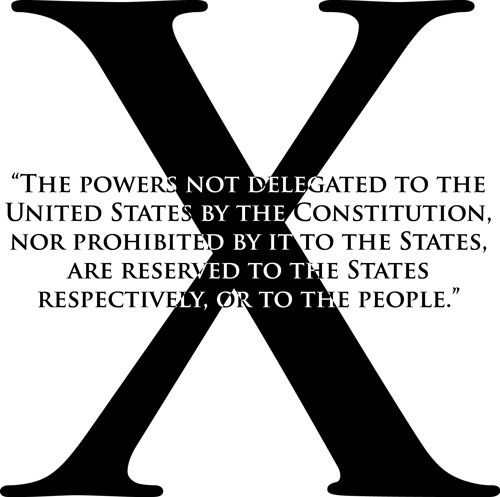
The powers delegated by the proposed Constitution to the federal government are few and defined. Those which are to remain in the State governments are numerous and indefinite. The former will be exercised principally on external objects, as war, peace, negotiation and foreign commerce; with which the last the power of taxation will for the most part be connected. The powers reserved to the several States will extend to all objects which, in the ordinary course of affairs, concern the lives, liberties and properties of the people, and the internal order, improvement and prosperity of the State.†– Federalist 45
Powers delegated. Few and defined. Powers reserved.
Sounds a lot like a clean division of power.
Advocates of centralized authority will point to things written and said years after ratification to argue that “they didn’t really mean it.†Epps utilizes this tactic, appealing to Chief Justice John Marshall’s opinion in McCulloch v. Maryland to advance his argument. In fact, many founders later discovered the joys of centralized power, wielded it and advocated for it. Even Madison was apparently a fan of a larger, more powerful national government.
But that was not how the Constitution was sold during the ratification debates. The ratifying conventions would never have accepted a Constitution creating the large central government with nearly unlimited power. The federalists promised a general government with limited, enumerated powers.
Epps advances a bait-and-switch interpretation of the constitution. Sure, the framers talked about limited, enumerated powers early on in order to get the Constitution ratified. But 20 years later, Marshall said that the Constitution REALLY meant that the feds can exercise any power they want, so that’s what it means today.
I hope Epps’ bank never adopts that interpretation of his mortgage.
In fairness, he actually rests his argument on a fundamental truth.
“The people are the holders of ‘rights’; they are the holders of ‘sovereignty.’â€
Epps is correct. States do not possess rights, only people exercise rights. Â Governments – whether local, state, or federal – have powers, not rights. So, where do those powers come from? Grants by the sovereign.
The people first granted powers to their states in order to protect their “property†– a word John Locke used to define life, liberty and estate. Through the states, the people delegated limited power to a general government for specific purposes.
Epps writes: “The powers that aren’t given explicitly and exclusively to one government or the other — belong to the people. The people are the holders of ‘rights’; they are the holders of ‘sovereignty.’ And, being sovereign, the people can insist that powers be shared by the states and the federal government. (Emphasis original)
That is, in fact, exactly what the people did. But our constitutional scholar seems to forget that the people had already granted political power to the states. In essence, the people took a few powers out of the “pot of power†already granted to the states, and transferred them to the general government. Representatives of the several states drafted the Constitution in order to delegate a few powers, up until then held exclusively by the states, to the new federal government. All powers not granted were reserved to the states and the people, the state of things existing prior to ratification.
Having just escaped from under the thumb of tyranny, most Americans were wary of centralized power. As the debate over the proposed constitution evolved, many insisted an amendment was necessary to spell out this implicit division of power.
Some of the framers didn’t see the point, arguing that the Constitution carefully enumerated the powers of the general government. It was self-evident, they argued, that this excluded any other power.  Designato unius est exclusio alterius – a legal maxim meaning, “the designation of one is the exclusion of the other.”
But the majority fearful of federal overreach didn’t want to rely on the assurance of proponents and insisted on an amendment making this explicit. (And they seem pretty insightful at this point in history, eh?)
The state of Massachusetts was the first to propose such an amendment.
“It removes a doubt which many have entered, and gives assurance that, if any law made by the federal government should be extended beyond the power granted by the proposed Constitution, it will be an error, and adjudged by the courts of law to be void.  It is consonant with the second article in the present Confederation, that each state retains its sovereignty, freedom and independence, and every power, jurisdiction and right, which is not, by this Constitution, expressly delegated to the United States in Congress assembled.†– Sam Adams
Epps makes a big ta-doo over the fact that the word “explicit†was removed from original drafts of the Tenth Amendment. He somehow takes the omission of the word as a sign that the framers really meant for the federal government to have nearly unlimited powers.
Epps quotes from The Complete Bill of Rights asserting Madison “[o]bjected to this amendment, because it was impossible to confine a government to the exercise of express powers, there must necessarily be admitted powers by implication, unless the constitution descended to recount every minutiae. He [Madison] remembered the word ‘expressly’ had been moved in the convention of Virginia, by the opponents to the ratification, and after full and fair discussion was given up by them, and the system allowed to retain its present form.”
So why was explicit removed? Epps hints at the real reason while waving a red white and blue herring.
“If ‘implied power’ sounds like tricky lawyer talk, ask yourself the following question: Is the American flag unconstitutional? The Constitution doesn’t make any reference to a national flag. By the ‘express’ argument, states and only states would retain what we might call ‘the flag power.’ The U.S. Army would have to march under a congeries of the fifty state flags, depending on the origin of each unit.â€
We all recognize this as a ridiculous scenario. Almost as ridiculous as inserting a little diatribe into an article to help cement the idea that “Tenthers†are extremists.
The American flag, commissioned by a committee of the Continental Congress and sewn by Betsy Ross, was created shortly before the Declaration of Independence was signed in 1776. Â Why would the authors of the Constitution feel the need in 1787 to authorize the creation of a flag that already existed?
But let’s pretend for a moment that the flag didn’t already exist. Would a strict reading of the Constitution forbid the creation of a flag and thus require the army to march under 50 banners?
Ummm. No.
Ironically, Epps inadvertently swerves into the truth in the middle of his frantic flag waving , answering the question: why was explicit removed from original drafts of the Tenth Amendment?
It was in essence to give “wiggle room†already provided for in the Constitution. The fear was that leaving the word explicit (the word clearly was also considered) in the amendment would, in effect, repeal the “necessary and proper†clause.
It was always understood that the federal government would exercise powers not “explicitly†enumerated, but incidental to carrying out those enumerated functions. The final clause of Article 1 Sec. 8 grants necessary and proper powers.
To make all Laws which shall be necessary and proper for carrying into Execution the foregoing Powers, and all other Powers vested by this Constitution in the Government of the United States, or in any Department or Officer thereof.
Up to this point, Epps and I are on the same page. But he starts writing way outside of the margins when he jumps from the idea of “necessary and proper†to “the federal government can do pretty much anything it wants.â€
Necessary and proper is a legal construction with a specific meaning, commonly used in legal documents granting power. Â Basically, it allows an agent to exercise powers not specifically spelled out, but necessary to exercise the power granted.
For example, let’s say I write out a contract granting you the power to run my grocery store. I don’t need to specify that you have to power to pay a guy to clean the floors, or hire a mechanic to fix a freezer when it goes down. Those powers are necessary and proper to running a grocery store. But necessary and proper powers don’t give you the right to give away all of the food items and start selling porno.
By legal definition, any necessary and proper power is narrowly defined. They must be:
1. Necessary to carry out the original purpose.
2. A customary way of carrying out the original purpose.
3. Â And incidental power can never be greater than the original power granted.

Get the New Book Today!
So yes Mr. Epps, the feds can commission a flag. Create a national health care system…not so much.
Epps brands those who believe the Constitution actually limits federal power and hold to the intended meaning of the Tenth Amendment “extremist.” In fact, he stands as the extremist. It is Epps who advances an extreme view of federal power with few limits.
It boggles the mind why anybody would want to loosen the chains constraining power. As 19th century legal scholar St. George Tucker wrote, “All governments have a natural tendency towards an increase, and assumption of power; and the administration of the federal government, has too frequently demonstrated, that the people of America are not exempt from this vice in their constitution.â€
The same people who rail against the concentration of corporate power in an economic context don’t bat an eye at concentrated power in the political arena.
Both are equally nefarious for the same reasons.
Thank you to Lesley Swann, Brian Roberts, John Michaels and others who contributed to this article.

- 1761: When American Independence was Born - February 13, 2026
- Writs, Riots, and Redcoats: Hancock’s Spark of the Revolution - January 17, 2026
- The National Bank That Breached the Articles of Confederation - June 2, 2025