
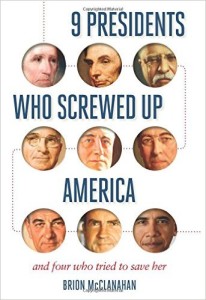
I recently received a one star “review” at Amazon for my newest release, 9 Presidents Who Screwed Up America and Four Who Tried to Save Her.
While I don’t normally respond to critical reviews, I thought this one offered an opportunity to expose some of the myths surrounding the founding generation and the Constitution that the reviewer has undoubtedly absorbed from the modern historical profession.
Quotes following the “myths” are from his review.
Myth 1: “The Founders…did not agree on what the Constitution meant (so much for a unified interpretive theory).”
False.
There was a consensus during the ratification process as to what the document would mean when adopted. The theme started with James Wilson’s “State House Yard” speech in October 1787 and carried through virtually all of the public speeches and pamphlets on the Constitution, namely that the new central authority would be a general government for general purposes only with clearly defined and limited powers over commerce and defense (contained in Article I, Section 8) and that State powers would be virtually unlimited. The proponents of the document spilled considerable ink defending it from prescient attacks. This defense is what is often labeled “originalism,” what James Madison said gave the Constitution its life and vitality. The Constitution was only reluctantly ratified because the “friends” of the document insisted the powers of the central authority would not and could not be abused. The Bill of Rights, adopted in 1791, were added to the document to ensure that the general government remained faithful to this original interpretation. They were “restrictive clauses” added to “prevent misconstruction or abuse of its powers.” What is “misconstruction?” Simple. It is the failure of the general government—Congress, President, federal courts—to abide by the meaning of the document at the time it was ratified. It matters not that several members of the founding generation reneged on their promise not to abuse power once they assumed office in 1789; it only matters that their actions were inconsistent with how they guaranteed the powers of the new government would be implemented and interpreted. That is a “unified interpretive theory.”
Myth 2: “…none of them [founding generation] expected the Constitution to be a static document (so expectations that adding to or taking away from executive power over time were built into the design).
False.
Yes, the Constitution can be amended, so in that regard it is not a “static” document, and the founding generation did amend it twelve times, but there is no evidence that the founding generation considered that “adding to or taking away from executive power over time were built into the design.” Quite the contrary. Every proponent of the Constitution reassured the general public that the powers of the new executive branch were circumscribed by the document and were confined to executing the laws of Congress and acting as chief diplomat. Even Alexander Hamilton said as much in Federalist No. 69. If anyone believed that they could be “added [enlarged]…over time,” the document would not have been ratified. Unlimited executive power was one of the great fears of the founding generation which is why the Philadelphia Convention sat in stunned silence when a single executive was first proposed in Madison’s Virginia Plan and why Benjamin Franklin openly feared what would come after George Washington.
Myth 3: “…a great deal of the power gained by the Executive was ceded to it by the Congress through the passage of legislation (notably the acts of the First Congress creating executive departments of State, Treasury and War).”
False.
I agree that Congress has been complicit in the expansion of federal power, but most of that has occurred during the modern era not during the years of the early federal republic. Yet, the executive branch also openly usurped power from Congress, particularly under the Lincoln, Wilson, and Roosevelt (both) administrations. All of the presidents from Truman to Obama simply followed their lead. The First Congress did sow the seeds of State destruction with the First Judiciary Act of 1789, but that is another issue, and creating executive departments hardly constitutes “ceding” power to the executive branch. Washington was continually frustrated with congressional meddling during his administration, and that trend would continue during much of the antebellum period.
Myth 4: “…George Washington’s tenure over a handful of former colonies [sic], Lincoln’s attempt to salvage a disintegrating Union, or FDR presiding over the Great Depression and the challenges of WWII are hardly equivalent to each other. This is judging apples to oranges. The real measure of any President is what he does to meet the challenges of his time. Each Administration begins with a unique set of problems, and a different array of legal and extra-legal means at his disposal [emphasis added].”
False.
When Washington took office, the free and independent states of America had existed for nearly thirteen years. That does not constitute a “handful of former colonies.” And they had been part of a union of States since 1776. That aside, as I continually point out in my book all of the presidents who “screwed up America” faced their respective crisis with a similar disposition, namely they would use “extra-legal” measures to “solve the crisis,” particularly in time of war. In fact, war has been the greatest boon for unconstitutional executive authority which is why Congress, not the President, has the power of the sword. I assume the reviewer understands that extra-legal does not mean constitutional. The real measure of a president is how he follows his oath of office, the only real way to assess his actions. Did he “preserve, protect, and defend the Constitution?” If they president uses “extra-legal” methods to “meet the challenges of his time,” then he has openly violated his oath and should be impeached. That is how the proponents of the document insisted executive abuse would be handled and to them abuse of power was an impeachable offense.
Myth 5: “Projecting modern notions of what the Constitution stands for back onto men who had very different perspectives on that Document than we do today is problematic at best–irresponsible at worst…. To be clear, the men who put their names to the Constitution were not in agreement as to what it meant, how it should operate in the future, or to what degree state authority should be subordinated to federal (the main issue in the election of 1800 after the Presidencies of both Washington and Adams). Even a cursory reading of the Federalist Papers and Anti-federalist Papers or any of the other documents surrounding the Ratification process of the Constitution makes this abundantly clear. Using a monolithic interpretation of the how the Constitution “meant” Executive power to be exercised is to miss the whole point of a founding document that was specifically written in ambiguous and general terms with organic means for amendment built into its construction so that it would be able to adapt itself to a changing world.”
 False.
Short and sweet, the author of this “review” does not understand originalism, nor do I believe he has read “any of the other documents surrounding the Ratification process of the Constitution.” The proponents of the Constitution did not argue in “ambiguous and general terms.” They clearly specified how the powers of the general government would be used and carefully outlined the demarcation between general and State powers. Everything that was not delegated to the general government nor prohibited in Article I, Section 10, was left to the States. Just reading the Tenth Amendment—which was typically first on the lists of proposed amendments coming from the States—makes that abundantly clear. Unfortunately, many of these proponents lied, Hamilton first among them, but since the Constitution would not have been ratified without such assurances, the arguments in favor of the Constitution from its “friends” should form the basis of our understanding of the document.
I also don’t believe the “reviewer” read my book, at least not carefully, but it is fun to shred his review anyway.
This article was originally published at BrionMcClanahan.com and is reposted here with permission of the author.

- Should We Abandon the Original Constitution? - March 31, 2023
- Is the Constitution “Pro-Slavery?” - July 13, 2021
- Why we get it wrong about the “antifederalists” - April 5, 2021