
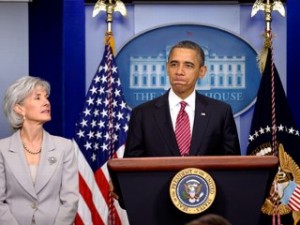
 Does the mandate forcing Catholic hospitals to offer abortifacients and contraception violate the First Amendment? The surprising answer is: Probably not.
True, there are serious moral and political issues inherent in requiring religious institutions to offer “treatments” they find theologically offensive. But, despite the claims of many Catholic and conservative commentators, the U.S. Department of Health and Human Services (HHS) rule probably doesn’t violate the freedom of religion clauses of the First Amendment, at least as currently interpreted.
[By the way, when claiming a First Amendment violation, some commentators also have said the First Amendment is “first” because of its primary importance. Actually it is first by historical accident: It was originally the third amendment, but became the first when the states failed to ratify the original first and second; the original second later became the 27th.]
The HHS rule applies to employers as a class (except churches per se). It does not single out institutions affiliated with religion. In the words of the Supreme Court, it is a “neutral and generally applicable” rule.
In the 1990 case of Employment Division v. Smith, the Supreme Court upheld “neutral and generally applicable” rules, even when they substantially burden religious practice. As the Court said in that case, “the right of free exercise does not relieve an individual of the obligation to comply with a ‘valid and neutral law of general applicability on the ground that the law proscribes (or prescribes) conduct that his religion prescribes (or proscribes).’” Note that both prohibitions and mandates are included in the court’s language.
This year, the Court issued Hosannah-Tabor v. Equal Employment Opp’y Comm’n, which blocked the Obama administration from interfering with how a church staffed its own ministry. Some might cite Hosannah-Tabor as evidencing a more friendly judicial attitude toward religion. Unlike Smith (and unlike the latest HHS rule), however, Hosannah-Tabor dealt with ministers in churches, not lay personnel in non-church institutions such as hospitals.
Hosannah-Tabor did include some language that might give hope to those claiming the HHS regulation violates the First Amendment:
“It is true that the ADA’s prohibition on retaliation, like Oregon’s prohibition on peyote use, is a valid and neutral law of general applicability. But a church’s selection of its ministers is unlike an individual’s ingestion of peyote. Smith involved government regulation of only outward physical acts. The present case, in contrast, concerns government interference with an internal church decision that affects the faith and mission of the church itself.”
You can argue that forcing a Catholic hospital to offer abortifacients is “government interference with an internal church decision that affects the faith and mission of the church itself.” But since hospitals are not churches and insurance policies are not ministers, chances are the Hosannah-Tabor holding would not void the HHS rule.
Another possible source of hope for religious groups is the federal Religious Freedom Restoration Act, passed in the wake of the Smith decision. It provides that even neutral and generally-applicable rules substantially burdening religion are valid only if “the least restrictive means of furthering [a] compelling governmental interest.” But that statute is useful only if not contradicted by Obamacare. And last year, in Mead v. Holder, a federal district judge held that Obamacare does serve the “compelling governmental interest” of “reforming the health care market by increasing coverage.”
So the real legal problem here is Obamacare and the mindset behind it. Obamacare’s profound interference into American life has already triggered many thorny constitutional and moral problems, and will trigger more.

Get the 2nd Edition Today!
As for the mindset, consider:
* A recent Fox News poll shows that “By a 61-34 percent margin, those surveyed this week approve of the Obama administration requiring all employee health plans to provide birth control coverage as part of health care for women.”
* The D.C. federal judge’s conclusion that increasing third party payments is a “compelling governmental interest”—when that system is actually the primary culprit in the health care crisis.
* Those in the Catholic hierarchy who actively supported Obamacare, thereby throwing the beliefs of other religious sects (such as Christian Scientists) under the bus.
Too late, liberal Catholics are learning that when you lie down with snakes, you get bitten.

- The Declaration of Independence: Its Debt to History - July 8, 2026
- What Is the Declaration of Independence? - June 29, 2026
- The Men Who Wrote the Declaration of Independence - June 19, 2026