
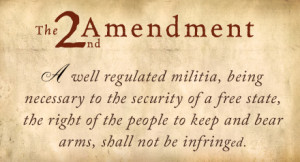
 Representative Brian Greene, in an effort to support the individual right to keep and bear arms, has sponsoredHouse Bill 114, titled the “Second Amendment Preservation Act.” This bill upholds both the U.S. and Utah Constitutions, each of which declare that this right “shall not be infringed.” HB114 simply strengthens state code to stipulate exactly how that such an infringement will be dealt with.
Specifically, the bill:
- affirms that it is the exclusive authority of the legislature to adopt and enact any and all laws, orders, rules, or regulations regarding the manufacture, transfer, possession, ownership, and use of firearms exclusively within Utah;
- provides that any federal action which purports to impose limitations on firearms contrary to the Second Amendment of the Constitution of the United States, or the Constitution or laws of the State of Utah, is unenforceable in Utah;
- creates a penalty for any enforcement of federal laws contrary to Utah laws or the United States or Utah Constitutions; and
- allows the attorney general to defend state officers, employees, and citizens prosecuted under certain federal laws.
Critics have pounced on this proposal, claiming that it is unconstitutional to pass a law in violation of a federal statute. For their support, they point to the legislative review note on HB114, authored by a staff attorney, which appears at first blush to substantiate their concerns.
But this legislative note is incorrect and misleading, and therefore merits a response.
Does HB114 violate the Supremacy Clause?
Attorneys disagree all the time. It’s what they’re employed to do. Judges also disagree, often overturning lower judges’ decisions, or even reversing decisions made by judges in the same court. The lesson to be learned here? Simply because an attorney advances an argument does not make it true.
This is the case with the legislative review note, which begins by stating that Rep. Greene’s bill conflicts with the Supremacy Clause. The drafting attorney writes:
As drafted, these provisions raise issues relating to the United States Constitution’s Supremacy Clause, contained in Article VI, Section 2, of the United States Constitution, which provides: ”This Constitution, and the Laws of the United States . . . shall be the supreme Law of the Land; and the Judges in every State shall be bound thereby, any Thing in the Constitution or Laws of any State to the Contrary notwithstanding.”
Did you notice the ellipses? Properly used, ellipses allow a person to omit words from a sentence that are not necessary to understanding the full sentence. But the words omitted in the attorney’s citation of the Supremacy Clause are the most relevant words when discussing whether federal statute can trump state code. Here is the actual Supremacy Clause with the omitted words highlighted:
This Constitution, and the Laws of the United States which shall be made in pursuance thereof; and all treaties made, or which shall be made, under the authority of the United States, shall be the supreme law of the land; and the judges in every state shall be bound thereby, anything in the constitution or laws of any state to the contrary notwithstanding.
Obviously, the language regarding treaties is not relevant to this issue. But leaving out the portion of the clause that specifies which federal laws are supreme is highly misleading to the legislators tasked with determining whether or not the pass the bill.
In fact, the omitted portion of this clause is the very reason HB114 exists at all! Many believe that federal gun laws are not made “in pursuance of” the Constitution, and are therefore unconstitutional. Therefore, state legislatures may interpose themselves between such unlawful mandates and their citizens to protect them from unconstitutional federal overreach. This is substantiated by a significant number of statements made in debates during the framing and ratification of the Constitution.
The legislative attorney’s incorrect interpretation of the Supremacy Clause, which relies upon omitting three important words from the text of the Constitution, was something that was actually considered by the framers of the document. A small number of them proposed what would be known as the “Virginia Plan” for the Constitution, one of its primary parts being the authorization of veto power by the federal government over all state laws. That plan was not approved.
The important lesson here is that the Founders directly considered a proposal to make all federal laws supreme, as the legislative attorney has argued. But that plan was rejected in favor of making supreme only those federal laws “made in pursuance of” the delegated, enumerated powers in the Constitution. That was the philosophical birth of Article VI, the so-called Supremacy Clause.
This issue was likewise a concern for many during state ratification conventions of the Constitution. Many were worried that the new national government would overtake all domestic matters, leading the states to become powerless. The rebuttals to these concerns from the proponents of ratification helps us understand what the clause’s intent actually was. For example, William Davie, a delegate to the Constitutional Convention from North Carolina and proponent of the resulting document, rejected attacks on the Supremacy Clause by arguing:
This Constitution, as to the powers therein granted, is constantly to be the supreme law of the land. Every power ceded by it must be executed without being counteracted by the laws or constitutions of the individual states. Gentlemen should distinguish that it is not the supreme law in the exercise of power not granted. It can be supreme only in cases consistent with the powers specially granted, and not in usurpations [emphasis added].
Future Supreme Court justice James Iredell of North Carolina agreed with Davie’s point, stating that, “[The supremacy clause] is supposed to give too much power, when, in fact, it only provides for the execution of those powers which are already given in the foregoing articles.If Congress, under pretence of executing one power, should, in fact, usurp another, they will violate the Constitution [emphasis added].”
Rep. Greene himself has responded to this concern regarding his bill in an op-ed in which he writes, “To conclude that the anticipated actions of the federal government will be entitled to supremacy status via the Supremacy Clause would require a blatant and intentional disregard of the abundant evidence to the contrary. Moreover, those of us who have the privilege of serving our fellow citizens are duty bound to preserve, protect and defend the fundamental rights of those who elected us. The bill I have proposed will do just that.”
The point here is clear: only federal laws which are consistent with the Constitution’s enumerated powers may invalidate a conflicting state law. In the case of gun control, the federal government has no authority to tell individuals that they cannot own and use weapons of a certain type. This brings us to the next point.
Intrastate vs. interstate commerce
The legislative note further argues that, “While this legislation limits itself to wholly intrastate conduct, it is not beyond the reach of Congress’s power under the Commerce Clause of the United States Constitution.” Let’s look at whether that is true.
The reach of Congress’s power can only be justified to the extent that is is based upon its constitutionally-delegated powers. The Commerce Clause states that, “[The Congress shall have Power] To regulate Commerce with foreign Nations, and among the several States, and with the Indian tribes.” So what does it mean to “regulate”?
Whether it means to micro-manage, as has recently been concluded in numerous Supreme Court cases, or to “make regular” (ensuring commerce flows freely), as some have argued, is ultimately irrelevant. This clause is restricted both by the prevailing colonial definition of “commerce,” which was mercantile trade and not anything indirectly connected to it, as well as being limited to commerce “among” (and not within) the several states.
In other words, even if Congress had been constitutionally conferred the authority to prohibit or mandate certain forms of commerce (which is a highly contestable point), they could only do so when such commerce moved (or was clearly going to move) from one state to another. It is illogical to conclude that the framers of the Constitution generally consented to a national government which could regulate, mandate, or prohibit economic activity within a family or community or state.
As the legislative note explains, however, there is “long-standing interpretation” by the Supreme Court which has allegedly authorized Congress to micro-manage any economic activity, whether it be interstate (“among the several States”) or intrastate (wholly within a single state). The primary case used as precedent by proponents of this argument (also cited in the note) isWickard v. Filburn (1942).
Wickard grew wheat for consumption only by his family and livestock, but the court opined that wheat locally consumed could, in theory, have been sold in interstate commerce—and so when Wickard retained his wheat instead of selling it, aggregate output and pricing in interstate commerce was affected. FDR’s court therefore concluded that Congress could pass a law regarding any form of commerce at any level.
Justice Clarence Thomas dissented from the majority of his peers in a recent U.S. Supreme Court case where a discussion of Congress’ power over intrastate commerce was key. Though it dealt with marijuana specifically, the issue of whether the federal government can prohibit an item grown or manufactured in one state, which then remains in that state, applies equally to firearms—as Thomas himself noted:
If the Federal Government can regulate growing a half-dozen cannabis plants for personal consumption (not because it is interstate commerce, but because it is inextricably bound up with interstate commerce), then Congress’ Article I powers – as expanded by the Necessary and Proper Clause – have no meaningful limits. Whether Congress aims at the possession of drugs, guns, or any number of other items, it may continue to “appropria[te] state police powers under the guise of regulating commerce.”
Writing further, Justice Thomas points out the logical problems with believing that Congress can micro-manage intrastate commerce:
If the majority is to be taken seriously, the Federal Government may now regulate quilting bees, clothes drives, and potluck suppers throughout the 50 States. This makes a mockery of Madison’s assurance… that the “powers delegated” to the Federal Government are “few and defined”, while those of the States are “numerous and indefinite.”
Indeed. Because gun control, like all economic regulation, interferes with the free flow of commerce, then it is actually antithetical to the original intent of the Commerce Clause. The federal government’s constitutional role is only to facilitate commerce, and not prohibit it.
In short, the federal government has not been constitutionally delegated any authority to micro-manage commercial transactions which exist entirely within a single state. The Supreme Court may have opined differently, but they are not the final arbiters of what the Constitution says—the people are. Too much evidence stands in opposition to the conventional wisdom that what the Supreme Court says is the ultimate and irrefutable declaration of a law’s constitutionality. Of the dozens of quotes which could be shared for support, consider the following from Thomas Jefferson:
To consider the Judges of the Superior [Supreme] Court as the ultimate Arbiters of Constitutional questions would be a dangerous doctrine which would place us under the despotism of an oligarchy. They have with others, the same passion for party, for power, and for the privileges of their corps—and their power is the more dangerous as they are in office for life, and not responsible, as the other functionaries are, to the Elective control. The Constitution has elected no single Tribunal. I know no safe depositary of the ultimate powers of society but the people themselves.
The people themselves, through their state legislatures, have, can, and will continue to oppose federal encroachments. James Madison likewise wrote that when the federal government imposes a mandate without constitutional authority, “the states who are parties thereto, have the right, and are in duty bound, to interpose for arresting the progress of the evil, and for maintaining within their respective limits, the authorities, rights and liberties appertaining to them.”
This is the entire point of HB114, and one which is not so easily refuted as the legislative note might suggest. Nothing in the bill contradicts the Commerce Clause, and Wickard and related court cases must finally be overturned and exposed for the logically empty justifications of federal aggrandizement that they have historically proven to be.
A chilling effect
Another concern raised in the legislative note explains that, “The provision making the enforcement of federal firearms laws a third degree felony would likely be held to have a chilling effect on federal officers’ authority.”
Like stating that the rain is wet, this self-evident statement does not convey new information. Obviously, the point of criminalizing the enforcement of an unjust, unconstitutional law is to place a “chilling effect” on those who would aim to enforce the “law” in question. That is the entire point of providing for penalties to begin with.
But the “authority” question is the point that needs addressing. The legislative note augments its argument by citing an 1880 Supreme Court case which states, in part: “If, when thus acting, and within the scope of their authority, those officers can be arrested and brought to trial in a State court, for an alleged offence against the law of the State. . . the operations of the general government may at any time be arrested at the will of one of its members.”
Of course, the question at the heart of this whole matter is whether federal officers are duly authorized to enforce gun control laws. They can only be duly authorized if the law conferring upon them the power is itself legitimate and constitutional—and in this case it is not. Therefore, the officers would not be acting “within the scope of their authority” and should be rejected when attempting to enforce a mandate that is not just.
Imagine if federal law stated that due to budget cuts, residents of each state would be required to provide housing to members of the National Guard from their state. This absurd overreach would raise the eyebrows of many, and rightly so. It directly contracts the Third Amendment to the U.S. Constitution which provides that, “No Soldier shall, in time of peace be quartered in any house, without the consent of the Owner, nor in time of war, but in a manner to be prescribed by law.”
If the homes of non-compliant Utah citizens were being confiscated due to their unwillingness to obey, should the state legislature impotently stand by and do nothing? Should the lives of dozens, or hundreds, or thousands of Utahns be upended while waiting for federal courts (part of the same government enforcing the “law”) to resolve the issue?
And if a majority of the justices on the Supreme Court opine that the action is constitutional, due to some technicality or circumstantial exception, despite the clear text of the Third Amendment, should the elected officials in Utah do nothing? Surely not.

Become a member and support the TAC!
Conclusion
Perhaps no better conclusion exists regarding HB114 than the one written in the legislative note itself:
In conclusion, this legislation purports to limit the reach of the federal law and is inconsistent with existing federal firearms provisions.
That’s the point of the bill—to limit the federal government’s ability to regulate and thus restrict the individual right to keep and bear arms. HB114 is indeed “inconsistent” with existing (and proposed) federal firearms provisions, because such provisions are not constitutional and violate this right.
Whether HB114 will be considered by a judge to be unconstitutional, based on bad precedent, is beside the point. The bill itself is quite constitutional, and will allow Utah to lead out on challenging the federal government’s decades-long encroachment on state powers based on flawed interpretations of the Supremacy and Commerce Clauses.
NOTE: This article was originally published at the Libertas Institute

- The 2nd Amendment Preservation Act is Constitutional - February 20, 2013
- Why I Have (Largely) Given Up on the Federal Government - May 25, 2012