
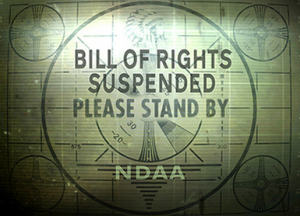
 UPDATE: An appeals court judge has reinstated federal kidnapping powers. Read about it here.
Over that last year, arguments have raged over the meaning and scope of sections 1021 and 1022 in the National Defense Authorization Act. NDAA detention supporters insist that it only applies to a narrowly defined group of “terrorists” and couldn’t possibly include the average person walking along American streets.
On the other hand, opponents of NDAA detention provisions argue that the language leaves the door open for abuse, and that government functionaries could stretch vague and undefined terms to detain virtually anybody, indefinitely without due process.
The very fact that the argument continues unabated nearly a year after passage indicates those opposing NDAA detention stand on solid ground. If the language in sections 1021 and 1022 was as cut and dry as the John McCains and Allen Wests of the world say, surely their arguments would have silenced opposition by this point. Surely their insistence that powers handed to the federal government remain narrowly defined to a small group of dangerous people. Surely the furor would have died down and Americans would have settled comfortably into the knowledge that NDAA detention provisions posed no threat to the average person.
Not the case.
Legal experts continue to wrangle over what certain terms in the NDAA mean or imply, and the simple fact that so many people disagree on the meaning of the detention provisions should give us all pause. That means it falls upon the president, courts and bureaucrats to decide how these provisions will apply. Handing the government that kind of power is dangerous and foolish.
At least one federal judge agrees.
Last week in a 112 page ruling, U.S. District Court Judge Katherine Forrest granted a permanent injunction on enforcement of section 1021 (b) (2). (Providing for indefinite detention of “A person who was a part of or substantially supported al-Qaeda, the Taliban, or associated forces that are engaged in hostilities against the United States or its coalition partners, including any person who has committed a belligerent act or has directly supported such hostilities in aid of such enemy forces.” )
“The Court finds that § 1021(b)(2) is facially unconstitutional: it impermissibly impinges on guaranteed First Amendment rights and lacks sufficient definitional structure and protections to meet the requirements of due process,” Forrest wrote. “This Court rejects the Government’s suggestion that American citizens can be placed in military detention indefinitely, for acts they could not predict might subject them to detention, and have as their sole remedy a habeas petition adjudicated by a single decision-maker (a judge versus a jury), by a ‘preponderance of the evidence’ standard. That scenario dispenses with a number of guaranteed rights.”
In a March hearing, the government would not assure the court that activities engaged in by the plaintiffs, primarily journalists and activists, didn’t potentially subject them to military detention. After Forrest issued a temporary injunction last spring, the government flip-flopped, telling the court that the activities “if described accurately, if they were independent, and without more, would not subject plaintiffs to military detention under § 1021.”
But Forrest said the government still leaves the door open for abuse of broad language in section 1021.
“The Government did not–and does not–generally agree or anywhere argue that activities protected by the First Amendment could not subject an individual to indefinite military detention under § 1021(b)(2). The First Amendment of the U.S. Constitution provides for greater protection: it prohibits Congress from passing any law abridging speech and associational rights. To the extent that § 1021(b)(2) purports to encompass protected First Amendment activities, it is unconstitutionally overbroad.”
Forrest also addressed the vagueness of the terms like “associated forces” in the NDAA detention provisions, noting that not even the government lawyers could define what they mean.
“A key question throughout these proceedings has been, however, precisely what the statute means–what and whose activities it is meant to cover. That is no small question bandied about amongst lawyers and a judge steeped in arcane questions of constitutional law; it is a question of defining an individual’s core liberties. The due process rights guaranteed by the Fifth Amendment require that an individual understand what conduct might subject him or her to criminal or civil penalties. Here, the stakes get no higher: indefinite military detention–potential detention during a war on terrorism that is not expected to end in the foreseeable future, if ever. The Constitution requires specificity–and that specificity is absent from § 1021(b)(2), she wrote. “The statute’s vagueness falls short of what due process requires.”
The federal government argued that the Court should step aside and only take action in actual detention cases by reviewing habeas corpus petitions. Addressing this argument, Forrest sheds light on the danger inherent in the government’s standards for determining what is or is not legitimate detention.
That argument is without merit and, indeed, dangerous. Habeas petitions (which take years to be resolved following initial detention) are reviewed under a “preponderance of the evidence” standard (versus the criminal standard of “beyond a reasonable doubt”) by a single judge in a civil proceeding, not a jury of twelve citizens in a criminal proceeding which can only return a guilty verdict if unanimous. If only habeas review is available to those detained under § 1021(b)(2), even U.S. citizens on U.S. soil, core constitutional rights available in criminal matters would simply be eliminated. No court can accept this proposition and adhere truthfully to its oath.
The ruling certainly counts as a victory for those opposing federal kidnapping powers. But does Forrest’s decision mean Americans can relax and states should abandon efforts to block any potential detention without due process?
Absolutely not!
The Obama administration filed an appeal just one day after the ruling. The feds clearly have no intention of simply abandoning these sweeping powers, and we cannot depend on federal courts to limit the power of the federal government. Forrest’s ruling counts as a rare but refreshing exception to a long line of stinky judicial ruling supporting government power and limiting civil liberties. And we clearly cannot trust the president to forever hold to a limited reading of the statute.
Get the New Documentary Today!
“For a man who doesn’t want the ability to order the military to abduct and detain citizens – without charge or trial – it is quite odd that his administration is appealing yet again,” Business Insider contributor David Seaman said.
The best way to ensure federal power remains check rests in the hands of state legislatures and executive officials. They must place roadblocks in the way of any federal agent attempting to exercise indefinite detention provisions written into the NDAA. State governments should follow James Madison’s admonition, do their duty and “interpose for arresting the progress of the evil.”
If anything, the recent ruling should elevate our awareness and make us that much more determined to block implementation of this unconstitutional power grab. It clearly demonstrates the dangerous threat to our most basic rights of free speech, association and due process posed by sections 1021 and 1022 of the NDAA.
Urge your state representative to sponsor liberty preservation legislation to block NDAA detention in your state.
For model legislation, click HERE.
To track state and local efforts against NDAA detention, click HERE.

- 1761: When American Independence was Born - February 13, 2026
- Writs, Riots, and Redcoats: Hancock’s Spark of the Revolution - January 17, 2026
- The National Bank That Breached the Articles of Confederation - June 2, 2025