
Standing on the Moral High Ground

You won’t get very far into a discussion about nullification before somebody invariably torpedoes the principle by associating it with racist segregationists in the south during the Civil Rights movement of the 1950s and 60s.

They make a valid point, at least from a historical perspective. Southerners did appeal to “states’ rights” generally, and nullification specifically, to support segregation. In 1956, 99 members of Congress signed on to the Southern Manifesto to counter the Supreme Court’s decision in Brown v. Board of Education.

The document decried school integration and insisted states retained the power to determine the makeup of their schools, regardless of the SCOTUS decision. The manifesto commended “the motives of those States which have declared the intention to resist forced integration by any lawful means.” Arkansas Governor Orval Faubus put the words into action, deploying National Guard troops to block nine black students from entering Little Rock Central High School in 1957.

Certainly not nullification’s finest hour.

Knowledgeable supporters of the principles of nullification will counter with some historical facts of their own. Northern abolitionists appealed to “states’ rights” and passed nullification legislation to block implementation of federal fugitive slave acts in the 1840s and 1850s. These federal laws deprived any accused fugitive slave of due process. Northern states insisted the fugitive slave acts were unconstitutional, and they passed personal liberty laws to thwart their implementation.

States refused to allow slave commissioners and federal marshals to use their jails to detain accused fugitive slaves. They imposed harsh penalties for kidnapping blacks– even under the “authority” of the fugitive slave acts. Massachusetts made it an impeachable offense for state judicial officers to cooperate with federal slave catchers. These personal liberty laws proved extremely effective in protecting blacks, and few were sent south after their implementation.

Perhaps nullification’s finest hour.

It appears we have a standoff pitting strong moral arguments for and against nullification.

Clearly, we can’t conclusively validate or invalidate the principles of nullification based on their application. In one case, they were used to perpetrate great evil against blacks. In the other, they were applied to protect the liberty and basic human dignity of these same people.

In fact, we should analyze any principle such as nullification within its political, legal and constitutional framework. We can easily defend nullification when we look at it from within the structure of the original constitution, the Tenth Amendment and the ratifying conventions. When you understand the intended relationship between the states and the federal government, nullification naturally follows.

Jefferson convincingly makes the case for nullification in the Kentucky Resolutions of 1798. He explains that “the several States composing, the United States of America, are not united on the principle of unlimited submission to their general government.” He points out that the federal government was delegated specific limited powers and “whensoever the general government assumes undelegated powers, its acts are unauthoritative, void, and of no force.”

So, what should we do when the federal government oversteps its bounds?

In cases of an abuse of the delegated powers, the members of the general government, being chosen by the people, a change by the people would be the constitutional remedy; but, where powers are assumed which have not been delegated, a nullification of the act is the rightful remedy.

Those opposed to nullification have a hard time refuting Jefferson’s logic. So instead, they resort to tarring the Principles of ’98 with a paintbrush dipped in segregationist rhetoric.

And nullification supporters counter with its application in the abolitionist cause.

Just for fun, let’s look a little deeper at this apparent standoff and see who really holds the moral high ground.

Nullification opponents hope to push supporters into a corner by forcing them to champion morally repugnant segregation along with nullification. But they create a false choice. One can easily embrace Jefferson’s principles, while condemning their application by those seeking to preserve the Jim Crow era. I do not condone every use of a tool when I assert that the tool has legitimacy and value. A murderer using a hammer to bludgeon somebody to death doesn’t negate the utility of the hammer for driving nails. In the same way, one can emphatically reject segregation and racism, while championing nullification as a legitimate process.

But opponents of nullification paint themselves into a corner when they condemn the principles simply because some nasty people used them toward a nasty end. To condemn segregationist application of nullification logically condemns abolitionist application of nullification. To remain logically consistent, those who oppose the Principles of ’98 must oppose them in ALL circumstances, because the principles themselves evidently contain some fatal flaw.
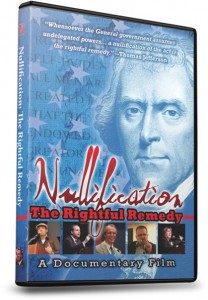
Get the New Documentary Today!

If the anti-nullifier admits it was properly used to thwart the draconian fugitive slave acts, he acknowledges the legitimacy of nullification, at least in some circumstances, and his argument falls apart. In order for the opponent of nullification to hold her ground, she must concede that defying centralized federal power stands as the unforgivable sin, and she must condemn the abolitionist nullifier as a sinner of the highest order, standing in line for the down escalator with Gov. Fabus and his fellow segregationists.

Through its history, Americans have invoked the principles of nullification to protect free speech, to preserve due process, to advance economic justice and to fight military conscription. Yet opponents continue to point to a singular period in history where it was used for a morally repugnant end as cause to reject it in its entirety. As we’ve seen, they must either allow their logic to unravel, or condemn those who risked their own liberty, and even their lives, to defend the freedom of blacks.

The principles themselves stand up to scrutiny. Nullification is historically, philosophically and morally the rightful remedy. So, I will soundly reject the doctrine of segregation, while boldly championing principles abolitionists unapologetically used to advance their cause.

What will you chose?

Enjoyed This Post?

We cannot succeed without your help, as we will never accept government grants or handouts. Please help us by investing in the Constitution and freedom today!

Enjoyed This Post?

Leave a Reply

14 Responses to Standing on the Moral High Ground

  1. onetenther July 23, 2012 at 6:17 pm #

    At some point, we are going to have to acknowledge that evil people have the same freedoms under the law, constitution, and natural that good people have.  Every state has the same right to lawfully resist federal power.  It does not matter what is the end purpose is whether it is for good or for evil because each state has the same ‘reserved powers’ under the constitution as the other. 
     
    I know I am going to get smacked around for this but I think the south had a point about school desegratation in that it was their right to decide for themselves.  The only thing that could undo that right was an amendment to the constitution.  The court, in that case, overstepped its bound even thought it was for a good cause.  No one complains because of that.

  2. onetenther July 23, 2012 at 6:19 pm #

    Thank you for not dancing around the subject on this.  I think not acknowleding factual history on this issue such as the southern manifesto kind of undermines our credibility.  We shouldn’t hide from facts or ‘outsmart the truth’.   

  3. onetenther July 23, 2012 at 6:23 pm #

    I hate to spam the comment section but I think the repeal amendment has a better chance than nullification since we won’t run into these arguments.  It makes people feel better that states won’t go rogue on everything because the states collectively can undo a federal law.  It provides a check against bad states and at the same time gives everything nullification does. 

    • Mike Maharrey July 23, 2012 at 6:37 pm #

       @onetenther But a repeal amendment only applies to the specific object(s) repealed. Nullification is a legitimate and necessary check on federal power in general.  My biggest difficulty with those who champion the amendment process as the panacea (while I don’t philosophically oppose the idea) is that the federal government ignores the Constitution we have. I’m not convinced adding to it will restrain the feds. Even with amendments limiting federal power, we still need the threat of state nullification to hold them in check. Paper chains won’t do the trick.

      • onetenther July 24, 2012 at 5:28 pm #

         @MikeMaharrey-TenthAmendment The way I see it is that federal laws and the constitution are really a compact among the states.  States agree to have these laws and a repeal amendment will allow states to collectively decide to invalidate these laws.  I feel that nullification kind of runs into this in that the states might agree to something and can’t allow a state to go rogue.  Its a part of what the states PERCIEVE as a part of the lawful compact and because of that they won’t tolerate any states going rogue.  Its the strongest resistance to state nullification which is people fear a state being out of control.  I think a repeal amendment would alleviate those fears by allowing the states to have some control over the process. 
         
        I also think states are within their right to put up resistance to federal laws even ones that are constitutional but why not have both?  We should have a repeal amendment that includes nullification.  It should say if a majority of states declare a law void then the law is repealed.  This way it combines the best of both worlds.  That is just my opinion on this.

        • Mike Maharrey July 24, 2012 at 5:50 pm #

           @onetenther I can’t disagree with you, my friend. It’s really just a matter of where we choose to focus our resources at this point. If a strong amendment movement develops, I certainly wouldn’t oppose it!

        • onetenther July 25, 2012 at 5:26 pm #

           @MikeMaharrey-TenthAmendment Have you ever heard of the madison amendment.  It was proposed by madison and it allows states to amend the constitution directly without calling for a full blown constitutional convention.  LINK:  http://www.madisonamendment.org/index.html

  4. Bob Greenslade July 23, 2012 at 8:29 pm #

    I continue to say the way to address federal usurpations is through separation of power (between the States and their federal government) resolutions adopted by the States and submitted to the feds with nullification as the action to be taken to negate the usurpations…followed by a constitutional amendment…yes a Convention can be called and restricted to a single issue.
     
    “The United States, in their united or collective capacity, are the OBJECT to which all general provisions in the Constitution must necessarily be construed to refer.”  [Emphasis not added]
     
    Alexander Hamilton, Federalist Essay No. 83.


  5. Stogie July 24, 2012 at 7:43 am #

    The Northern states in pre-Civil War America certainly had the right to nullify the fugitive slave laws.  The South also certainly had the right to secede.  I agree with the other commenter that the South had a right to nullify the Brown vs Board of Education decision, especially since the latter was “legislating from the brench.”  The Brown decision was not remotely constitutional, though it produced (or so some argue) a good result.  What it led to was more draconian federal intervention through forced busing and taking control of the education of several states, costing those states billions of dollars while disrupting and destroying neighborhood schools.  Integration went from a right (with which I agree, as long as one lived in the school district) to a federally forced condition (where students were bused miles from their neighborhoods, with which I disagree, merely to force a multiracial student body).  

    • onetenther July 24, 2012 at 5:32 pm #

       @Stogie It also puts kids with other kids from different parts of the city.  When I went to school it was a shock to go from neighborhood kids that I knew to kids who were a part of gangs.  Pretty damn scary and it actually hurt the education process and, as I got older, I realized being scared to go to school isn’t normal.  I wish states would not comply with supreme court decisions that violate the powers they have under the constitution.  Seriously..what is justice stab-me-in-the-back Roberts going to do?  Is he going to order an invasion?

  6. pentale July 28, 2012 at 4:38 pm #

    With all this shenanigans, who stands to gain the most?  Who stands to gain from the borrowing of money that is now known as the“National Debt?;” did you know that under the Constitution before the so called adoption of the 14th Amendment that the State Citizens and (as) Citizens of these united States of America were not liable for Congress’ debt?  The states were liable and had to pay it through apportionment to each state.  But, the states controlled the debt through the Senate, whose representatives were appointed by the state legislatures.  The Senators were not elected under the unlawful 17th Amendment.  Every Amendment since the 14th is unlawful.  Verify it. “The “Repeal The 17th” movement is a vocal part of the overall tea party structure,”  TPM http://tpmdc.talkingpointsmemo.com/2010/05/tea-party-call-to-repeal-the-17th-amendment-causing-problems-for-gop-candidates.php/ Nullify the 14th Amendment, you can’t repeal that which never existed, and all Amendments following it will vanish.    apenstale.wordpress.com

Trackbacks/Pingbacks

  1. Standing on the Moral High Ground | Libertarios of America - July 23, 2012

    [...] for state judicial officers to cooperate with federal slaveRead the rest of this article at: http://tenthamendmentcenter.com/2012/07/23/standing-on-the-moral-high-ground/ Click "Home" to find this article in English. Clic "Inicio" para encontrar este artículo en [...]

  2. Taking the Moral High Ground – Tenth Amendment Center Blog - July 28, 2012

    [...] The Robert Scott Bell Show Mike Maharrey Bringing the Republicans back to their nullification roots Standing on the Moral High Ground John Avery Emison’s book: Lincoln Uber [...]

  3. Covering the Supremacy Clause – Tenth Amendment Center - January 25, 2013

    [...] a question: why can’t reporters like Barnard ever find a source who will make the following equally historically accurate [...]