
Podcast: Play in new window | Download (Duration: 13:24 — 12.4MB)
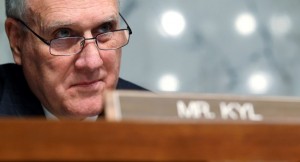 Last week the Heritage Foundation hosted a speech delivered by Arizona Senator Jon Kyl, entitled “Why Conservatives Should Fund and Support a Strong National Defense.” The event was the annual Jesse Helms Lecture, designed “to highlight America’s founding principles.” It was given as part of the Heritage Foundation’s Protect America Month.
The intent here is not necessarily to give a word by word rebuttal of the Heritage report and Kyl’s speech, but instead – to address the overarching themes of his speech.
The Heritage report is prefaced with an abstract, featuring Thomas Jefferson’s declaration that “the price of liberty is eternal vigilance…” This idea, misapplied, forms the foundation of Kyl’s thesis, as vigilance, much like the word defense, is stretched to mean overseas intervention and military budgets of grotesque proportions.
A quick note on terminology is important here. Kyl states early in his talk that “liberals and progressives have never been supportive of the imperative to preserve American sovereignty…” While the term sovereignty is sometimes used in a foreign policy context to denote independence, Kyl seems to use it as a synonym for the word security. He goes on to list three ways in which American “sovereignty” is put at risk, and each relates not to independence from international governmental organizations, but to issues commonly related to national security. They are: cuts to so-called defense, opposition to foreign intervention, and privacy concerns (he didn’t give details on this last item, citing too little time).
Before moving into Kyl’s full argument, it is important to point out the false dichotomy he presents for the audience. There is no fundamental difference in the foreign policy ideologies of conservative and progressive politicians, as judged by their actions. Practically speaking, the Obama foreign policy is the same as Bush’s, which is the same as Clinton’s, which is just like that of Bush before him, and so on. To be sure, progressive politicians often speak in more humble terms, but their actions – escalating drone strikes, tripling troop levels in Afghanistan, ignoring due process, and launching new wars – belie this rhetoric.
In his lecture, Kyl does not aim his criticism at liberals, but instead directs it at other Republicans. He warns of a “creeping sentiment within certain Republican circles that America is indeed in a period of decline, mostly due to runaway spending, and that we cannot, therefore, afford the kind of military we had in the past and should disengage from many areas of the world.” This is to say that these Republicans are beginning to reject the neoconservative dogma that has dominated U.S. policy for decades. Kyl laments this – but it’s a good thing.
Intervention is not conservative and it is not consistent with “America’s founding principles,” nor is intervention conducive to a “strong national defense,” in its true sense. For the United States, the 20th Century marked the rise of foreign intervention, and it was ushered in by progressives, notably Theodore Roosevelt and Woodrow Wilson, neither of whom was very conservative. Consider also that Franklin Roosevelt, Harry Truman, and Lyndon Johnson – all progressives – were proponents of foreign military involvement. By and large, the foreign policy of the U.S. during its first century was far more humble, mirroring the advice from the likes of Thomas Jefferson and George Washington.
Foreign entanglements, of the kind Kyl advocates, degrade the actual defense of the country in three ways. With troops stationed all over the planet they are more vulnerable to attack and, cannot adequately defend the U.S. The bombing of naval ships and foreign barracks provide examples of the former; and the fact that the U.S. military was better prepared to defend South Korea, Saudi Arabia, or Germany on 9/11 explains the latter. But the last, and most fundamental reason of all, is that intervention begets intervention by way of blowback. When the U.S. intervenes in the affairs of another country it necessarily creates enemies by choosing sides and killing civilians – even accidentally. Thus begins a cycle where the victims’ resentment builds, they retaliate, are attacked again, and still more seeds of blowback are sewn.
This is to say nothing of the economic price tag for what amounts to an empire. Kyl brings up the perennial argument over entitlements versus military spending, and suggests that cutting “defense” spending to accommodate entitlement funding would be “devastating to national security.” Reducing defense spending would likely be detrimental to security, but so much of the pentagon’s budget is dedicated not to actual defense, but instead is offensive in nature. Not a single one of the many wars now being fought is truly defensive, nor do the inhabitants of the targeted countries pose any credible threat to the U.S. mainland.
Kyl admits that “the fastest-growing part of the budget is in personnel costs, especially for health care.” This is all due to the very policies which he promotes. Personnel costs are higher and the price of healthcare continues to rise directly because the military is spread across the globe waging wars with no end in sight. Tens of thousands of wounded veterans, many of them burn victims and amputees, the hundreds of thousands suffering from traumatic brain injury, and the more than one hundred thousand on psychiatric drugs all cause spending to rise dramatically.
Like all good advocates of the state, Kyl uses the Orwellian term “interests” to supplement his argument. U.S. foreign policy has evolved significantly, perhaps beginning with Thomas Jefferson’s authorization to deploy troops to Tripoli in 1801. But with a military presence now in some 130 countries, virtually anything could be construed as part of “our national interest” and used to justify intervention. We must get away from this mentality – that everything that happens in the world deserves an immediate response from the U.S. military. It’s destructive, it’s unconstitutional, and it’s immoral.
But as things stand today, even ancillary issues are used to justify inserting the U.S. government into the affairs of other nations. Kyl laments the decision of several members of the Senate Foreign Relations Committee to reject a “resolution in support of the besieged Syrian people.” The resolution would have established as U.S. policy that “the legitimate aspirations of the Syrian people cannot be realized so long as Bashar al-Assad remains in power and that he must step aside.” The reason it was rejected by those Republicans, he surmises, was because such a policy “might ultimately lead to taking some kind of action.”
In fact, the resolution would have only codified existing U.S. policy, as the U.S. State Department had already promised to fund the rebellion and provide communications equipment as a month prior to the aforementioned resolution. And, it is widely understood that many of the previous military conflicts began with resolutions and so-called “non-lethal aid.” Rarely is an all-out military invasion something that happens overnight. In practically all cases it stems from another Orwellian term: “diplomacy.”
In the twisted definition now used by war Hawks, “diplomacy” is no longer negotiations and attempts at non-violent solutions. It has now morphed into an aggressive process that involves sanctions, threats, blockades, and the deployment of troops, naval ships, and aircraft to further isolate and coerce the targeted parties into compliance. That so many Republicans refused to participate in this endeavor is to be celebrated, as most often it is not the political and military leaders that suffer from such “diplomacy,” but the people of the country who have no say in the matter.
In his final segment, Kyl invokes Jesse Helms, urging Americans to “demonstrate not only to ourselves, but to the world that as a nation we stand by American values—freedom, rule of law, sovereignty—both at home and abroad.” If this advice is to be taken seriously, and not meant merely as a platitude, Americans should reject the foreign policy shared by neoconservatives and progressives now being applied. It is indeed anathema to freedom and the rule of law, as the Patriot Act (also known as the “repeal the 4th Amendment act”), certain provisions in the NDAA, and everything the TSA has done in the last decade attest.

Become a member and support the TAC!
In the end, Kyl asks: “How do we determine the appropriate American leadership role?” Of course a rudimentary approach involves looking to the constitution. That document is very clear on how war is to be declared. That is the legal means, but it’s vague as to why it may be declared, or the moral reason. For the answer to this we must look to the principle of non-aggression for moral guidance. Murray Rothbard defined the non-aggression principle thusly: “No one may threaten or commit violence (‘aggress’) against another man’s person or property. Violence may be employed only against the man who commits such violence; that is, only defensively against the aggressive violence of another.”
In essence, this is the Golden Rule, and it should guide foreign policy; not some bastardized definition of “defense,” “interests,” or any other manipulated term to sterilize unjustified military force.

- Some Clarification on ‘Integrity’ - August 14, 2013
- Copperhead: A Tenther Film Review - July 19, 2013
- Edward Snowden: Nullifier - June 25, 2013