
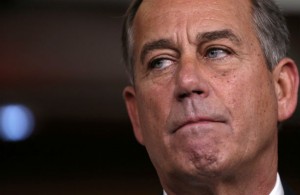
 From the standpoint of one familiar with our constitutional history, the spectacle of the Speaker of the U.S. House of Representatives making pre-emptive tax concessions to the President is unnerving.
Over a period of centuries, the lower house of the English Parliament, the House of Commons, fought for and won the “power of the purse”—that is, the right to initiate, as well as approve, all revenue measures. Based on English success, we adopted the same system. Until now, apparently.
Fundamental to the rights of Englishman was (and is) the right not to be taxed without consent. That required approval by the House of Commons, as the best representative of the people in the English government.
It also meant that only the House of Commons could initiate tax laws. Such laws could be vetoed by the upper chamber (the House of Lords) or by the King, but they had to originate in the Commons. This rule proved to be a decisive factor in England’s conversion from an aristocratic government into a free country.
But if the leaders of the Commons had made pre-emptive concessions as Boehner is doing now, England might not have become a free country. And if England hadn’t, neither would have the United States.
In America, we copied this aspect of the English system. During the 1787 constitutional convention, the commissioners [delegates] had to wrangle over the composition of the new Congress. A key part of the ensuing “Great Compromise” was the stipulation that only the House of Representatives—the federal institution most closely reflecting the people—could originate revenue bills.
To be sure, a few commissioners tried to dismiss that prerogative as insignificant. But in one of the convention’s most memorable moments, John Dickinson described how experience instructed us in ways that mere reason never could:
“Experience must be our only guide,” told his fellow commissioners. “Reason may mislead us. It was not Reason that discovered the singular & admirable mechanism of the English Constitution. . . . And has not experience verified the utility of restraining money bills to the immediate representatives of the people.. . . the effect was visible & could not be doubted.”

Get the Book Today!
Hence, the final wording of Article I, Section 7, Clause 1: “All Bills for raising Revenue shall originate in the House of Representatives; but the Senate may propose or concur with Amendments as on other Bills.”
Boehner’s job is not to make pre-emptive concessions to the President. It is not to negotiate for presidential permission to pass a budget. His job is to lead the House to adopt a budget in line with the views of those who elected them and the interests of the country.
The initial decision to lower, raise, or maintain tax rates should be made in the House. Any negotiations should take place only after the House adopts a budget, and that budget should serve as the starting point. Not the demands of the President.

- How the Founders Explained Limits on the Federal Government - January 21, 2026
- The Constitution and the Trump Tariffs - December 7, 2025
- Ancient Rome and the Constitution - October 29, 2025