
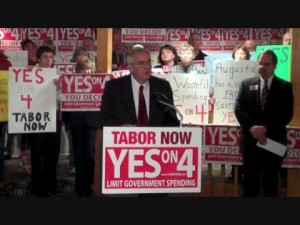
 TABOR Endangered in Colorado?
Die-hards attacking Coloradans’ constitutional right to personally vote on tax increases won an unexpected victory in federal court when Judge William J. Martinez found that their lawsuit is justiciable. That means the case can proceed to the merits.
Colorado’s Taxpayer Bill of Rights (TABOR) was adopted in 1992, and has been tattered by hostile lawsuit after hostile lawsuit. Yet the core of the measure still stands, and a group of government apologists have decided to take out the rest. Their claim is that by limiting the state legislature’s power to raise taxes, TABOR violates Article IV, Section 4 of the U.S. Constitution, the “Guarantee Clause.” That’s the clause by which the United States guarantees to every state a “Republican Form of Government.”
There are four things wrong with the lawsuit—besides, of course, its elitist arrogance. The first is that the Supreme Court already has told us that such suits are not justiciable because “Republican Form of Government” cases are for Congress, not the states. In working around this precedent, Judge Martinez relied on the 1962 Supreme Court case of Baker v. Carr, which listed six categories of non-justiciable disputes and found that none of the categories applied.
However, Judge Martinez erred in handling two of those categories. He found that Congress had not spoken on the issue of whether Colorado has a “republican Form”—a mistake, since the Supreme Court has told us that when Congress admits a state’s representatives and Senators Congress is approving its form of government. The judge also held that upending TABOR would not require re-visiting established law because TABOR is used to block, not create, taxes. This was a mistake because upending TABOR could resurrect all the tax increases blocked under it.
The second thing wrong with this lawsuit is the way it turns the Guarantee Clause on its head. The Clause was established to uphold popular government—to ensure that no American state became a monarchy that might seek to aggrandize itself at the expense of the other states and of the federal government. The plaintiffs are trying to use the Clause toundermine popular government.
The third problem with this lawsuit is its claim that to be “republican” a state must have a legislature with the unchecked ability to raise money.
But that is not the Constitution’s definition of “republican.” Founding-Era dictionaries all described a “republic” as a commonwealth, a “government of more than one” (i.e., not a monarchy), or a government where the people rule. There is no hint that there even need be a legislature other than the people themselves. Consistently with these definitions, the Founders repeatedly referred to past governments as “republics” in which (as the Founders remarked) the people made laws, including tax laws, directly (i.e, ancient Athens, ancient Rome, various Swiss cantons, and others). For a survey of the evidence, including the single-out-of-context Madison quotation cited by the Plaintiffs, see my article on the constitutional meaning of “republic.”
The fourth thing wrong with the lawsuit is that the plaintiffs offered no measurable standard for their novel definition of republic. Their “fully effective legislature” phrase raises a host of unanswered and unanswerable questions: Is a legislature less than “fully effective” if the the people can vote on any measures at all? Does that purported standard ban all voter initiatives? All referenda? If not, which ones? Must the executive be “fully effective,” too? If so, then how many checks and balances are permissible? Etc. Etc.

Get the Book Today!
Judge Martinez’s decision is wrong, but when you read his opinion you come away with the impression that one reason he decided as he did was the state attorney-general’s weak defense of the case. For example, the A-G’s brief simply blew off the “Republican Form” issue by refusing to address it and falsely suggesting that this issue was a topic for serious debate.
The A-G’s omission forced us at the Independence Institute to file an amicus curiae (friend of the court) brief on what the Constitution actually means when it refers to the “Republican Form.”
That issue now becomes the next focus of the case.

- The Declaration of Independence: Its Debt to History - July 8, 2026
- What Is the Declaration of Independence? - June 29, 2026
- The Men Who Wrote the Declaration of Independence - June 19, 2026