
EDITOR’S NOTE: It is the thesis of Raoul Berger’s monumentally argued book, Government by Judiciary, that the United States Supreme Court – largely through abuses of the Fourteenth Amendment to the Constitution – has embarked on “a continuing revision of the Constitution, under the guise of interpretation.”
Consequently, the Court has subverted America’s democratic institutions and wreaked havoc upon Americans’ social and political lives. One of the first constitutional scholars to question the rise of judicial activism in modern times, Berger points out that “the Supreme Court is not empowered to rewrite the Constitution, that in its transformation of the Fourteenth Amendment it has demonstrably done so. Thereby the Justices, who are virtually unaccountable, irremovable, and irreversible, have taken over from the people control of their own destiny, an awesome exercise of power.”
The following text is excerpted from Part II of the book.
Where early claims to extraconstitutional power were made in the name of “natural law,” the present fashion is to invoke the “living Constitution” when it is sought to engraft or amputate a limb. Commentators at a loss to justify judicial arrogations fall back on Marshall’s sonorous reference to a “constitution intended to endure for ages to come.” In an oft-quoted apostrophe, Justice Frankfurter declared that it “expressed the core of [Marshall’s] constitutional philosophy . . . the single most important utterance in the literature of constitutional law.” It has become a mythic incantation. Chief Justice Hughes, when confronted by the “mortgage moratorium”-“impairment of contract” problem, declared:
If by the statement that what the Constitution meant at the time of its adoption it means today, it is intended to say that the great clauses of the Constitution must be confined to the interpretation which the framers, with the conditions and outlook of their time would have placed upon them, the statement carries its own refutation. It was to guard against such a narrow conception that Chief Justice Marshall uttered a memorable warning— “We must never forget that it is a Constitution we are expounding . . . a constitution intended to endure for ages to come, and consequently to be adapted to the various crises of human affairs.”
At best Marshall’s dictum represents a self-serving claim of power to amend the Constitution. In Justice Black’s words, “in recalling that it is a Constitution ‘intended to endure for ages to come,’ we also remember that the Founders wisely provided for the means of that endurance: changes in the Constitution are to be proposed by Congress or conventions and ratified by the States.” Claims to the contrary need to be measured by Lord Chief Justice Denman’s observation that “The practice of a ruling power in the State is but a feeble proof of its legality.” Such judicial claims stand no better than the bootstrap “precedents” created by a number of presidents for reallocation to themselves of the warmaking power confided to Congress, in justification of single-handed commitments of the nation to war, as in Vietnam. But the fact is, as I shall show, that Marshall’s words have been removed from context, that he flatly repudiated the revisory power Hughes attributed to him, and that other Marshall utterances also show that the conventional view of M’Culloch does not represent the “core of his constitutional philosophy.”
Marshall’s dictum was uttered in M’Culloch v. Maryland; the issue was whether the Constitution empowered Congress to establish the Bank of the United States, and that turned on whether a bank was a proper means for execution of other expressly granted powers. Marshall reasoned that a government “intrusted with such ample powers” as “the great powers, to lay and collect taxes; to borrow money; to regulate commerce,”
must also be intrusted with ample means for their execution. The power being given, it is in the interest of the nation to facilitate its execution . . . This could not be done, by confining the choice of means to such narrow limits as not to leave it in the power of congress to adopt any which might be appropriate . . . To have prescribed the means by which government should, in all future time execute its powers, would have been . . . [to give the Constitution] the properties of a legal code.
Manifestly, this was merely a plea for some freedom in the “choice of means” to execute an existing power, not for license to create a fresh power at each new crisis. Marshall himself flatly denied such license-claims in a pseudonymous debate with Judges Spencer Roane and William Brockenbrough of Virginia.
M’Culloch immediately had come under attack. To Madison the Court’s ruling seemed
to break down the landmarks intended by a specification of the powers of Congress, and to substitute, for a definite connection between means and ends, a legislative discretion as to the former, to which no practical limits can be assigned . . . [A] regular mode of making proper alteration has been providently provided in the Constitution itself. It is anxiously to be wished . . . that no innovation may take place in other modes, one of which would be a constructive assumption of powers never meant to be granted.
Thus, the chief architect of the Constitution rejected the replacement of the amendment process by judicial revision as an “assumption of powers never meant to be granted.” Even more severe strictures were published by Roane and Brockenbrough. Marshall leapt to the defense under a pseudonym; speaking to the “intended to endure for ages” phrase, he said:
it does not contain the most distant allusion to any extension by construction of the powers of congress. Its sole object is to remind us that a constitution cannot possibly enumerate the means by which the powers of government are to be carried into execution.
Again and again he repudiated any intention to lay the predicate for such “extension by construction.” There is “not a syllable uttered by the court” that “applies to an enlargement of the powers of congress.” He rejected any imputation that “those powers ought to be enlarged by construction or otherwise.” He emphasized that “in all the reasoning on the word ‘necessary’ the court does not, in a single instance, claim the aid of a ‘latitudinous’ or ‘liberal’ construction.” He branded as a “palpable misrepresentation” attribution to the Court of the view of the “necessary and proper clause” “as augmenting those powers, and as one which is to be construed ‘latitudinously’ or even ‘liberally.’ ” “It is not pretended,” he said of the “choice of means,” “that this right of selection may be fraudulently used to the destruction of the fair landmarks [Madison’s term] of the constitution.” Finally, the exercise of the judicial power to decide all questions “arising under the constitution and laws” of the United States “ cannot be the assertion of a right to change that instrument. ” Slender as was the justification for invocation of Marshall’s dictum prior to Gerald Gunther’s discovery of Marshall’s Defense, it has been shattered altogether by Marshall’s categorical disclaimer of judicial “right to change that instrument.”
Before leaving M’Culloch, account should be taken of a proposal in the Federal Convention to authorize Congress “to grant charters of incorporation.” Rufus King pointed out that it “will be referred to the establishment of a Bank, which has been a subject of contention” in Philadelphia and New York. Modified to apply only to canals, it was voted down 8 to 3. Louis Pollak points out that “This legislative history was known at the time M’Culloch v. Maryland was decided, for Jefferson had utilized it in his 1791 memorandum to Washington opposing the Bank Bill.” As a successor to Jefferson as Secretary of State, Marshall had more reason than most to know. His omission to notice it is the more puzzling in light of his allusion to the heated debate on the subject in 1789. For the moment discussion of a possible clash between word and deed may be deferred to examination of other Marshall opinions—strangely never mentioned in the “living Constitution” incantations—which adhere to the “constitutional philosophy” he proclaimed in the Roane-Brockenbrough debates.
In Ogden v. Saunders, Marshall stated that the words of the Constitution are not to be “extended to objects not . . . contemplated by its framers.” In Gibbons v. Ogden he stated that if a word was understood in a certain sense “when the Constitution was framed . . . [T]he convention must have used it in that sense,” and it is that sense that is to be given judicial effect. In Osborn v. Bank of the United States, he stated: “Judicial power is never exercised for the purpose of giving effect to the will of the judge; always for the purpose of giving effect to the will of the legislature” —that is, of the “original intention.”
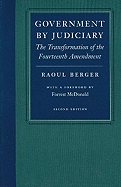
Get the book here
In Providence Bank v. Billings, he stated: “The constitution . . . was not intended to furnish the corrective for every abuse of power which may be committed by the State governments. The interest, wisdom, and justice of the representative body and its relation with its constituents furnish the only security . . . against unwise legislation generally,” echoing Gerry’s rejection of judicial “guardians.” These statements are irreconcilable with the interpretation Hughes put on theM’Culloch dictum. Their significance was summed up by Marshall’s associate, Justice Henry Baldwin, who, after noting Marshall’s “a constitution we are expounding,” went on to say, “no commentator ever followed the text more faithfully, or ever made a commentary more accordant with its strict intention and language.”
The evidence, I submit, calls for an end to the incantatory reliance on Marshall’s “a Constitution . . . to be adapted to the various crises of human affairs.” If the Constitution is to be altered by judicial fiat, let it not be under seal of a reading Marshall himself repudiated.