
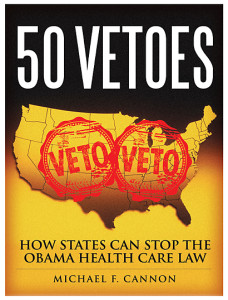
 by Michael F. Cannon, CATO Institute
Despite surviving a number of threats, President Obama’s health care law remains harmful, unstable, and unpopular. It also remains vulnerable to repeal, largely because Congress and the Supreme Court have granted each state the power to veto major provisions of the law before they take effect in 2014.
The Patient Protection and Affordable Care Act (PPACA) itself empowers states to block the employer mandate, to exempt many of their low- and middle-income taxpayers from the individual mandate, and to reduce federal deficit spending, simply by not establishing a health insurance “exchange.” Supporters of the law do not care for this feature, yet they adopted it because they had no choice. The bill would not have become law without it.
To date, 34 states, accounting for roughly two-thirds of the U.S. population, have refused to create Exchanges. Under the statute, this shields employers in those states from a $2,000 per worker tax that will apply in states that are creating Exchanges (e.g., California, Colorado, New York). Those 34 states have exempted at least 8 million residents from taxes as high as $2,085 on families of four earning as little as $24,000. They have also reduced federal deficits by hundreds of billions of dollars.
The Obama administration is nevertheless attempting to tax those employers and individuals, contrary to the plain language of the PPACA and congressional intent, and to deny millions of Americans the opportunity to purchase low-cost, high-deductible coverage.
Employers, consumers, and even state officials in those 34 states can challenge those illegal taxes in court, as Oklahoma has done. States can also block those illegal taxes—and even stop the federal government from operating an Exchange—by approving a strengthened version of the Health Care Freedom Act.
The PPACA’s Medicaid expansion, which would cost individual states up to $53 billion over its first 10 years, is now optional for states, thanks to the Supreme Court’s ruling in NFIB v. Sebelius. Some 16 states have announced they will not expand their programs, while half of the states remain undecided.
Yet the Obama administration is trying to coerce states into implementing parts of the expansion that the Court rendered optional. States can replicate Maine’s lawsuit challenging this arbitrary attempt to limit the Court’s ruling.
Collectively, states can shield all employers and at least 12 million taxpayers from the law’s new taxes, and still reduce federal deficits by $1.7 trillion, simply by refusing to establish Exchanges or expand Medicaid.
Congress and President Obama have already repealed the third new entitlement program the PPACA created—the Community Living Assistance Services and Supports Act, or CLASS Act—as well as funding for the “co-op” plans meant to serve as an alternative to a “public option.”
A critical mass of states exercising their vetoes over Exchanges and the Medicaid expansion can force Congress to reconsider, and hopefully repeal, the rest of this counterproductive law. Real health care reform is impossible until that happens.
Michael F. Cannon is director of health policy studies at the Cato Institute.