
 by Wendy McElroy, Future of Freedom Foundation
With the media obsessing about the fiscal cliff, many people may not have noticed that net American taxes for the next decade just rose by around $1 trillion. That’s the cost of the first phase of the Patient Protection and Affordable Care Act, commonly called Obamacare.
Much of the increase will be borne by the average working person. The watchdog organization Americans for Tax Reform (ATR) describes the impact of just one new tax: a 2.3 percent excise tax imposed on the gross sales of medical-device manufacturers even if those manufacturers are not making a profit. ATR notes, “Medical device manufacturers employ 409,000 people in 12,000 plants across the country.… In addition to killing small business jobs and impacting research and development budgets, this will increase the cost of your health care — making everything from pacemakers to artificial hips more expensive.”
The nationalization of medical care will be a financial and humanitarian disaster. It will further bankrupt America while lowering health care standards and lessening choice. It is designed to squeeze the private sector out of America’s largest industry: health care. But there is a real chance that Obamacare will be stopped in its tracks. Many pin their hopes on the contraception-mandate lawsuits that are making their way to the United States Supreme Court. In these cases, individuals and agencies argue that the requirement for insurance to cover contraceptives and abortifacients violates employers’ freedom of religion.
But there is another hurdle to the implementation of Obamacare.
State-based insurance exchanges — or the lack thereof
The federal government’s method of delivering Obamacare is through health-insurance exchanges. These new institutions are intended to offer individuals and businesses a choice between private health-insurance coverage and a government option, with both forms of insurance conforming with federal policies such as the inclusion of preexisting conditions and contraception coverage.
The states have three alternatives in the formation of exchanges.
(1) They can establish state-based exchanges. With this option, the state assumes all responsibility for operations, from outreach to “customers” to developing the information-technology infrastructure. The deadline to choose this alternative was December 14, 2012. According to theNational Conference of State Legislatures (NSCL), “As of Dec. 20, 2012, 18 [states] total, including District of Columbia submitted blueprints” for such exchanges.
(2) Alternately, the state can establish an exchange in partnership with the federal government. According to the Kaiser Foundation, HHS recognizes the difficulty the exchanges present to some states, so it has provided “for the combined management of exchange functions and for an easier transition to a fully state-based exchange in the future” (PDF).
The fully state-based exchanges are clearly the federal preference and goal. The deadline to choose the transition alternative is February 15, 2013. NSCL states that, “Seven states are planning to pursue a state/federal partnership where they run the consumer assistance and/or plan management function of the exchange.”
(3) Finally, the state can request a federally facilitated exchange. This is also the default position for states that decline participation or do not declare a preference by February 15. The federal government will then take full or overwhelming responsibility for the operation of the exchange within that state. Kaiser explains, “As of the end of November 2012, 17 states had declared they would not create a state-based exchange and will likely [go] to a federally-facilitated exchange.” The remaining 9 states have not yet stated a preference. (Note: some sources give slightly different figures.)
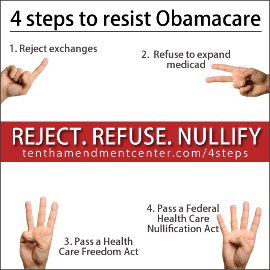
The hope for stopping Obamacare lies with the states that have declined to participate. This is because there is no funding mechanism for the federally facilitated exchanges.
Why most states do not wish to create exchanges
In a November 9 National Review article, Michael F. Cannon of the Cato Institute observed,
State-created exchanges mean higher taxes, fewer jobs, and less protection of religious freedom. States are better off defaulting to a federal exchange.
Heartlander Magazine (Jan. 2) described, for instance, the announcement of Oklahoma Governor Mary Fallin, who emphatically declared that her state “will not create a state-based health insurance exchange.”
Fallin is a Republican, as are the majority in Oklahoma’s legislature. Republicans are almost solidly opposed to Obamacare. Currently, 29 states have Republican governors; 20 have Democrats; and 1 has an independent.
Cannon lists other reasons that will discourage states from creating their own insurance exchanges. The reasons include the fact that “operating an Obamacare exchange would be illegal in 14 states” under their statutes or constitution; taxes would have to increase to meet the estimated $10 to $100 million per year required to operate each exchange; even a state-based exchange would be entirely controlled by federal policy; and, “the Obama administration has yet to provide crucial information that states need before they can make an informed decision.” Moreover, many politicians do not wish to be associated with a program that is unpopular with their constituents.
No wonder New Jersey’s Governor Chris Christie (a Republican) resoundingly declined to set up a state-based exchange. He declared,
I will not ask New Jerseyans to commit today to a state-based exchange when the federal government cannot tell us what it will cost, how that cost compares to other options and how much control they will give the states over this option that comes at the cost of our state’s taxpayers.
Significantly, Congress never authorized payment for federally facilitated exchanges. Obamacare mandates that every state have an exchange, but it does not address how the federal exchanges will be funded. The program seems to have been designed to rely on the state-based or partnership options.
America has a long history of legislated programs faltering due to the lack of a mechanism for actually acquiring funds. For example, the first income tax was introduced through the Revenue Act of 1861 in order to fund the Civil War ventures of the North. But it had no effective collection mechanism. Thus, it was quickly replaced by the Revenue Act of 1862, which spelled out collection enforcement in detail. Then-president Abraham Lincoln could count on the support of a cooperative Congress to pass a second, quick funding bill in order to patch over the holes in the first.
In an August 16, 2011, article entitled “HHS May Have to Get ‘Creative’ on Exchange,” Politicoadmitted,
 While sorting out the policy kinks in setting up a federal exchange, HHS must tackle another problem: There is no money to pay for it.
A quirk in the Affordable Care Act is that while it gives HHS the authority to create a federal exchange for states that don’t set up their own, it doesn’t actually provide any funding to do so. By contrast, the law appropriates essentially unlimited sums for helping states create their own exchanges.
The Obama administration excels at creative fund-raising. In an August 1 article entitled “Obamacare Robs Medicare of $716 Billion to Fund Itself,” the Heritage Foundation explained that Medicare funds are being channeled into the new health care structure.
But if enough states opt for the massively expensive federally facilitated exchanges, then Obama may have to go back to Congress, hat in hand. With Republicans dominating the current House, he will not receive the Lincoln treatment.
If this happy exigency comes to pass, then the ideal outcome would be an outright rejection of the Patient Protection and Affordable Care Act by a refusal to fund it. A more likely yet still hopeful scenario is the elimination of some of the act’s worst aspects. In either case, it would be a good time for a hostile House to shine.