
 Someone on my Facebook page (which I hope you will like) sent me a document drafted by a small group in Wisconsin (the Wisconsin GrandSons of Liberty [WGL]) that strongly opposes nullification — the Jeffersonian idea that the states must, according to the very logic of the Union, have the power to prevent the enforcement of unconstitutional federal laws within their borders.
The group’s statement is wrong in nearly every sentence, so for pedagogical purposes I have decided to examine it closely.
Here are some of those sentences, along with my commentary and corrections.
First, let us start by being clear as to what nullification is…and how it is viewed by the legal community.
The “legal community” was trained in American law schools, which if anything are worse than American universities as a whole in terms of promoting a particular point of view (in this case, Hamiltonian/Marshallian nationalism) and pretending no others exist. A Tea Party organization should want to challenge the “legal community,” not meekly sit at its feet, cross-legged, awaiting instruction.
It [nullification] is a state’s refusal to comply with a specific federal law, which that state considers to be unconstitutional, to the extent of breaking the federal compact (our federal Constitution, although not referred to here in the sense of legal “compact theory”), in the form specifically of the Supremacy Clause of our Constitution which states that the Constitution trumps all other laws, especially that of the individual states.
So according to the WGL, a nullifying state is breaking the federal compact and ought to be singled out for condemnation, but the possibility that the passage of an unconstitutional law by the federal government might break it is so trivial as not to be worth mentioning. Very strange priorities for a “limited-government” outfit, don’t you think?
The WGL gives us a slight improvement on the Official Law School Version of the Supremacy Clause. “The Constitution” trumps state laws. (This is better than the usual Official Law School Version, which says, “Federal law trumps state law.”) That’s true as far as it goes, but it’s irrelevant to nullification. A nullifying state is claiming that a particular law violates the Constitution. It begs the question to reply by saying the Constitution trumps all. That is precisely why the state is nullifying the law in the first place — to vindicate the Constitution against an unconstitutional law.
For what the Framers actually meant by the Supremacy Clause, see my article Nullification: Answering the Objections, and Brion McClanahan’s recent book The Founding Fathers Guide to the Constitution. But it obviously did not mean that any old law the federal government might pass was on par with “the Constitution” and therefore “supreme.” No one in his right mind would have ratified the Constitution under that understanding.
It is based on a theory originally proposed in the Kentucky Resolutions of 1798 and 1799 authored by Thomas Jefferson and the Virginia Resolutions of 1798 authored by James Madison and later cited and advanced by John C. Calhoun. The Resolutions were published ANONYMOUSLY for good reason – namely the possibility of the Resolutions being called treasonous and due to the government positions of Jefferson and Madison at the time of writing.
The idea of nullification actually extends back to Virginia’s state ratifying convention of 1788, as Kevin Gutzman has shown and as I note in my book Nullification. The Tea Party seems to cheer the possibility that the Virginia and Kentucky Resolutions might have been regarded as treasonous. The correct response to the possibility that the authors of these documents — which simply sum up the obviously correct compact theory of the Union — might have been hanged is horror, not delight.
These Resolutions were rejected by every one of the other states. Every state immediately realized that these resolves were a rejection of the Constitution and threatened the integrity of the Constitution and the cohesion of the nation.
This is not true. I count seven states that issued statements against the Virginia and Kentucky Resolutions. We are supposed to believe that these states were just so concerned that the “integrity of the Constitution and the cohesion of the nation” was threatened by the power of the states to protect themselves against unconstitutional laws.
In fact, however, six of those seven states explicitly declared the Alien and Sedition Acts to be perfectly constitutional. These states supported the idea that journalists ought to be thrown in jail for criticizing John Adams. The WGL left that part out. No wonder those states opposed the Virginia and Kentucky Resolutions!
Also left out by the WGL is that within less than ten years, some of these very states were themselves defending the Principles of ’98, as the ideas of the Virginia and Kentucky Resolutions became known. In 1820, the legislature of Ohio overwhelmingly approved a resolution noting that the great majority of Americans shared these views — views, one might add, which swept Thomas Jefferson into the presidency in 1800.
At the time, political leaders stated that the damage of the Resolutions was “deep and lasting, and was a recipe for disunion.”
But the damage of the Alien and Sedition Acts was so trivial as not to be worth mentioning? Again, what kind of priorities are these?
At the time of the Resolutions’ writing, there was no recognized “power of a state to reject unconstitutional federal law” and there is none now; contrary to the flyer’s statement otherwise. The flyer claims that nullification is “implied in the Constitution” but does not say where the implication is written although we surmise that the author of the flyer will say that such power is to be found in the 10th Amendment. If one cannot undertake to lay a finger on that article of the Constitution that is the unquestionable source of such a “constitutional power” then one must conclude that it does not exist.
Let’s start with the last sentence first. The WGL evidently thinks the states have only the powers expressly granted them in the Constitution. A more grotesque misunderstanding of the Constitution can hardly be imagined. The federal government has only the powers mentioned in the Constitution. The states and the people hold the remainder — in other words, all the powers not mentioned. To claim that the states do not possess the power of nullification because it is not mentioned is to misunderstand the Constitution entirely. Indeed the WGL has the Constitution exactly reversed.
The WGL is also incorrect to say no power to resist unconstitutional laws was recognized. We are to look to the ratifying conventions for the meaning of the Constitution, said Madison, and Virginia’s ratifying convention was perfectly clear that the states held such a power.
Federalist supporters of the Constitution at the Virginia ratifying convention assured Virginians that they would be “exonerated” should the federal government attempt to impose “any supplementary condition” upon them – in other words, if it tried to exercise a power over and above the ones the states had delegated to it. Virginians were given this interpretation of the Constitution by members of the five-man commission that was to draft Virginia’s ratification instrument. Patrick Henry, John Taylor, and later Thomas Jefferson himself elaborated on these safeguards that Virginians had been assured of at their ratifying convention.
The Kentucky Resolution of 1799 declared that Kentucky “will bow to the laws of the Union” but would continue “to oppose in a constitutional manner” the Alien and Sedition Acts. The Virginia Resolution did not use either the word or the concept of nullification. It used interposition which is an entirely different concept from nullification. Like nullification, interposition has also been repudiated by the Supreme Court of the United States (SCOTUS).
Since Kentucky believed that nullification was a constitutional manner of resisting unconstitutional laws, I do not see the WGL’s point here. The further claim that the Virginia Resolutions in no way envisioned nullification cannot be taken seriously. A glance at the Virginia General Assembly debates over the Resolutions makes this clear. Kevin Gutzman, themost recent biographer of James Madison, likewise doesn’t buy it, finding no essential difference between the language of the resolutions of Virginia and Kentucky. (See Kevin R. Gutzman, “A Troublesome Legacy: James Madison and ‘The Principles of ’98,’” Journal of the Early Republic 15 [1995]: 569-89.) Judge Abel Upshur, in his 1833 pamphlet An Exposition of the Virginia Resolutions of 1798, systematically refuted the claim that the Virginia Resolutions were calling for anything other than nullification. (Upshur’s work is reprinted in my Nullification.)
The WGL then claims Daniel Webster refuted the idea of nullification in the Webster-Hayne debates. If I say Hayne in turn successfully refuted Webster, which he indeed did, what have we thereby resolved? Like the Left it is supposed to oppose, the WGL is evidently committed to the nationalist view of the Union that the Jeffersonians correctly and heroically resisted for generations.
The flyer quotes Jefferson and Madison in support of the idea of nullification but uses earlier 1790s era citations rather than quotations from later in their lives when they recanted against [sic] the nullification concept. During the Nullification Crisis of 1832-33, Madison rejected South Carolina’s thesis stating that those who were leading the move to nullify and using his words from the Resolutions had misinterpreted his statements. He denounced nullification as a “colossal heresy”, a “specious doctrine”, “a more fatal inlet to anarchy cannot be imagined” and called it a “deadly poison”.
Jefferson never recanted his views on nullification, since they followed naturally from the compact theory of the Union. As for Madison, the WGL never explains why his protestations over three decades later are to be preferred to his statements at the time. The WGL even cites Kevin Gutzman on Madison, evidently without realizing that Gutzman’s argument is that Madison’s later protests are feeble and incoherent. As Gutzman put it, “One of Madison’s most notable ‘tactical adjustments was his campaign, as a retired former president, to becloud the events of 1798 by denying they had meant what they plainly had meant.”
Madison’s claim that he had never intended to propose nullification is very difficult to credit. That is certainly how other state legislators understood his words at the time. Indeed, Madison’s frequent change of positions throughout his career was well known. As Albert Taylor Bledsoe put it, “The truth seems to be, that Mr. Madison was more solicitous to preserve the integrity of the Union, than the coherency of his own thoughts.”
Madison even tried denying that Jefferson had included the word “nullification” in his draft of the Kentucky Resolutions of 1798, an assertion he knew was false since he had seen the draft himself. When a copy of the original Kentucky Resolutions in Jefferson’s own handwriting turned up, Madison had to withdraw that claim.
When Madison tried to weasel out of his position three decades later, placing a weak and inoffensive gloss on his original words, people asked: if that was all you meant, why even bother drafting such an inane resolution in the first place? And for heaven’s sake, when numerous states disputed your position, why in the Report of 1800 did you not only not clarify yourself, but you actually persisted in the very view you now deny and which everyone attributed to you at the time?
The WGL then says the Supreme Court has rejected the reasoning on which nullification is based, citing such cases as Ableman v. Booth (in which the Court said the states couldn’t resist the Fugitive Slave Act — nice example there!) and the obscure obiter dicta of Cooper v. Aaron. In this latter case, the Supreme Court expressly declared its statements to have exactly the same status as the text of the Constitution itself. But no matter what absurd claims the Court makes for itself, Madison’s point in his Report of 1800 holds – the very structure of the system, and the very nature of the federal Union, logically require that the principals to the compact possess a power to examine the constitutionality of federal laws. Given that the whole argument involves who must decide such questions in the last resort, citing the Supreme Court against it begs the whole question – indeed, it should make us wonder if those who answer this way even understand the question.
Here’s how Madison replied to the judicial supremacists, in a passage the WGL evidently overlooked:
The resolution of the General Assembly [the Virginia Resolutions of 1798] relates to those great and extraordinary cases, in which all the forms of the Constitution may prove ineffectual against infractions dangerous to the essential rights of the parties to it. The resolution supposes that dangerous powers, not delegated, may not only be usurped and executed by the other departments, but that the judicial department also may exercise or sanction dangerous powers beyond the grant of the Constitution; and, consequently, that the ultimate right of the parties to the Constitution, to judge whether the compact has been dangerously violated, must extend to violations by one delegated authority, as well as by another; by the judiciary, as well as by the executive, or the legislature.
However true, therefore, it may be, that the judicial department, is, in all questions submitted to it by the forms of the Constitution, to decide in the last resort, this resort must necessarily be deemed the last in relation to the authorities of the other departments of the government; not in relation to the rights of the parties to the constitutional compact, from which the judicial as well as the other departments hold their delegated trusts. On any other hypothesis, the delegation of judicial power would annul the authority delegating it; and the concurrence of this department with the others in usurped powers, might subvert for ever, and beyond the possible reach of any rightful remedy, the very Constitution which all were instituted to preserve.
The WGL goes on to explain why we have a Supreme Court:
so that there is one consistent authority and not numerous and competing, conflicting authorities.
Of course, the flourishing of “competing, conflicting authorities” happens to be how liberty came to Western civilization.
One way to get rid of “competing, conflicting authorities” would be to have a world government. On what grounds could the WGL object to such a thing? Wouldn’t it be a lot more efficient, with much less possibility for conflict and confusion?
Nullification is the political “n-word” and is treated as such. Those that use it are dismissed as kooks, crack-pots, malcontents and dismissed out of hand as radical extremists and constitutionally uneducated.
By this point it should be obvious who the constitutionally uneducated are, and it isn’t the supporters of nullification. Anyone who promotes the truth about U.S. history, the Constitution, the economy, and just about anything else will be condemned by our so-called intellectual class as a crackpot. Any truth-teller is going to be called names. That is not a good reason for being a coward instead, and meekly playing by rules designed by your enemies.
So how does the WGL intend to hold back the federal government? See if you can follow this passage:
There is another, fourth option, a more obstructionist strategy of simply refusing to make a choice and “just say ‘no’” without stipulating what the state shall do in response to the federal government. Leave it open ended and “remove the consent of the governed” by reverting to citing the unconstitutionality of the PPACA through pointing to the error in the SCOTUS ruling – the SCOTUS has erred many times in the past so this is no surprise to anyone – think Dred Scott v. Sanford. We are advocating this precise stand. There are enough SCOTUS rulings that work in the states’ favor to refuse assent and cooperation with the federal mandates. See NY v. US (1992) and Printz v. US (1997) for more detail.
I have no idea what that means.
Imagine the chaos if nullification was successful; everything would be contested by the states and the federal government would now be even less effective than it was under the Articles of Confederation.
For the WGL — which supports “limited government,” remember — the real danger is that the federal government keeps passing all these wonderful laws, and there’s a chance some states might miss out on some of these great laws if they nullified them.
So the WGL can look at the U.S. government as it exists at present — shot through with injustice, expropriation of the public in countless forms, contempt for the Constitution, and so on — and conclude that the real danger is that it might be stripped of some of its authority and be less able to achieve its aims. Why, whatever would we do if some of the states decided the federal government might not have these powers after all? Chaos!
But as Upshur noted in 1833, is it not also a kind of chaos for the federal government to act without restraint? Why do those who shout “chaos” when a sliver of the public considers nullifying one federal act fall silent when it comes to the gazillions of unconstitutional measures taken by the federal government?
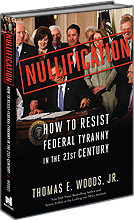
Get the Book!
Also, wouldn’t an organization that claims — I am tempted at this point to say pretends — to favor limited government be of the opinion that the vast bulk of federal laws passed today are unconstitutional? And if so, so what if the states nullify a bunch of them? So we’d be that much closer to a free society in some parts of the country — and this is something to deplore?
In short, the position of the WGL appears to be as follows: we must not adopt any position that might cause us to be called names by respectable people. We must adopt all the fundamental assumptions of the regime. We must assume that the Marshall Court’s cases were all decided correctly. We must assume that the nationalist theory of the Union is correct, even though it is contradicted by the most basic facts of U.S. history. We must not try to change the minds of our fellow citizens to get them to think in new and forgotten ways. We must accept judicial supremacy. We must do nothing unconventional. We must, in short, stick to the same strategies that have yielded the “conservative movement” precisely zero victories over the past hundred years.
Maybe it isn’t the nullifiers, after all, who are being unreasonable.
[Don’t let this happen to you. Pick up a copy of Nullification. And learn U.S. history from Kevin Gutzman, Brion McClanahan, and me.]

Copyright © Tom Woods
- The Great Gold Robbery of 1933 - April 5, 2020
- The Two Paragraphs the So-Called Legal Experts are Keeping from You - November 19, 2018
- The Constitution and War Powers: Not a Presidential Dictatorship - April 9, 2018