
These days there has been a lot of talk of nullification – the refusal of a state to allow the enforcement within its borders of an unconstitutional federal law – and even secession. This is not allowed in the United States. We are supposed to let the New York Times dictate the terms of the national debate, and the Times has not indicated that these topics are on the table for discussion.
What kind of national health program we ought to have, how much the political class should expropriate us, or whether that foreign country ought to be bombed right away or starved to death first – this is how the Times prefers it. The debate is framed from the establishment’s point of view, and no matter how it comes out, the vested interests and the status quo prevail.
Then there are the conservatives and libertarians who likewise take their lead from the Times. Why, that issue you are raising must be “crazy” – after all, I don’t see Newsweek or the New York Times talking about it. Not even Rush Limbaugh, that bold ideological risk-taker, discusses your ideas, citizen! Are you sure you still want to advance them?
And so there you have the glorious American political spectrum – all 3.7 inches. What we laughingly call the “limited government” side of the American political debate plays by the rules of the pro-government party, so much so that when the chips are down one can hardly tell them apart. When it comes to people who want to raise truly fundamental questions, the two official sides can’t kiss and make up fast enough.
Secession is especially unthinkable. You might think the size of the political unit called the United States would be a practical question, not a matter of religious mysticism. But mention secession, or the possibility that the existing apparatus may be so big as to be dysfunctional even by government standards – propositions that are obviously within the realm of possibility – and you are treated like a heretic, if not a lunatic. Why, 103,671,742,065,706 square feet is the heaven-sent size of the United States, and not one square inch less! And anyway, they assure us, secession wouldn’t solve anything.
Wouldn’t it? Here’s just one thing. If the United States devolved into several smaller units, would they all have a Jacobin foreign policy in the Middle East? Would they all have made the disastrous decision to enter World War I? These are interesting possibilities, yet we are not even allowed to consider them. Stick to the 3.7 inches, citizen.
So the same kind of article you might read criticizing (for example) nullification or secession in Human Events or WorldNetDaily might just as easily be found in the New Republic. The two sides can’t kiss and make up fast enough.
Case in point: this article by Jarrett Stepman in Human Events, the “national conservative weekly.” Now I myself have been published in Human Events now and again, so that publication is at least willing to consider dissenting voices – which is more than we can say for the Weekly Standard or National Review, for instance.
Although there is a great temptation for conservatives, in light of the most recent election, to attempt to nullify federal laws and even abandon the union, it must be noted that those actions are unproductive, unconstitutional, have led to the destruction of two national political parties and one bloody civil war. There are far better options on the table, and more legal ways for citizens to resist the power of the federal government, ones that will not easily feed into negative media narratives about the conservative movement.Here’s where the article gets fun:
Straying from the rules laid down by the New York Times would be “unproductive,” says Stepman. Compared to what? All those gains the official conservative movement has made over the past 100 years?Great Conservative Gains could be one of those gag books full of blank pages.
“Unconstitutional”? Stepman doesn’t even bother defending that one. I’ve been over this quite a bit in the past, so here’s the reader’s digest version.
First, nullification. The mere fact that a state’s reserved right to obstruct the enforcement of an unconstitutional law is not expressly stated in the Constitution does not mean the right does not exist. To expect such a thing is to misunderstand the structure and function of the Constitution. The Constitution is supposed to establish a federal government of enumerated powers, with the remainder reserved to the states or the people. Essentially nothing the states do is authorized in the federal Constitution, since enumerating the states’ powers is not the purpose and is alien to the structure of that document.
James Madison urged that the true meaning of the Constitution was to be found in the state ratifying conventions, for it was there that the people, assembled in convention, were instructed with regard to what the new document meant. Jefferson spoke likewise: should you wish to know the meaning of the Constitution, consult the words of its friends.
Nullification derives from the (surely correct) “compact theory” of the Union, to which no full-fledged alternative appears to have been offered until as late as the 1830s. That compact theory, in turn, derives from and implies the following:Federalist supporters of the Constitution at the Virginia ratifying convention of 1788 assured Virginians that they would be “exonerated” should the federal government attempt to impose “any supplementary condition” upon them – in other words, if it tried to exercise a power over and above the ones the states had delegated to it. Virginians were given this interpretation of the Constitution by members of the five-man commission that was to draft Virginia’s ratification instrument. Patrick Henry, John Taylor, and later Jefferson himself elaborated on these safeguards that Virginians had been assured of at their ratifying convention.
1) The states preceded the Union. The Declaration of Independence speaks of “free and independent states” that “have full power to levy war, conclude peace, contract alliances, establish commerce, and to do all other acts and things which independent states may of right do.” The British acknowledged the independence not of a single blob, but of a group of states, which they proceeded to list one by one. Article II of the Articles of Confederation says the states “retain their sovereignty, freedom, and independence”; they must have enjoyed that sovereignty in the past in order for them to “retain” it in 1781 when the Articles were officially adopted. The ratification of the Constitution was accomplished not by a single, national vote, but by the individual ratifications of the various states, each assembled in convention.
2) In the American system no government is sovereign, not the federal government and not the states. The peoples of the states are the sovereigns. It is they who apportion powers between themselves, their state governments, and the federal government. In doing so they are not impairing their sovereignty in any way. To the contrary, they are exercising it.
3) Since the peoples of the states are the sovereigns, then when the federal government exercises a power of dubious constitutionality on a matter of great importance, it is they themselves who are the proper disputants, as they review whether their agent was intended to hold such a power. No other arrangement makes sense. No one asks his agent whether the agent has or should have such-and-such power. In other words, the very nature of sovereignty, and of the American system itself, is such that the sovereigns must retain the power to restrain the agent they themselves created. James Madison explains this point in the famous Virginia Report of 1800:
Given these facts, secession is equally allowable, since this principle too can appeal to the original sovereignty of the peoples of the states. What’s more, since no power to prevent secession was ever delegated to Congress, and since secession is not prohibited to the states, it remains a reserved right of the states under the Tenth Amendment.The resolution [of 1798] of the General Assembly [of Virginia] relates to those great and extraordinary cases, in which all the forms of the Constitution may prove ineffectual against infractions dangerous to the essential right of the parties to it. The resolution supposes that dangerous powers not delegated, may not only be usurped and executed by the other departments, but that the Judicial Department also may exercise or sanction dangerous powers beyond the grant of the Constitution; and consequently that the ultimate right of the parties to the Constitution, to judge whether the compact has been dangerously violated, must extend to violations by one delegated authority, as well as by another, by the judiciary, as well as by the executive, or the legislature.
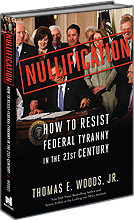
Get the Book!
(The entirety of chapter four of my book Nullification is dedicated to demonstrating that the compact theory of the Union is correct; this is not so difficult a task, since all the evidence is on its side, but it is information no one learns in school.)
Meanwhile, Stepman never actually offers an argument showing us that nullification and secession are unconstitutional. He quotes a few people who opposed it. He seems to think a few quotations add up to an argument. There is no argument in his article, anywhere.
And who is Jarrett Stepman, exactly? Apart from being a writer for Human Events, which we already knew, his bio tells us only that young Jarrett “is a graduate of UC Davis, where he studied Political Science.”
Jarrett was a good student, it would seem. No unapproved thoughts entered that head of his. The state structure approved of by all the moderns and all his professors, he approves of as well.
Stepman lazily and without imagination simply accepts the logic of the modern state, according to which society must be organized with a single, irresistible authority at the center. The idea that constituent parts could have prior liberties of their own that they might assert against the center is anathema not just to Stepman but to Hillary Clinton, Barack Obama, Mitt Romney, and (with a few noble exceptions) the whole slate of modern political philosophers from Thomas Hobbes to Karl Marx. Stepman, like these thinkers, simply takes the unity and indivisibility of the state for granted. They and their horrific “one and indivisible” nonsense, meanwhile, gave birth to the single most destructive institution in human history, with the twentieth century as an especially grisly Exhibit A.
If we dare to entertain the possibility that there may be models for organizing society other than the Hobbesian one in which all power originates from the center, and the periphery has only those rights the center graciously grants – why, we must be enemies of “America” and the “conservative movement.” Well, if by “America” you mean a centralized imperium whose government operates without real limits, and if by the “conservative movement” you mean a group of careerists who get rich by sending out fundraising letters promising “limited government,” then yes, we are indeed enemies of those things.Unknown to Stepman is the humane, Althusian alternative to the modern state. (So as not to give poor Jarrett a heart attack, I withhold from discussion the radical Rothbardian alternative.) I discuss Althusian decentralism here. No, Stepman reflexively takes the central idea of modern Western political thought, shared by all major thinkers, makes it his own, and persuades himself that he’s cheeky and original, a real fighter against the establishment. He is in fact as conventional as they come.
The doctrines of nullification and secession led to a bloody civil war, Stepman tells us. Again, our author’s inability to entertain a thought other than what he read in some textbook somewhere impairs his reasoning. The idea of decentralism did not lead to a bloody civil war. The doctrine of centralization, the un-American doctrine of the one-and-indivisible Union – the doctrine, in other words, of the modern state – led to a bloody civil war. So blinded is Stepman by his unthinking acceptance of the premises of modern political thought that he cannot even perceive the most obvious facts.
Note well: the secession of the Soviet republics did not lead to a bloody civil war. The secession of Slovenia did not lead to a bloody civil war. The secession of Norway from Sweden did not lead to a bloody civil war. There is nothing about secession in and of itself that need involve violence, as long as we are dealing with civilized people who understand that the best way to deal with political downsizing might not be to slaughter the people involved.
Stepman goes on to note that the Virginia and Kentucky Resolutions of 1798, which spelled out the doctrine of nullification (Stepman doesn’t mention the Richmond ratification convention of 1788), were “outright rejected by ten states, unmentioned by four others and met with suspicion in Virginia of all places.”
Now why do you suppose Stepman doesn’t mention that little tidbit? Why do you suppose he won’t tell you that the people he’s citing for his case cheered the imprisonment of newspaper editors? Either he doesn’t know this, which I strongly suspect, or he doesn’t want you to know.I wish Stepman had at least bothered to read my book. Of the states that disapproved of the Virginia and Kentucky Resolutions, all but one of them objected because they approved of the Sedition Act and incarcerating critics of John Adams, and they didn’t want states to be able to protect their citizens against these outrages.
As for Virginia itself, Stepman couldn’t have read the discussion in the Virginia General Assembly over the Virginia Resolutions of 1798, or he would have discovered that whatever alleged “suspicion” of nullification in Virginia he remembers reading about somewhere did not in fact exist. The only real point of contention was over the phrase “unconstitutional, and not law, but utterly null, void, and of no force or effect” to describe the Alien and Sedition Acts. John Taylor believed the words following “unconstitutional” were superfluous, since everyone knew that an unconstitutional law was no law, and obviously void and of no force or effect. That was the big debate.
And before ten years had passed, the northern states themselves – the ones who were so outraged over nullification in 1798 – were appealing to what became known as the Principles of ’98. Actions speak louder than words.
Then we get the “James Madison was opposed to nullification” line. I deal with this on pages 288-290 of Nullification. Madison’s most recent biographer, Kevin Gutzman (James Madison and the Making of America, St. Martin’s, 2012), isn’t buying it, either. My reply is already running long, so on the Madison issue I refer the curious reader to these replies to objections I drafted nearly two years ago now. They have never been answered.
But Jarrett, the federal government says it can force an individual to participate in the healthcare system, etc. Wouldn’t your proposed method of resistance be like nullifying the federal law?Finally, Stepman assures us there are lots of things we can do to fight against the federal government other than nullifying federal laws. Why, we can just, er, nullify federal laws! Stepman writes, “One way that states are resisting ObamaCare is through the Health Care Freedom Act, which has already been passed in many states. The law states that no government entity can force an individual to participate in the healthcare system or stop an individual from purchasing treatment.”
Stepman closes with this: “If my arguments aren’t convincing enough that nullification and secession are dangerous to the conservative movement and the country, then I will leave you with an excerpt from the end of Sen. Daniel Webster’s debate with Sen. Robert Hayne at the height of the nullification crisis.”
Now let’s be sports and leave aside the uncomfortable truth that at the time, Webster was considered the clear loser in the Webster-Hayne debate, whether we consider the reaction of the rest of the Senate, the press, or the public at large. Forget about that. Just click through and look at the quotation from Webster that Stepman chooses to end his article.
Stepman tells us that if he hasn’t convinced us of the dangers of nullification and secession, this quotation from Webster should do the trick. But the quotation he chooses isn’t even an argument! It’s just some rhetorical flourish by an orator. See if you can find an argument in it. There isn’t one.
In short, we are supposed to quit all this crazy Thomas Jefferson talk and get back to the task at hand: being losers who follow the same failed playbook the New York Times has been foisting on us for more than 100 years.
Some of us have higher ambitions than that.

Copyright © Tom Woods
- The Great Gold Robbery of 1933 - April 5, 2020
- The Two Paragraphs the So-Called Legal Experts are Keeping from You - November 19, 2018
- The Constitution and War Powers: Not a Presidential Dictatorship - April 9, 2018