
Writing for Hot Air’s Green Room last week, Patrick Ishmael declared that nullification was unconstitutional and cited a number of columns from organizations such as The Heartlander and The Heritage Foundation as proof. Ishmael’s post was mostly a continuation of a discussion, as he calls it, between him and David Roland, of the Freedom Center of Missouri, regarding a bill in the Missouri house to nullify the Affordable Care Act (Obama care). You can view that exchange here.
It appears that Ishmael’s arguments stem either from a poor understanding of history and political science, or serves as a defense of the centralized state. It’s my attempt here to set the record straight on the history of nullification, its uses, and defend the states and the people from the damaging effects of federal overreach and those who would aid it.
In The Heartlander piece Ishmael is quoted by the author and had this to say regarding the Missouri house bill: “This approach is toxic. There are better ways of trying to mitigate the problems inherent in the law than going this route.” In the same piece, Matthew Spalding, who is the vice president of American studies at the Heritage Foundation, says rather than states nullifying unconstitutional laws, they should look to the Supreme Court or throw bums out. If that doesn’t do the trick, then the states should call for a convention.
I’ve already explained why pleading with politically well-connected lawyers is a fool’s errand, and it’s well-established that more bums always replace the last ones thrown out, so these two options are really just dead ends. And his last suggestion, that an Article V convention is somehow going to do the trick, is pure fantasy. As I’ve noted previously, these mythical conventions have never resulted in a single unconstitutional act being repealed, and even on the remote chance one were to be used against the Affordable Care Act, what guarantee do we have that it too won’t be ignored by the gang on Capitol Hill? Remember, the very reason for overturning “Obama care” isn’t just because it’s bad healthcare policy or politically unpopular; it’s a breach of the Tenth Amendment and was passed under dubious circumstances, to boot.
Later in his own post Ishmael writes that “President Andrew Jackson, a staunch and boisterous defender of states’ rights, rejected nullification as a right reserved for the states.” Well of course Andrew Jackson would oppose nullification as president; the states were using it against him! Citing Jackson in such a way during a nullification argument is like saying Al Gore doesn’t support the Electoral College because he lost, therefore it should be abolished. The fact that a politician is restricted by a policy, or that a government finds certain restrictions inconvenient only legitimizes those acts further, because they must be effective at limiting centralized power.
A good way to judge how effective a movement or policy will be is by listening to how loudly the establishment wails over its use. You’ll know you’re on to something important when they tell you that it’s “toxic,” “harmful,” or that history isn’t on your side, as Ishmael does. And you’ll know you’ve struck a nerve when they throw out red herrings like the Supremes or constitutional conventions. Rest assured that whatever the establishment recommends won’t be an effective tool in reversing course.
Spalding explained that nothing in the Constitution allows state legislatures to interfere with federal law, citing the constitution’s supremacy clause. Of course this is true, and advocates of nullification don’t dispute this claim. But we aren’t just discussing a federal law; we’re talking about an unconstitutional law, which is by definition, not a law at all. The supremacy clause, if one happens to read it in full, makes specific reference to federal laws pursuant to the constitution, not just “laws” that power-hungry legislatures pass and servile justices rubber stamp.
Thomas Jefferson wrote in the Kentucky Resolutions that “whensoever the [federal] government assumes undelegated powers, its acts are unauthoritative, void, and of no force…” But you would never have known this by reading Ishmael’s piece, since Jefferson’s contributions are ignored entirely. He gives plenty of attention to James Madison, though and says that Madison didn’t advocate nullification in the Virginia Resolutions. Anyone who’s read them knows this.
The reason Madison’s contribution is significant is because it reinforces the concept of states deciding the constitutionality of laws, which is clearly done in the resolution. Remember, it wasn’t until five years later, in 1803, that Marbury v. Madison established “judicial review,” and further entrenched the Supreme Court’s power. But more important than that is the concept of interposition, which Madison introduces. This is why the two resolutions are described as the principles of 1798, since it was nullification and interposition that were introduced to the American lexicon. Arguing that nullification isn’t lawful because Madison didn’t promote it explicitly in the Virginia Resolutions is not much different than arguing gays in New York aren’t allowed to marry because New Mexico doesn’t recognize same-sex marriage. The resolutions were drafted by separate authors, covered different but related topics, and were passed by independent legislatures.
It should also be noted that James Madison is widely understood among historians to be a flip-flopper, in modern terms. Needless to say it’s always wise to consider this when interpreting his writings.
The Heritage Foundation is at least honest enough to mention Jefferson in its “fact sheet,” but only to try and persuade readers that he “[rejected] nullification.” They admit that his Kentucky Resolutions of 1798 refer specifically to nullification, but point out the version passed by the Kentucky legislature didn’t contain the specific term “nullification,” as if that spirit were absent the final document. They attempt to muddy the waters by conflating the resolutions of 1798 with those of 1799, which were a follow up to the original declaration, and whose author is not conclusively known anyway.
Heritage goes on to suggest that the resolutions of 1799 were nothing more than a “solemn protest,” but that protest included some pretty tough language. To wit: “…the several states […] being sovereign and independent, have the unquestionable right to judge [the constitution]; and that a nullification, by those sovereignties, of all unauthorized acts done under colour (sic) of that instrument, is the rightful remedy.”
Under the heading of “The Constitutional Path” Heritage draws attention to Madison’s doctrine of interposition, which is a bit ironic, given that such a concept is generally viewed as being more radical than nullification. It’s one thing to refuse to abide a certain act, it’s an entirely different thing to intervene and prevent that act from being carried out. To temper such ideas Heritage defines what activities represent interposition, and they suggest states can “arouse public opposition, challenge federal actions, and ultimately change or stop the objectionable action.”
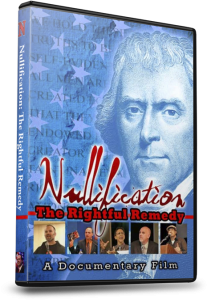
Get the Documentary Today!
Of course interposition was never defined under those specific terms, and throughout American history states have used interposition in a number of ways. The people of Wisconsin, with assistance from a judge and a sheriff, went so far as to break into the Racine County jail to free a kidnapped former slave and arrest two federal Marshalls and the man who claimed to be his “owner.”
Finally, Ishmael writes that: “There is no ‘secret’ or ‘forgotten’ history here.” And, “There is no provision in the Constitution for states to ‘nullify’ a federal law, and I hope the liberty-minded will decline to try and breathe life into such an interpretation.” Well clearly there is some forgotten history here, unless Ishmael is simply obfuscating the record.
Proponents never claim that state nullification is a power found in the constitution; it’s not. Nullification came about as a response to additional powers not found in the constitution being usurped by the federal government. When the supposed confines of the constitution are abandoned by the feds, it makes little sense for states to worry about what is in the constitution and what is not, since clearly the document has been nullified already. At such a point the states must seek a “rightful remedy;” nullification and interposition are just that.

- Some Clarification on ‘Integrity’ - August 14, 2013
- Copperhead: A Tenther Film Review - July 19, 2013
- Edward Snowden: Nullifier - June 25, 2013