
No one doubts that our understanding of historical figures may need to be revisited from time to time. But academic specialists have been known to overreach. To portray a historical figure in a light exactly opposed to the popular impression and to how all other scholars have viewed him is far more exciting than repeating the boring conventional wisdom. And if you can contrive a case that an admired statesman from history actually supported your own views after all, all the better.
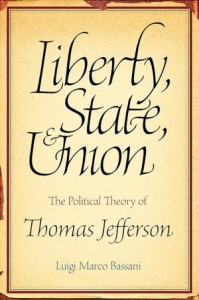
Poor Thomas Jefferson has suffered this kind of treatment at the hands of countless historians, and Marco Bassani, a scholar of the history of political thought, will have none of it. Bassani, an American-born professor teaching at the University of Milan, takes ruthless aim at what has been called the “scholars’ Jefferson,” who bears scant resemblance to the classical liberal figure of the popular mind. Jefferson is one of those cases in which — in terms of his views on property, states’ rights, the Union, political majorities, and the Constitution — the earlier, conventional view was in fact the correct one. Bassani’s wide-ranging knowledge of Jefferson scholarship serves him well in Liberty, State, & Union, as he carefully describes and then refutes the competing schools of thought.
He begins with the controversy over “republicanism” and “liberalism” that erupted among historians of early America in the latter half of the 20th century. The “republican” consensus that developed sought to downplay, and even to dismiss altogether, the role of classical liberalism in the tradition of John Locke from the formative influences of the revolutionary generation. In its place they substituted an ideology called “republicanism.”
In colloquial usage, “republican” might be used to describe those who merely support a republican form of government, but that is not what the republican school had in mind. The republicanism those historians postulated was a full-fledged counter-philosophy that was said to describe the thinking of the revolutionary generation more faithfully than the limited-government classical liberalism everyone had thought to be at the center of early American thought. Republicanism, so formulated, placed the locus of true liberty and fulfillment not in the individual, private pursuit of one’s ends, but in active participation in the res publica. The strict limitation of government power to the protection of person and property is not the central concern of the “republican” as it is of the classical liberal.
Bassani traces the path by which this interpretation of the revolutionary generation grew to the point that it came to dominate the profession, eclipsing rival versions of the revolutionary outlook and excluding Locke and natural law altogether.
The new consensus, in turn, tried to force the square peg of Thomas Jefferson into the round hole of “republicanism.” Jefferson, it turned out, was no classical liberal after all; he, too, was a “republican.” J.G.A. Pocock, the founder of the republican school, even tried to portray the Declaration of Independence as a document devoid of Lockean influences. Hannah Arendt, who anticipated many of the themes of the republican school, referred to the ward system that Jefferson spelled out in 1816 (in which most decisions would be made at the level of the ward, a part of a city) as evidence that he considered civic participation to be the highest source of human fulfillment. “The basic assumption of the ward system,” she argued, “whether Jefferson knew it or not[!], was that no one could be called happy without his share in public happiness, that no one could be called free without his experience in public freedom, and that no one could be called either happy or free without participating, and having a share in, public power.”
Forcing Jefferson of all people into this mold is no easy task, and all such efforts have been ludicrously strained. His political thought is certainly not centered on “republicanism,” as understood by those historians. To the contrary, observes Bassani, Jefferson “spent his whole life on the reflection upon the best mechanism to curb and oppose the concentration of political power, both of government against individuals and of the union against the states.” Little wonder that in recent years the historiographical pendulum has at last begun to swing the other way.
Private property
Some scholars have even called into question Jefferson’s commitment to private property in the tradition of Locke. That effort seems doomed from the start. “Locke’s little book on government [which includes a section on the natural right of property] is perfect as far as it goes,” Jefferson said. He had in fact been accused of plagiarizing Locke’s Second Treatise in the text of the Declaration of Independence: “There are certain principles in which all agree, and which all cherish as vitally essential to the protection of life, liberty, property, and the safety of the citizen.” Jefferson likewise wrote that “a right to property is founded in our natural wants, in the means with which we are endowed to satisfy these wants, and the right to what we acquire by those means without violating the similar rights of other sensible beings.” He added in 1816, “To take from one, because it is thought that his own industry and that of his fathers has acquired too much, in order to spare to others, who, or whose fathers have not exercised equal industry and skill, is to violate arbitrarily the first principle of association, ‘the guarantee to every one of a free exercise of his industry, and the fruits acquired by it.’” Toward the end of his life, Jefferson remarked, “As to the general principles of liberty and the rights of man, in nature and in society, the doctrines of Locke, in his ‘Essay concerning the true original extent and end of civil government’ and of Sidney in his ‘Discourses on government,’ may be considered as those generally approved by our fellow citizens of [Virginia], and the United States.”
Those who would question the view of Jefferson as a Lockean natural-rights theorist on property contend that he viewed property not as a natural right that may never be curtailed, but as a purely conventional right that individuals enjoy at the sufferance of the community. One way of advancing that claim is by making an argument from omission: in the Declaration of Independence, such critics point out, Jefferson substituted “pursuit of happiness” for “property” in the familiar triad of “life, liberty, and property.” That is supposed to indicate that Jefferson wished to remove property from the list of rights man enjoys by nature. Bassani takes on that argument convincingly, providing an impressive body of evidence showing that the enjoyment of property was one of the indispensable ingredients of a truly happy human life.
In order to posit any other Jefferson, revisionist scholars would have to produce a comparable body of statements to the contrary, or show why every existing statement in which Jefferson appears to describe property as a natural right must be given the opposite meaning. That, needless to say, they have not done. “The burden of proof,” writes Bassani, “lies with those who espouse the bizarre picture of a champion of Lockean natural rights — considered by his contemporaries as the most representative of the ideas of an entire generation steeped in natural law tradition — denying property as a natural right. And the clinching evidence is lacking.”
The compact theory
On the Constitution, Bassani acknowledges that Jefferson did endorse the work of the Philadelphia Convention — with reservations — but finds that his enthusiasm has been exaggerated. Jefferson spoke favorably of the Articles of Confederation, telling a correspondent that “the Confederation is a wonderfully perfect instrument, considering the circumstances under which it was formed.” In November 1787, two months after the Philadelphia Convention had completed its work, Jefferson confided to John Adams that “all the good of this new constitution might have been couched in three or four new articles to be added to the good, old and venerable fabrick, which should have been preserved even as a religious relique.”
To assess Jefferson’s endorsement of the Constitution we need to bear in mind the very limited consequences that its ratification entailed in his view. In an era in which “Tenther” (i.e., a supporter of the Tenth Amendment to the Constitution) has, absurdly enough, become a term of derision, Jefferson’s approach to the Union is a splash of cold water:
The true theory of our constitution is surely the wisest & best, that the states are independent as to everything within themselves, & united as to everything respecting foreign nations. Let the general government be reduced to foreign concerns only, and let our affairs be disentangled from those of all other nations, except as to commerce, which the merchants will manage the better, the more they are left free to manage for themselves, and our general government may be reduced to a very simple organization, & a very unexpensive one; a few plain duties to be performed by a few servants….
That, in turn, brings us to Bassani’s discussion of states’ rights, the topic on which Jefferson’s thought seems to elicit the greatest consternation among purveyors of fashionable opinion today. (“States’ rights,” a phrase Jefferson himself used, is of course a shorthand term; Jefferson understood as well as anyone that states do not have rights in the sense that individuals do.) Jefferson was a principal architect of the compact theory of the Union, which conceives of the United States as a collection of self-governing, sovereign communities (the states). (More precisely, it is the peoplesof the states who are sovereign; no government is sovereign in the American system.)
Those communities, according to the compact theory, have not forfeited their sovereignty by delegating a portion of their sovereign powers to a central government that is to act as their agent. The sovereign peoples of the states areexercising their sovereign powers when they apportion tasks among the state governments, the federal government, and themselves. They remain just as sovereign as before.
That it is the peoples of the states (often referred to in shorthand merely as “the states”), rather than an American people in the aggregate, who are sovereign is evident from history. The colonies-turned-states declared their independence from Britain as thirteen “Free and Independent States” that had “full Power to levy War, conclude Peace, contract Alliances, establish Commerce, and to do all other Acts and Things which Independent States may of right do.” The British acknowledged the independence of those states by naming them individually. Article II of the Articles of Confederation declared, “Each state retains its sovereignty, freedom, and independence”; the states must have had that sovereignty to begin with in order toretain it in 1781, when the Articles officially took effect. And when the Constitution was to be ratified, it was ratified by each state separately, not in a single national vote. This simple historical overview establishes a very strong prima facie case that the states remained sovereign and were never collapsed into a single whole.
What that meant for Jefferson and many of the thinkers who followed in his footsteps was that in the last resort the states, the constituent parts (and creators) of the Union, had to have the power of nullification, the refusal to allow the enforcement of unconstitutional federal laws within their borders. When a conflict arises as to whether a particular power was delegated to the federal government or reserved to the states, the states must be the ultimate judges; they are the proper disputants in such a case. It would be logically backward for the principals to ask their agent whether that agent was intended to have a particular power.
The states need some kind of defense mechanism by which they can prevent the federal government from destroying the very system they themselves created. (James Madison insists on this point in his famous Report of 1800.) When the delegated powers are abused, recourse may be had to ordinary political remedies. But when the federal government exercises powers not delegated to it, a more direct and immediate response from the states is called for.
 According to Bassani, the Kentucky Resolutions of 1798, which vindicate the compact theory — and which countless historians have tried to run away from — contain “the whole of [Jefferson’s] theory of the federal union.” Jefferson’s draft even contained the word “nullification,” which was later removed by a skittish legislature; it would later appear in the Kentucky Resolutions of 1799. It is exceedingly rare to encounter a historian or a political philosopher who approaches this document or its decentralist ideas with sympathy, so entrenched is nationalism in the popular mind. The usual response is to try to explain away Jefferson’s position, downplay its significance, or portray it in an absurd light, often raising objections against it that Jefferson himself answered. Bassani, to the contrary, gives us one of the best short overviews of Jefferson’s view of the states and the federal government readers are likely to encounter.
Although a popular audience can learn a great deal from Liberty, State, & Union,readers should understand that Bassani is looking to do much more than merely present the real Jefferson to interested laymen. He is seeking to overturn competing schools of thought on Jefferson that have emerged over the years, and he does so in careful and systematic fashion. In navigating the thickets of recent scholarship and uncovering the real Thomas Jefferson, Bassani is an outstanding guide.
This article originally appeared in the December 2011 edition of Freedom Daily. Subscribe to the print or email version of Freedom Daily.

Copyright © Tom Woods
- The Great Gold Robbery of 1933 - April 5, 2020
- The Two Paragraphs the So-Called Legal Experts are Keeping from You - November 19, 2018
- The Constitution and War Powers: Not a Presidential Dictatorship - April 9, 2018