
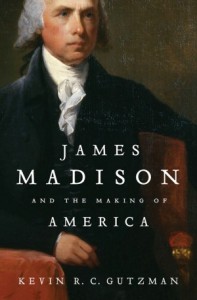
 Kevin Gutzman’s James Madison and the Making of America takes what we thought was a familiar story and gives it a fresh and important interpretation that challenges old orthodoxies and helps us better understand important episodes in American history.
For instance, proper credit for the world-historic Virginia Statute for Religious Freedom is at last granted not to its draftsman, Thomas Jefferson – who had his gravestone list the statute along with the Declaration of Independence and the founding of the University of Virginia as his proudest achievements – but to James Madison, who actually managed to get the statute enacted (and who would have nothing inscribed on his gravestone).
More significantly, we are treated to a precise and detailed description of Madison’s evolving role vis-a-vis the drafting of the Constitution. At the Philadelphia Convention Madison had championed a much stronger central government, a veto over state laws, and a diminished role and significance of the states. He favored a national rather than a federal government, and one in which the states would be retained insofar as they might be “subordinately useful.” His major proposals, including the veto of state laws, a legislature with plenary authority, and basing both legislative houses on population, were all rejected.
Madison may be known as the father of the Constitution, but Gutzman is having none of it. “Far from being the ‘father of the Constitution,’ Madison was an unhappy witness at its C-section birth. Perhaps he might be more appropriately called an attending nurse. He certainly did not think of it as his own offspring.”
What emerged from the Philadelphia Convention was a federal government with enumerated powers, not a national government with plenary authority.
At that point there were two ways forward for the nationalists. One way was the approach of figures like Alexander Hamilton and John Marshall, who simply spoke and acted as if the federal Constitution drawn up in Philadelphia had been the nationalist creation with broad powers they favored rather than the limited, federal structure it turned out to be.
Marshall, for instance, would later make much of the fact that the Constitution nowhere said that the federal government possessed only the powers “expressly delegated” to it; the word “expressly” is not used, he said. But Marshall knew better. He was present at the Richmond Ratification Convention, where people were assured that the Constitution they were being urged to ratify would indeed grant the federal government only the powers “expressly delegated” by that instrument.
Madison took a more honest route. Although he preferred a national government, he acknowledged that such a thing was neither what had been drafted in Philadelphia nor what the people ratified in the conventions that followed. So he defended not what he wished had been ratified, but what had actually been ratified.
Already in the early 1790s Madison found himself in opposition to those who acted as if the federal government had been granted powers it surely had not been granted. He spoke out against the incorporation of a national bank and in opposition to Alexander Hamilton’s use of the Constitution’s “necessary and proper” clause in support of that bill. When Hamilton and his allies tried, in defiance of universal practice both in the United States and elsewhere, to derive powers from the Constitution’s preamble, Madison reminded them that preambles merely state the ends of a document and do not assign powers.
Madison likewise opposed John Marshall’s seminal decision in McCulloch v. Maryland (1819), which echoed the arguments of Alexander Hamilton for broad federal powers. The Supreme Court, warned Madison, had thereby given Congress power “to which no practical limit can be assigned.” The Court’s reasoning stood in defiance of the understanding by which Virginia had ratified the Constitution in 1788.
Gutzman’s important account of Virginia’s ratifying convention, heretofore confined to the professional journals, makes its first appearance in a scholarly book. The accepted version of American history holds that the doctrines of nullification and secession were the product of an extreme Antifederalist reading of the American political tradition. Gutzman shows that this rendering has things backward. It was supporters of the Constitution, eminent Federalists themselves, who in seeking to persuade skeptics to ratify, spelled out the limited nature of the federal government and the true meaning of ratification for Virginians. Virginia would be “exonerated” from the imposition of “any supplementary condition” upon them – i.e., the exercise of a federal power Virginia did not grant.
It was this Virginia understanding of the meaning of ratification that Madison defended in the famous Virginia Resolutions of 1798 and the follow-up Report of 1800, where the states as the parties to the federal compact were said to possess the sovereign right in the last resort to prevent the enforcement of an unconstitutional federal law. (Gutzman is unconvinced by Madison’s later claims that he had never endorsed any such principle; Madison in retirement simply “mischaracterize[d]” the Principles of ’98, Gutzman says.)
Although Gutzman provides some important and useful analysis of the better known entries of The Federalist that were drafted by Madison, he also contends that those articles by Publius (the pseudonym under which Madison, Alexander Hamilton, and John Jay wrote their 85 articles in support of the Constitution) have been overemphasized by historians in relation to their actual effect in the ratification struggle. Hardly anyone outside the range of the New York newspapers in which those essays appeared ever heard their arguments. By the time New York’s ratification convention met, ten states had already ratified. New York had to decide whether it wanted to join North Carolina and Rhode Island as the only two states remaining outside the Union, and also faced the prospect of a secessionist New York City withdrawing from the rest of the state and ratifying the Constitution on its own. That, and not the arguments of those 85 essays, is what persuaded New York’s convention to ratify, by a tiny margin.
Edward Lengel, editor of The Papers of George Washington, contends that James Madison and the Making of America, the featured selection of the History Book Club for February, promises to become the standard biography of this important man. Let’s hope it does.
Copyright © 2012 Thomas Woods

Copyright © Tom Woods
- The Great Gold Robbery of 1933 - April 5, 2020
- The Two Paragraphs the So-Called Legal Experts are Keeping from You - November 19, 2018
- The Constitution and War Powers: Not a Presidential Dictatorship - April 9, 2018