
 by Clyde Wilson, LewRockwell.com
The federal constitution ratified by the people of the States provided for a limited government to handle specified joint affairs of the States. The document describes itself not as “the U.S. Constitution” or the “Constitution of the United States,” but as a “Constitution FOR the United States of America.” With this in mind, read what follows in the preamble as the purposes of this instrument: “forming a more perfect Union,” “common defense,” and “general welfare.” Throughout the document “United States” is a plural (the States United) and treason against the United States consists of levying war against THEM.
As clear and simple as these facts are and have always been, grasping them seems to be beyond the abilities of presidents, congresspersons, supreme court justices, and professors of “Constitutional Law” at the most prestigious institutions.
In recent times the abuses of these people (what the Founders would have described as “usurpations” justifying rebellion) have run amuck, distorting an already wounded constitution beyond recognition. Ambition, rent-seeking, willful historical ignorance, deceit, ideology, and the lust for power (which the Founders hoped to guard against) have rendered the real constitution of our forefathers virtually null and void. This has prompted serious citizens to re-expound what the Constitution for the United States is supposed to be. There have been good books in this vein by Professors Thomas Woods, Walter K. Wood, and Kevin Gutzman, and by William J. Watkins and Judge Andrew Napolitano.
James Madison is reputed by those who don’t know any better to be the “Father of the Constitution.” In fact, Madison lost more votes than he won at Philadelphia, although he did more maneuvering and scribbling than any other delegate. In his almost half-century of post-ratification life Madison was all over the place, contradicting himself numerous times on constitutional interpretation. But Madison himself in one of his more lucid moments tells us where we should look for the meaning of the Constitution. The meaning of the Constitution, he avowed, is to be found in the understanding of those who ratified it, who alone gave what was merely a proposal all the authority it possesses.
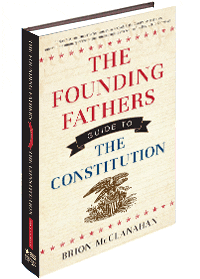
The latest contribution to this field is The Founding Fathers Guide to the Constitution by Professor Brion McClanahan, just published by Regnery History. McClanahan’s treatment of the subject is in many ways the best, a concise, hard hitting constitutional handbook that goes right to the true source of understanding without being diverted by later commentaries and judicial opinions. What the drafters of the Constitution meant is revealed in the first place but not exclusively or even primarily by their discussions and votes, including the ideas that were voted down. (Many of those reappeared later touted as legitimate federal powers.)
So we must look for understanding at the discussions that preceded the ratification conventions and at the conventions themselves. McClanahan knows this ground thoroughly and tells us in convincing chapter and verse on each article what those who ratified the Constitution intended and, perhaps more importantly, what they did not intend.
The opponents of the Constitution feared that the document would prove an instrument for the incremental establishment of a centralized dictatorship over the people. They were right. But, as McClanahan makes clear, the proponents of the Constitution swore point by point that the powers granted were limited and no cause for alarm. These assurances persuaded some of the doubtful. Ratification would never have passed otherwise, and, as it was, it only passed with assurances that amendments would be swiftly adopted and with several States making it clear that their ratification was revocable.
The Federalist, which we see cited all the time as the key to the Constitution is speculation and was never ratified by anybody. But handicapped thinkers read Madison’s philosophical ruminations, nearly all of which have been proved superficial and wrong, and imagine themselves participating in deep thoughts about government and learning about the true Constitution. This is part of the long-established practice of treating the Constitution as something sacred handed down by divine wisdom rather than understanding it by its real history.
So in interpretation we ought to be guided by what the proponents of the Constitution plainly said it intended. This is what McClanahan elucidates point by point. If we accept what its proponents said, then those who ratified it believed that it established a limited federal power. Third-string “political philosophers” and “Constitutional scholars,” and even learned jurists, have made an icon out of The Federalist, but it is only one of many discussions of the Constitution. It was a partisan document designed to overcome the objections of New York, and was not very convincing to its audience since ratification passed in New York by the narrowest possible margin Furthermore, it discusses the Constitution as it was merely a proposal under consideration and not the Constitution as ratified by the people of the States, who made their intentions clear in the undisputable language of the 10th Amendment.
The authors – Madison, Hamilton, and Jay – were all disappointed that the Constitution did not centralize power as much as they would have liked, yet realized what they had to say to win over the majority. On the part of Alexander Hamilton, contributions to The Federalist were outright dishonest, because once he got into power he worked to do all sorts of things that he claimed the Constitution did not authorize.
The Constitution is there. It can still be known and understood by honest citizens. As McClanahan writes, the real Constitution is a “limiting document,” not a grant of limitless power. Whether that Constitution can ever be established again is a question of political will and whatever is left in the American people of a capacity for self-government.
Clyde Wilson [send him mail] is a recovering professor. Now that he is no longer a professor of history he can at last be a real historian. He is the editor of The Papers of John C. Calhoun. His forthcoming book,Forgotten Conservatives in American History (Pelican, 2012), is co-authored by Brion McClanahan.
Copyright © 2012 by LewRockwell.com. Permission to reprint in whole or in part is gladly granted, provided full credit is given.