
Here’s what a teacher from Iowa writes in the Daily Iowan today (in italics), followed by my comment:
“Claiming that the Constitution does not authorize Congress to create a Department of Education (it does), Ron Paul displays a startling lack of Constitutional competency. Article I, Section VIII, Clause XVIII – the ‘Necessary and Proper Clause’ – granted Congress the authority to create the Department of Education in 1979 with the ‘Department of Education Organization Act.'”
Kids, don’t listen to what your teachers tell you about the Constitution. It’s really that simple. Let’s count the problems with this claim.
(1) George Nicholas, future attorney general of Kentucky, told the Virginia ratifying convention (and remember, according to James Madison it is to the ratifying conventions that we turn for constitutional interpretation) that the necessary and proper clause “only enables them [Congress] to carry into execution the powers given to them, but gives them no additional power.” In other words, citing this clause for authority to establish a Department of Education begs the question, since our Iowa teacher has not first established education as one of “the powers given to them.”
(2) In Federalist #33, Alexander Hamilton noted that the clause only made explicit what was logically and unavoidably implied in the Constitution’s very nature, and that it added nothing other than simple clarification: “It may be affirmed with perfect confidence that the constitutional operation of the intended government would be precisely the same, if these clauses [necessary and proper and the supremacy clause] were entirely obliterated, as if they were repeated in every article. They are only declaratory of a truth which would have resulted by necessary and unavoidable implication from the very act of constituting a federal government, and vesting it with certain specified powers.”
(3) In numerous state ratifying conventions the people were assured the federal government would have only the powers “expressly delegated” (yes, those were the words used) to it. Power over education is obviously not expressly delegated.
(4) Jefferson explained that “necessary and proper” had to mean really necessary, as opposed to merely convenient, if the clause were not to swallow up the whole Constitution and defeat its very purpose:
The Constitution allows only the means which are “necessary,” not those which are merely “convenient” for effecting the enumerated powers. If such a latitude of construction be allowed to this phrase as to give any non-enumerated power, it will go to everyone, for there is not one which ingenuity may not torture into a conveniencein some instance or other, to some one of so long a list of enumerated powers. It would swallow up all the delegated powers, and reduce the whole to one power, as before observed. Therefore it was that the Constitution restrained them to the necessarymeans, that is to say, to those means without which the grant of power would be nugatory.
(More on this in my 33 Questions.)
“President Thomas Jefferson, the author of the Declaration of Independence, championed this idea from his time in the Virginia Legislature.”
Ouch. Here’s what Jefferson actually said: “An amendment to our constitution must here come in aid of the public education.”
An amendment to our Constitution. That means federal involvement in education is unconstitutional given the text of the document as it stands. Nice try, though.
“James Madison, architect and primary author of the Constitution, also defended this belief.”
Wrong again. (See a pattern here?) Here’s Madison in 1792, explaining the absurdity of broad constructions of the “general welfare” clause: “If Congress can employ money indefinitely to the general welfare, and are the sole and supreme judges of the general welfare…they may take into their own hands the education of children.” Madison was saying that if we were silly enough to misinterpret the general welfare clause, it would lead to anabsurdity like federal involvement in education.
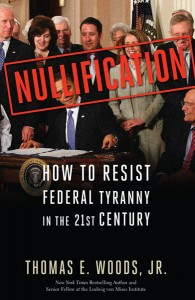 The rest of the article is an attempt to argue from precedent: hey, lots of people did this or that. That doesn’t answer the question: is it constitutional? Neoconservatives have tried the same line of argument to show that the broad presidential war powers we have grown accustomed to are constitutional – hey, everyone’s doing it! You sure that’s a road you want to travel down?
Funny how the Department of Education is now a sacred cow, when (as I show in Rollback) at the time it was proposed even the Washington Post, the New York Times, and the president of the American Federation of Teachers came out against it.
Iowans, this teacher’s name is Scott McKeag. If he is teaching your child, your child’s head is being filled with lies.

Copyright © Tom Woods
- The Great Gold Robbery of 1933 - April 5, 2020
- The Two Paragraphs the So-Called Legal Experts are Keeping from You - November 19, 2018
- The Constitution and War Powers: Not a Presidential Dictatorship - April 9, 2018