
 by Richard Epstein
EDITOR’S NOTE: The University of Chicago Law School’s Richard A. Epstein analyzes the relationship between the “internally flawed†logic of Wickard v. Filburn and the constitutionality of the Affordable Care Act. This essay for SCOTUSblog’s recent symposium - The Constitutionality of the Affordable Care Act – is a response to previous entries by three legal scholars.
*******
I have now had the chance to read the posts (in alphabetical order) of Jonathan Adler, Elizabeth Price Foley, and Ilya Somin, each of which take the position that the unprecedented extension of federal power under the Patient Protection and Affordable Care Act (PPACA) exposes the individual mandate under the bill to serious constitutional challenge, for exceeding the scope of federal power under the commerce power.
What is so striking about these arguments is that none of them starts with the text of the Commerce Clause itself. Each begins with the sensible assumption that the law as stated in Wickard v. Filburn(1942) covers the case so that it becomes important to explain why a case that holds that a farmer has engaged in interstate commerce when he feeds his own grain to his own cows cannot be read to allow Congress to impose a duty on individuals to pay a fine if they do not take out health care for their own protection, under circumstances where they lose either way. Let them take out the coverage and, given the community rating issues, they will pay more for their protection than the actuarial value of the policy. Let them not take out coverage and they are socked with a $2,000 fine.
To my untutored mind, this damned-if-you-do-damned-if-you-don’t choice is a classic form of expropriation that differs only in inconsequential detail from a government edict to surrender either your watch or your wallet, all to the greater public good. Yet paradoxically the takings and due process issues have just disappeared from this case without a trace, presumably because the low rational basis standard used to judge economic regulation allows Congress to do these things in the same way that Congress can do whatever it wants to redistribute wealth through general revenue schemes in the United States.
I will, with sadness, let this point pass, and then ask this question. How does anyone wrench Wickard v. Filburn out from a clause that says that “Congress shall have power . . .  To regulate commerce with foreign nations, among the several states, and with the Indian tribes.â€Â It beats me how a provision that is drafted to allow Congress the important power to deal with transportation, communication, and the shipment of goods across state lines, can be expanded to let it regulate any activity that affects commerce, even if done in a purely local setting.
That broad reading of the Commerce Clause, which is adopted, for example, by Elizabeth Wydra is flatly contradictory to the great Marshall decision in Gibbons v. Ogden (1824).  Gibbons said that even though the Commerce Clause lets Congress regulate a single journey into the interior, its power to regulate stops when the goods are unloaded on the dock, where they are commingled with the mass of local goods and are subject to the general inspection laws of the state to which they are shipped. If it is said that we allow Wickard to survive because of the indirect effects that increased production has on the ability of Congress to maintain cartel pricing through the Department of Agriculture, then surely Marshall was wrong to think that inspection of goods at the dockside was beyond the scope of Congress. Likewise, he was just being otiose when he said that purely internal commerce within the state is outside the scope of Congress’s power, which includes the shipment of those offloaded cargos from the dock to local retail and manufacturing businesses.
But it is said that we need a national government to solve national problems. But we do not need a national government to distort all voluntary markets beyond recognition, which is what happens when federal monopoly power drives out competition between states, which is in fact the engine of material progress. For present-day purposes, the ideal structure is just what it was in 1787: a federal government that can keep the lines of communication open between states, after which firms in one state can compete with others.
The modern view is sheer fantasy because it thinks that monolithic governments can solve just about any problem.  Yet the left-right squabble over this broad view of government now drives a set of distinctions that are completely unintelligible to any one who takes the original constitutional structure seriously. Is a decision not to buy insurance a nonactivity, or is it a decision to take one’s chances with self-insurance? Do we think that the misfeasance/nonfeasance distinction at common law should be put into service in the aid of the critics of the statute, or take the view that all decisions on whether to buy or sell any product or service are necessarily economic, even if done by default?
I confess that the effort on both sides to split hairs on this most weighty of questions leaves me cold. But the hard question is how to thaw out the discourse. And the truth of the matter is that the Wickard decision invites just these inquiries because it is so internally flawed that it cannot be the basis for a serious textual discussion of what the Commerce Clause, as drafted, means. We are in the world of second-best (or is it fifth-best) as we try to figure out whether a clause that was read in Wickard to cover a hundred times more ground than it was intended to do should now be read to cover two hundred times more ground as well.
The two answers are these. In favor of the statute, once the Supreme Court crossed the Rubicon, there is no turning back, so that the rational basis test carries the day and the entire massive (and massively misguided) PPACA has to succeed on the ground that it is not qualitatively worse than Wickard, whose defenders insist on treating it as the second coming of Gibbons, on the ground that both decisions use the word “affects†in their opinions, albeit it in totally different ways.
 Against the statute is the time-honored principle that “enough is enough.â€Â  Wickard does not represent the distillation of some new level of wisdom of constitutional interpretation. Rather it has the indefensible pedigree of twisting the Commerce Clause beyond recognition in order to sustain the Agricultural Adjustment Acts whose cartel maintenance activities have done so much harm to this overall welfare of this nation.
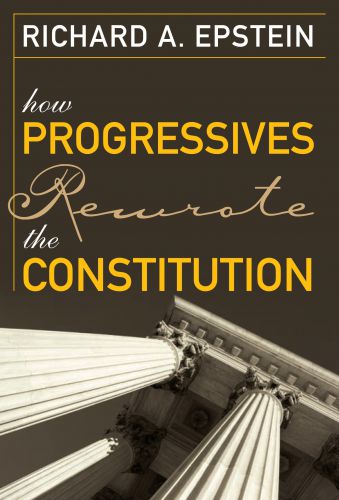
At this point, I line up with the second group. In the world of second-best, small government instincts should win out. We should slow down the ship of state so that it does not consume the economy. My view was always that the progressive mindset is the single greatest threat to limited government.
Recent news has not been good. The overexpansion of government, the inexorable deficit, the want of confidence in our public institutions points just in the small government direction. The Supreme Court as an institution has much to answer for with its endorsement of the freewheeling rules that undercut the earlier federalism vision that sought to create separate spheres of action for state and federal government. So at this point the case against Wickard is that its general concession of federal power will do even more harm to a nation that can ill stand it. So back off, yea Supreme Court before this misguided effort to provide health care across the board ends up ruining health care for the large majority of the people whom the legislation purports to benefit.  Enough.
Richard A. Epstein is the James Parker Hall Distinguished Service Professor Emeritus of Law and Senior Lecturer at the University of Chicago Law School. Professor Epstein started his legal career at the University of Southern California, where he taught from 1968 to 1972. He served as Interim Dean from February to June, 2001.