
The Individual and the Tenth

by Steve Palmer

Introduction

Most discussions of the Tenth Amendment center around using the state legislature to enforce it when the Supreme Court fails to do so.  In that situation, the state legislature declares a law null and void within the state’s borders.  In this posting, we’ll focus on another historic enforcement mechanism.  The Ninth Amendment says,

“The enumeration in the Constitution, of certain rights, shall not be construed to deny or disparage others retained by the people.” (emphasis mine)

And the Tenth Amendment says,

“The powers not delegated to the United States by the Constitution, nor prohibited by it to the States, are reserved to the States respectively, or to the people.” (emphasis mine)

So in this post we will look at another remedy which is available to the second beneficiary of Tenth Amendment protection, the people.  The remedy is plain old civil disobedience.

Early America gives us at least two examples of successful efforts at resisting the federal government through civil disobedience.  One well known example is the underground railroad, where many individuals and families conspired against the FederalFile:Moonshine-still-harpers-nc1.jpg Fugitive Slave Acts in order to help escaped slaves find their way to freedom in the north.  A second example, which we will examine in more detail today is the whiskey rebellion, in which Pennsylvania played a prominent role.
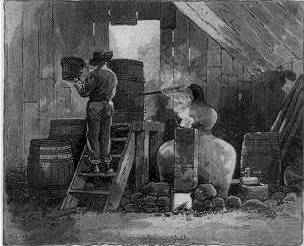
The ‘Official’ Story Line

The standard version of the whiskey rebellion story, the one which I believed until I started reading on the topic this week, goes something like this….  In 1791, the Congress passed a whiskey tax.  In 1792, four back-woods counties in western Pennsylvania, unable to cooperate and accept the new reality that they were subservient to federal authority, resisted the tax and initiated a violent response which had to be put down by the federal government.  So, in 1794, President Washington dispatched 13,000 troops, put down the resistance then arrested (and pardoned) the ring-leaders.  With the rebellion quashed, federal supremacy lived happily ever after.

It only takes a few minutes of web surfing, however, to discover that this story line has some factual problems.

Not Just Pennsylvania

One problem we encounter with the official story line is that the whiskey rebellion was actually not limited to Pennsylvania.  It was a wide-spread resistance effort.  The National Park Service says,File:Thirteen Colonies 1775 map-fr.svg

“The Whiskey Rebellion took place throughout the western frontier.  There was not one state south of New York whose western counties did not protest the new excise with some sort of violence.”

And Murray Rothbard writes,

“President Washington and Secretary Hamilton chose to make a fuss about Western Pennsylvania precisely because in that region there was a cadre of wealthy officials who were willing to collect taxes.  Such a cadre did not even exist in the other areas of the American frontier; there was no fuss or violence against tax collectors in Kentucky and the rest of the back-country because there was no one willing to be a tax collector.”

In short, it seems that President Washington made an example of western Pennsylvania because the rest of the western frontier had successfully nullified the whiskey tax.

Tax Repealed

Another problem with the standard whiskey tax story comes when we learn that the tax was repealed only 11 years after its inception.  On this point, Rothbard writes,

Rather than the whiskey tax rebellion being localized and swiftly put down, the true story turns out to be very different.  The entire American back-country was gripped by a non-violent, civil disobedient refusal to pay the hated tax on whiskey.  No local juries could be found to convict tax delinquents.  The Whiskey Rebellion was actually widespread and successful, for it eventually forced the federal government to repeal the excise tax.

Even wikipedia, no bastion of classical liberal thought, says,

The Whiskey Rebellion demonstrated that the new national government had the willingness and ability to suppress violent resistance to its laws.  The whiskey excise remained difficult to collect, however.  The events contributed to the formation of political parties in the United States, a process already underway.  The whiskey tax was repealed after Thomas Jefferson’s Republican Party, which opposed Hamilton’s Federalist Party, came to power in 1800. (my emphasis)

Repeal Overseen by a Whiskey Rebel
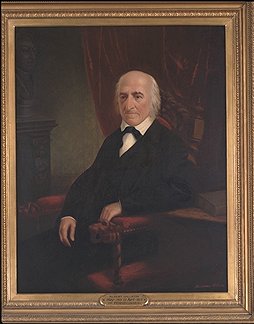
File:Portrait of Albert Gallatin.jpgAnother possible problem with the standard story, or at least an interesting aspect of the story, comes in the form of a man named Albert Gallatin.  In 1794, Gallatin’s name appeared on a list of whiskey rebels.  The National Park Service tells us,

Unfortunately for Gallatin, the government officials did not differentiate between the moderates and the radicals who took part in these meetings. Participation brought guilt as far as those in the government were concerned.  In 1794 the militia called by Washington marched to dispel the rebels in western Pennsylvania.  They also brought a list of names of participants that certain members of the Presidential staff wanted arrested.  This list included Brackenridge and Gallatin.

Is it coincidental that Gallatin, accused of being a whiskey rebel, was the man who became Jefferson’s Secretary of the Treasury in 1801 and oversaw the 1802 repeal of the whiskey tax?  According to the Alcohol and Tobacco Tax and Trade Bureau,

Elected to Congress after the rebellion, Gallatin worked for a more exact accounting of the Federal government’s finances, leading President Thomas Jefferson to appoint him Secretary of the Treasury, a post he also held under President James Madison.  In 1802, Gallatin oversaw the ending of all direct, internal Federal taxes, including the distilled spirits tax.

Conclusion

It appears that the whiskey tax was a Constitutional tax, and I don’t advocate civil disobedience against laws which are Constitutional and just.  However, the whiskey rebellion still offers a tactical lesson for us when confronted with an unconstitutional or unjust law.  It confirms the lesson that we have learned from other events such as the Civil Rights movement, India’s fight for Independence from Great Britain, and the Underground Railroad.  When confronted with an unjust or unconstitutional law, civil disobedience can be an effective counter-tactic.

In the case of the whiskey rebellion, civil disobedience was effectively combined with jury nullification and with a refusal to enforce by officials in several states.  These activities made the tax ineffective while it was in force and impacted the 1800 elections in a way that led to the repeal of the unpopular tax.

An example of an appropriate place for civil disobedience in today’s Tenth Amendment activities might come in the form of the intrusive and unconstitutional questions of the 2010 Census.

Steve Palmer is the State Chapter Coordinator for the Pennsylvania Tenth Amendment Center.

Copyright © 2010 by TenthAmendmentCenter.com. Permission to reprint in whole or in part is gladly granted, provided full credit is given

Enjoyed This Post?

We cannot succeed without your help, as we will never accept government grants or handouts. Please help us by investing in the Constitution and freedom today!

Enjoyed This Post?

, ,

19 comments
gigi
gigi

OK, so let's say we wanted to be civilly disobedient in a state that will not nullify this, what does that look like? I have no idea how you could disobey this infiltration since, if you chose not to have health insurance, not purchase it, the IRS will take it away by not distributing your tax refund. So you would have to not pay your taxes and then you would be hoisted off to jail. Not sure that will accomplish what we want unless 20 million people did the same and most people are just not willing to take the risk. So tell me how do you see individuals standing up against this?

theunknownamerican
theunknownamerican

I wonder if we can pass state laws that forbid the IRS from confiscating property of a person for the purpose of tax collection when that property is within the state's jurisdiction.

David X Johnson
David X Johnson

I have no quarrel with the idea of "civil disobedience", but I do have a problem drawing a line to it directly from rights "retained by the people". The 9th amendment refers to rights not specifically enumerated, such as the right to privacy, the right to be left alone, the right to life, liberty and the pursuit of happiness, the right to one's own thoughts, the right to your own body etc. Connecting the 9th amendment to civil disobedience against legitimate constitutional laws is a non-sequitur.

theunknownamerican
theunknownamerican

Perhaps the 9th amendment can be used to destroy this because we can say that it is my right not to purchase something which would be 'rights retained by the people'. We then say that powers existing within constitution can't be used to violate that 'right retained by the peope'.

Bylle
Bylle

If all else fails, pick up your arms, time to re-declare independence from tyrannts.

Gray
Gray

looking at the group that now sits as the supreme court,,, do you think they will actually honor the constitution??
using the catch-all "interstate commerce" they will uphold this healh care B.S,. this group will probably disallow 10th amendment nullification challenges as well

Gary
Gary

Part of the problem with doing such acts of civil disobedience , is the fact that the use of jury nullification has been pretty much banned in our modern courts along with the belief of mens rea - the intent of the accused.

KL9Bryan
KL9Bryan

Yes, really. So it happens. Let's discuss this question.

Angel
Angel

"In the case of the whiskey rebellion, civil disobedience was effectively combined with jury nullification and with a refusal to enforce by officials in several states."
Unfortunately, this would seem to be irrelevant since they have left if up to the IRS to enforce this unconstitutional bill and not the states.

MichaelBoldin
MichaelBoldin

Angel, while health care mandates are a huge issue right now, this article is addressing c.d. on a broader level, and points to, for example, disobeying the unconstitutional census. Any thoughts on that?

tsmackie
tsmackie

Michael, read Herbert Spencer, Social Statics [1851]...Chapter XIX..."The Right to Ignore the State". Would it not be a tremendous contribution to everyone to begin to speak to the jurisdiction the federal government wields over all citizens by our voluntary acceptance of any of the "programs" they offer.

fleethewrathtocome
fleethewrathtocome

How about a campaign to petition the states' Attorney Generals to join the lawsuits. Some of them are democrats and haven't smelled the coffee yet. If a letter was drafted that provided a well-written summary of how this is going to cost the states more money than they have to spend (or could dream of having to spend), then it could be used/improvised and many citizens send it to their offices state by state.

MichaelBoldin
MichaelBoldin

The real question, of course, is this - will the people learn to exercise their rights whether the federal courts want to give us permission to or not?

theunknownamerican
theunknownamerican

We should also invoke the tenth amendment for assuming powers reserved for the people since it also mentions persons as well as states have all powers not given to the federal government so even if our state does not fight this then our own person can claim the same tenth amendment right that any state can.

theunknownamerican
theunknownamerican

I agree with this. I get tired of hearing this argument that if the government says I have the right to do something then I do and when it says otherwise then I don't. That is not God-given rights but human-given rights because the state is ultimately composed of other people which is just other people deciding what are your natural rights are. That formula is a leash that the government gives to us which defines are free range of actions. I prefer to create my own 'leash' where my self-chosen conscience restrains me in the things I do and where the law protects my life and property from others who don't have that restraint. This is the formula for a civilized society with the maximum freedom.

theunknownamerican
theunknownamerican

I was trying to say that when people believe that it is the government or the courts that decide what powers the people have it is a recipe for enslavement but if the courts solely focus their thoughts on what powers the state has then it becomes a restraint on the government. They may at time expand that power beyond what they should but at least their focus would be on the government and the people would not have to feel they have to ask for things.

I think it is sad when you talk to 'liberals' and they tell you you have more rights in American than in Canada but in actuallity you have the same amount of rights wherever you go on the earth. The only thing that changes is that governments have more or less power in some places. Where there is more power there are less freedom but the modern liberal has inverted that into something incredibly slavish to the state.

tsmackie
tsmackie

unknown: you must descend from the Spencer line, i.e. Herbert Spencer, Social Statics [1851], wherein he speaks to "The Right to Ignore the State"...Chapter XIX. It is a good read and almost parallels your thought above. One must be careful, however, to seek not the protection the State may offer (your next to the last sentence) lest the courts determine from the "totality of circumstances" that you appear to be under their jurisdiction for your actions.

tsmackie
tsmackie

unknown: this is precisely the complaint presented to King John in 1215...you make the rules, and then your courts determine the validity of such rules (laws)...what has happened is we have sat upon our haunches and delivered our freedoms back to the king. However, let us not stop there, look back and see when "majority rules" became the "law of the land". If this is so, two of us could be traveling down a road, come upon another and determine we should rob him...2 - 1...majority rules.

theunknownamerican
theunknownamerican

One more thing, I with the same people who think the state decides what powers each person has over their own lives should start realizing that it is the courts that decide what powers the government has.

Trackbacks

  1. [...] From the Tenth Amendment Center. [...]

  2. Social comments and analytics for this post…

    This post was mentioned on Twitter by GodsOfLiberty: RT @RonPaul_2012: The Individual and the Tenth http://bit.ly/drjdii #tlot #tcot #RonPaul…

  3. [...] The Individual and the Tenth | Tenth Amendment Center [...]

  4. [...] This post was mentioned on Twitter by Christine, JICKO B. BREWSTER, Ron Paul, Gods Of Liberty, Noelle and others. Noelle said: RT @KatyinIndy: The Individual and the Tenth http://is.gd/aV3RD #tcot #tlot #sgp #gop #hhrs [...]

  5. [...] to govern themselves away from Federal regulations when applicable, in the form of the Ninth and Tenth Amendments.  We need to revisit this fact; we need to implement this [...]