
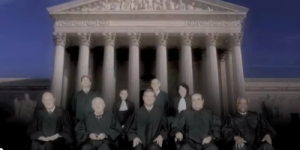
The Myth of the “Conservative Supreme Court”

Supreme-Court-Gallery-500x250Is the current U.S. Supreme Court conservative? No, it is not. And certainly not if you define “conservative” as interpreting the Constitution according to the understanding of the makers.

The claim that the Court has a conservative majority is certainly widespread. Googling the phrase “conservative supreme court” turned up over 38 million hits. The more specific phrase, “conservative majority supreme court” yielded 3.75 million. TheNew York Times has even editorialized that “the aggressiveness of the majority’s conservatism” actually renders the court “radical.”

A careful reading of a study by the Times itself shows the latter claim to be pure bunk. Although the headline affixed to the study suggested that it found the Court to be conservative, that headline was somewhat misleading. The study’s findings were much less definitive. It did conclude that (1) “the recent shift to the right is modest,” (2) “the court’s decisions have hardly been uniformly conservative,” and (3) by contemporary public standards the court is centrist, not conservative.

Careful analysis of the Times study by Professor Jonathan Adler turned up more. Professor Adler demonstrated that the study actually found that the current justices are restrained, not necessarily conservative. They form, in point of fact, the most restrained bench in decades. That means they don’t change the law much one way or another.

Now, you might think that “Restrained = Conservative.” But think again: When the Court leaves existing constitutional jurisprudence untouched, it  protects constitutional jurisprudence that is mostly liberal. You see, most existing constitutional jurisprudence is the product of the “progressive” justices who dominated the Court for the greater part of the 20th century. That jurisprudence often disregarded established methods of interpretation, overruled established doctrines, authorized huge expansions of federal power, and re-wrote important parts of the Constitution to serve “progressive” ends. When the Court leaves “progressive” jurisprudence untouched, the results are mostly “progressive” decisions.

Ironically, some of the cases liberals complain most about today—such as the Citizens United ruling on corporate campaign spending—are merely applications of rules formulated in prior years by “progressive” majorities.

Not only has the current Court refused to cashier most of this liberal jurisprudence, but it sometimes has expanded it. A good example is Lawrence v. Texas, a decision authored by Justice Kennedy. Lawrence ruled that anti-sodomy laws violated the Due Process Clause of the Fourteenth Amendment, although such laws had been part of the western tradition for 3000 years. (Needless to say, there is no evidence the Fourteenth Amendment had anything to say on the subject. And, just to be clear, I do not personally favor anti-sodomy laws; that is a different question from constitutionality, however.)

The Times editorial asserting that the present Court is “radical” was triggered by the conclusion of five justices that Obamacare’s individual mandate was not justified by the Commerce or Necessary and Proper Clauses. But that was not even a conservative conclusion, much less a radical one. The five justices called into question no current congressional power. They did not reverse a single liberal holding—not even the rogue 1944 decision that insurance is “commerce.” They merely stated that the Commerce and Necessary and Proper Clauses did not authorize a new congressional power. Even more to the point, the Court ultimately upheld the exercise of that new power by pretending that the mandate was an indirect tax.

The Original Constitution

Get the Book Today!

Among the Supreme Court’s membership, a plurality (four of nine) are fairly reliable liberals. Only one, Clarence Thomas, is “conservative” in the sense that he consistently interprets the Constitution according to the rules generally applied during the Constitution’s first 150 years. Justice Scalia usually does so as well—but not always: In Gonzales v. Raich, he joined a liberal majority that extended the congressional Commerce Power to window-box plants.

Justice Kennedy frequently sides with the four liberals. Chief Justice Roberts, as the Obamacare case illustrates, usually protects the status quo and the inflated pretensions of Congress. Justice Alito, while more conservative than Roberts, has been mostly unwilling to reverse liberal constitutional jurisprudence.

Admittedly, the present Supreme Court is more restrained than the activist benches of the mid-20th century. Perhaps it would be fair to characterize it as centrist or moderate.

But conservative? Not hardly.

Enjoyed This Post?

We cannot succeed without your help, as we will never accept government grants or handouts. Please help us by investing in the Constitution and freedom today!

Enjoyed This Post?
4 comments
Sort: Newest | Oldest
TaskForce16
TaskForce16

Contrary to what many may want of the Justices who set the SCOTUS, they are suppose to be neutral, being neither liberal or conservative. According to Article VI, paragraph 2 of the US Constitution, The Constitution itself is suppose to be the "Supreme Law of the Land...and the Judges in every State shall be bound therby;" As Mr. Natelson points out, SCOTUS has indeed unconstitutionally expanded the powers of Congress, beyond its powers enumerated in Article I, Section 8. But it's been my observation, that conservatives have often desired SCOTUS to do this on their behalf as well. IF the Justices had been ruling in accordance with the text and language within the Constitution itself, rather than looking to outside writings for interpretations, this nation would not have strayed from constitutional governence.


One thing that I have taken from my own study of the Constitution, is that it is not always going to support everything anyone on either side wants from government.


Case in point: There's been a big misinterpretation about the 1st Amendment establishing "separation of Church and State". What I read from it, is a "Separation of POWERS of Church and State". Congress has to "keep hands off" of religion. It can't make laws that favor one religion over any others, or favor any particlular religious doctrine. It doesn't mean that you can't have prayer in school or religious sybolism on government property. So that pretty well shoots the liberal sides argument down. However, the Church can't use government to prohibit activities the church (conservatives) sees as contrary to its religious doctrine. The church has to stay out of other peoples business. Conservative Christians aren't happy when I tell them this. All government can do is make laws that prevent all of us from injuring each other, physically or financially, or other wise infringing on each others enumerated rights. And BTW, the Judical and Executive Branches have no power to make law, so no one can really stop folks from praying or posting religious symbolisms where ever they want, except on someone elses private property if the property owner doesn't want it there. NO Judge can constitutionally forbid it.


If anything, I believe the SCOTUS bench has often failed to uphold the Constitution, as it was written. We all lose when they don't, because it takes us further from constitutional governence every time they ignore this sacred contract.

WilliamSchooler
WilliamSchooler

Rob you give these folks far more credit than they deserve and then to to say restrained is just ridiculous;


These folks have been doing what they have been told their whole lives pretending to know pretend laws so they have never stood up for themselves because they have no clue who themselves is because they have been playing someone else’s game that damn long and to put it bluntly they are very badly controlled by folks that have no respect for them or you.


Your thinking you have this all down is not helping you either because it shows how much you play their game and think you know it. But they play the dumb game because it will never amount to Liberty ever.


They are part of a system of Ruling class and this has nothing to do with a public servant class and for that reason alone they lied to themselves, they lied to you and the only examples we see all around us are some of the biggest lies ever created right here in America.


How about we get real and nullify it ALL because playing with the lies is only that.


Life is all encompassing and Life nullifying the ruling class is our bound duty to life, for we are to be served by people who choose to serve us. To be lied to serves life in not one manner thus nullification becomes the act of ridding ourselves of something bad, not good for life at all.


Rob Natelson
Rob Natelson

 @WilliamSchooler I'm not sure how to respond to that rant, Mr. Schooler. The only point I was making about "restraint" is that the current Court generally follows existing constitutional jurisprudence and that jurisprudence is liberal. I don't see how that point set you off.


If you want to make a real contribution to liberty, perhaps you should join the move for a limited Article V amendments convention. That's a movement that is growing, and one that actually holds out some hope for success.

WilliamSchooler
WilliamSchooler

@Rob Natelson

It wasn’t a personal attack, I personally do not hold them as any value at all for they are useless and work for a Corporation and that is all they uphold. 


As for Liberty I posted some of what is coming down the pike on the last post Dr, King on how to destroy the Corporation and the questions for Government is yet to have discussion.


I understand you do not know how to respond because most of you are attempting to correct and uncorrectable system. I actually used to agree with what you were doing but have since become very enlightened to degrees all things are now in question. I hope it caused some thought not a response but that is cool to. You have all worked hard, so I totally get that. This is one of the very few of groups I have any respect for so I continue to share here.


My apologies if you thought is was to rant, it was more to stimulate some thought about this subject.


Trackbacks

  1. [...] The Myth of the “Conservative Supreme Court”Tenth Amendment CenterIs the current U.S. Supreme Court conservative? No, it is not. And certainly not if you define “conservative” as interpreting the Constitution according to the understanding of the makers. The claim that the Court has a conservative majority is … [...]

  2. [...] January 27, 2013 Rob Natelson 1/22/2013 Source ….. [...]