
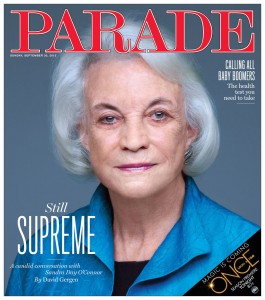
 Last week’s Parade Magazine, the Sunday insert, featured a cover article on former Supreme Court Justice Sandra Day O’Connor. It was a terrific choice: Justice O’Connor has lived an inspirational life.
But Parade essentially muffed the job. While displaying its eagerness to celebrate some of her more liberal views, the article entirely overlooked Justice O’Connor’s truly historic contribution: Her role in resuscitating federalism (“states’ rights”) in Supreme Court jurisprudence.
Unlike most of the justices appointed to the modern Supreme Court, O’Connor brought with her solid experience in all three branches of state government. She had served in Arizona’s executive branch as an assistant attorney general, in the legislature as a state senator and majority leader, and in the judiciary both as a trial and appellate judge.
This practical experience and appreciation for federalism showed in her opinions. In 1987, Justice O’Connor dissented in South Dakota v. Dole, where the Court upheld a federal law invading traditional state prerogatives. (The law threatened to withhold a small fraction of highway funds from any state that did not raise its drinking age to 21.) Although she lost that case, her sharp dissent gave bite to critical concessions by the Court’s majority: (1) The federal spending power has limits, (2) conditions on federal funding must be related to the purpose of the program, and (3) withdrawal of federal funds cannot be so severe as to be “coercive.”
The Court enforced those limits in 2012 when it voided, by a 7-2 majority, Obamacare’s imposition of coercive Medicaid mandates on the states.
In South Dakota v. Dole, O’Connor and her fellow Arizonan and Stanford Law School classmate, Justice Rehnquist, were on opposite sides. That was not to remain so for long.
In a string of later federalism decisions, Rehnquist flipped to her side, and they carried the majority of the Court with them. The famous cases of Lopez, Morrison, Alden and others all owe something to her influence.
In 1992, O’Connor led a 6-3 majority what proved to be a trend-setting case, and almost certainly the most important pronouncement of her career (although Parade Magazine didn’t think it worth a mention). The case was New York v. United States.
New York v. United States established, or rather re-established, the principle that states are independent sovereigns in the federal system—and that Congress cannot “commandeer” them in service of its own priorties.

Get the Book Today!
In arguing the matter, the federal government contended that because New York had cooperated with the unconstitutional law, New York couldn’t challenge it. O’Connor’s response ranks as one of the Supreme Court’s greatest pronouncements ever on the role of the states in the federal system:
The Constitution does not protect the sovereignty of States for the benefit of the States or state governments as abstract political entities, or even for the benefit of the public officials governing the States. To the contrary, the Constitution divides authority between federal and state governments for the protection of individuals. State sovereignty is not just an end in itself: “Rather, federalism secures to citizens the liberties that derive from the diffusion of sovereign power.” . . . . “Just as the separation and independence of the coordinate branches of the Federal Government serves to prevent the accumulation of excessive power in any one branch, a healthy balance of power between the States and the Federal Government will reduce the risk of tyranny and abuse from either front.” . . . Where Congress exceeds its authority relative to the States, therefore, the departure from the constitutional plan cannot be ratified by the “consent” of state officials.
Nearly 20 years later, in the 2011 case of Bond v. United States, the Court reaffirmed those words of Justice O’Connor. The vote for doing so was unanimous.

- The Runup to the Declaration of Independence - June 7, 2026
- How the Founders Explained Limits on the Federal Government - January 21, 2026
- The Constitution and the Trump Tariffs - December 7, 2025