
 In Part I, I summarized the argument over repealing the 17th Amendment, explained the benefits of doing so in terms of empowering the states at the federal level, and refuted a few of the points made by Alex Seitz-Ward, author of the Salon piece that prompted this two-part series. In this article I’ll continue the analysis of the issue and argue against repealing the 17th Amendment, though not for the same reasons Seitz-Ward gives, and provide what I believe to be a better alternative.
The principle argument advanced in favor of repeal is that it would help restore the authority of the states and perhaps shift power in their favor, thereby returning the country to something more closely resembling a republic. With senators appointed by direct election the United States lost at least some of the features of a republic and, as I argued in Part I, a number of other acts pushed the climate in the U.S. further from the limited confederation originally established.
Let’s first note that constitutional amendments are incredibly difficult to pass. There’ve been only a few in the last 100 years, despite many proposals for change. In fact, as of 2010, 11,447 amendments had been proposed since the constitution was ratified. Now the odds of accomplishing a goal shouldn’t prevent us from at trying to reach it, necessarily. But if the potential rewards are insufficient, as I believe they are here, dedicating a great deal of energy and political capital to its end seems wasteful. Not only are our resources limited, but we face an ever-growing Leviathan state; in the years it would take to prepare for and finally ratify a 28th Amendment, the federal government will have likely grown substantially.
A virtual axiom in politics is that whenever a government assumes a new or more broadly defined power it will not voluntarily release that power. Only an outside force can take that authority back, whether by violent means, as in a revolution of arms, or a non-violent means, such as peaceful noncompliance, resulting in the government being rendered powerless. Given this reality, combined with how long senators have been serving the people of their states (rather than the legislatures of those states), it seems improbable that any meaningful reduction in federal power may come from repealing the 17th Amendment.
Had repeal taken place much sooner, or if federal power had grown at a much slower pace, changing senatorial selection back might have been more effective than it now would be. Consider the political difficulty in abolishing the Department of Education or the Commerce Department. Despite being established in violation of the 10th Amendment they’ve been in existence for decades; many Americans are dependent on these programs, and others, for jobs, not to mention the emotional dependence that many more have on these institutions. Most can’t imagine life without a paternal state, so reversing the power of the Feds is a tall order on its own merits. But when the attempt is made through the federal government itself, the task is virtually impossible.
Another problem with repealing the 17th Amendment, and perhaps the biggest of all, is the very premise on which it stands: that the people can centrally plan an efficient government.
The state cannot centrally manage an economy because it cannot account for the constantly evolving and adapting preferences of millions of purposefully acting individuals. When it does attempt to plan the economy it must necessarily and arbitrarily override the wishes of the individual. Naturally, individuals look for ways around the barriers put in place by government. Loopholes are exploited and trade commences; black markets form and forbidden commerce resumes.
In the same way, people cannot expect to plan a government without its members attempting to gerrymander the system to their own benefit. Legal barriers put in place to restrict government will be removed, manipulated, or as is most often the case, ignored entirely. In this way a constitution may be subverted and a black market of sorts develops in government. One major difference is that governments are considered by many to have a moral legitimacy, while the free market (black market included) does not. And of course the other key difference between a private black market and one ran by government is that the former is done on a voluntary basis and only by consenting individuals; the latter is predicated on coercion and force, and no one outside the government’s circle of influence can escape its reach.
This is why I oppose movements such as the one to form a convention according to the constitution’s Article V as a means to bring about change. It’s not because I’m opposed to limiting federal power, or feel that there is a right way and a wrong way to achieve those ends, but because it defies reason to believe that we can expect the federal government to limit itself. Repealing the 17th Amendment is simply another case of this.
As an alternative to pushing for a repeal amendment, I suggest using a longstanding method of resolving problems with an out of touch and unresponsive federal government: nullification.
In Part I, I referred to REAL ID as an example of a federal law that imposed an undue burden on the states and the people, both in terms of the financial and economic costs, but also in the sense of violating the 10th Amendment and basic human rights. I suggested that it likely would not have passed had the states been represented in the senate, but it turns out that it doesn’t matter either way. This is because for the past seven years the states have refused to implement the program and that’s been the end of it. Because enough states objected and effectively nullified the REAL ID Act, it’s been rendered impotent.
The same can be said of a growing number of unconstitutional acts that are being rendered void and without force – medical marijuana and certain gun laws come to mind. The simple reality is that the people don’t have to follow unlawful acts of congress, bureaucratic regulation, executive orders, presidential signing statements, Supreme Court rulings or any other unconstitutional directive coming from Washington D.C. if enough just refuse to comply. Going a step further, the people should never follow orders that are unlawful, immoral, or otherwise violate the rights of any person.
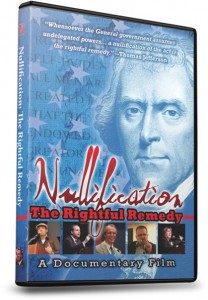
Get the New Documentary Today!
I also presented a hypothetical case of the federal government restricting the rights of gay people, with an analogy between that issue and the real-life version of how slavery was handled by some northern states during the Antebellum Period, i.e., nullification. And as we saw in the slavery issue, even with the senate having representation from the states, the federal government still encroached on the rights and liberties of the people; they still put undue pressure on the states. So just because we have the congress set up in its original form doesn’t guarantee we’ll get the limited government that some promised it would provide.
This is because the nature of government is always to increase, always to stretch and discover new powers for itself. Binding men down with the chains of a constitution is a popular concept that appears robust, but in practice there must be more than words on a page to contain the metastasizing nature of the state. A rivalrous power must act as a counterweight to the federal government and the states can provide that, but we must be wary of them as well, for they’re only different from the federal government – in terms of their ability to usurp individual authority and crush freedom – by degree.
We must not build up the states in power and prestige in the hopes of pitting them against the federal government, only to have both turn on us and end up in an even worse situation than before. One possibility is that we can use the states as a buffer to create some breathing room while continuing efforts to educate others on the philosophy of liberty. This, combined with a broader understanding of the theory of how a free society can work, along with tangible examples of freedom in reality, e.g. parallel institutions, a steady rollback of government could become more of a reality and less of a fantasy for those who value human freedom.

- Some Clarification on ‘Integrity’ - August 14, 2013
- Copperhead: A Tenther Film Review - July 19, 2013
- Edward Snowden: Nullifier - June 25, 2013