
The Occupy *insert place here* movement could represent an incredible opportunity to advance the idea of decentralization and Constitutional restraint. It could also pose the greatest threat to liberty seen in a long time.
The protesters exemplify a growing frustration and disillusionment with the status quo seen across the United States over the last year. We’ve seen evidence of this in other measures of public opinion. A recent Gallup poll revealed more than half of all Americans are “dissatisfied with the nation’s governance,†and further that nearly half of those polled believe the federal government possesses too much power and poses a threat to individual liberty.
They’ve seen the spiraling debt, endless war, and increasingly concentrated power. They recognize the problem.
But many seem less sure of solutions. This creates the opportunity to educate the disaffected and create allies in the quest to rein in overreaching federal power. But it also leaves the door open for others to push the movement toward tyrannical actions.
TAC deputy director Bryce Shonka spent nearly five hours talking with folks at Occupy Seattle on Oct. 4. He said he saw a lot of potential in the gathering. He called it a, “Blank page youth movement waiting for leaders.â€
What will we write on that page?
The initial call for Occupy Wall Street apparently came last summer from a magazine called AdBusters. The publication, based in Vancouver, British Columbia, Canada, describes itself as, “a not-for-profit, reader-supported, 120,000-circulation magazine concerned about the erosion of our physical and cultural environments by commercial forces. Our work has been embraced by organizations like Friends of the Earth and Greenpeace, has been featured in hundreds of alternative and mainstream newspapers, magazines, and television and radio shows around the world.â€
David Graeber, an American anthropologist, was one of the initial organizers of Occupy Wall Street. He taught at Yale, but the university declined to rehire the controversial professor in 2007. He currently holds a position as Reader in Social Anthropology at Goldsmiths, University of London. He is known for his anarchist views and has ties to Industrial Workers of the World, an international labor union that advocates for an abolishment of wages. The union website describes the organization’s goal
The working class and the employing class have nothing in common. There can be no peace so long as hunger and want are found among millions of the working people and the few, who make up the employing class, have all the good things of life.
Between these two classes a struggle must go on until the workers of the world organize as a class, take possession of the means of production, abolish the wage system, and live in harmony with the Earth.
In an interview with the Daily Kos, he explains how the event was organized. On July 2, a general assembly was held, but Graeber said that a Marxist group was already acting like it was running the show and it seemed more like a rally, so he and several others pulled a group together to hold a real assembly.
“AdBusters had already advertised the date to 80,000 people. And their date was a Saturday. You can’t really shut down Wall Street on a Saturday. So we were working under some significant constraints. We assembled 80 or 100 people and formed working groups for outreach, process, so forth and so on. And we began meeting every week,†Graeber told the Daily Kos.
The movement really has global roots.
“One thing that helped a lot was a smattering of people from Spain and Greece and Tunisia who had been doing this sort of thing more recently. They explained that the model that seemed to work was to take something that seemed to be public space, reclaim it, and build up an organization headquarters around that from which you can begin doing other things.â€
Graeber described the root philosophy of the movement in terms of decentralization and direct democracy, thus the lack of any direct demands.
“We’re trying to reframe things away from the rhetoric of demands to a question of visions and solutions. Now, how that translates into actual social change is an interesting question. One way this has been done elsewhere is you have local initiatives that come out of the local assemblies,†he told the Daily Kos.
Of course, other groups have moved into the spotlight at well. Traditional left leaning organizations and unions have voiced support and participated in the occupation.
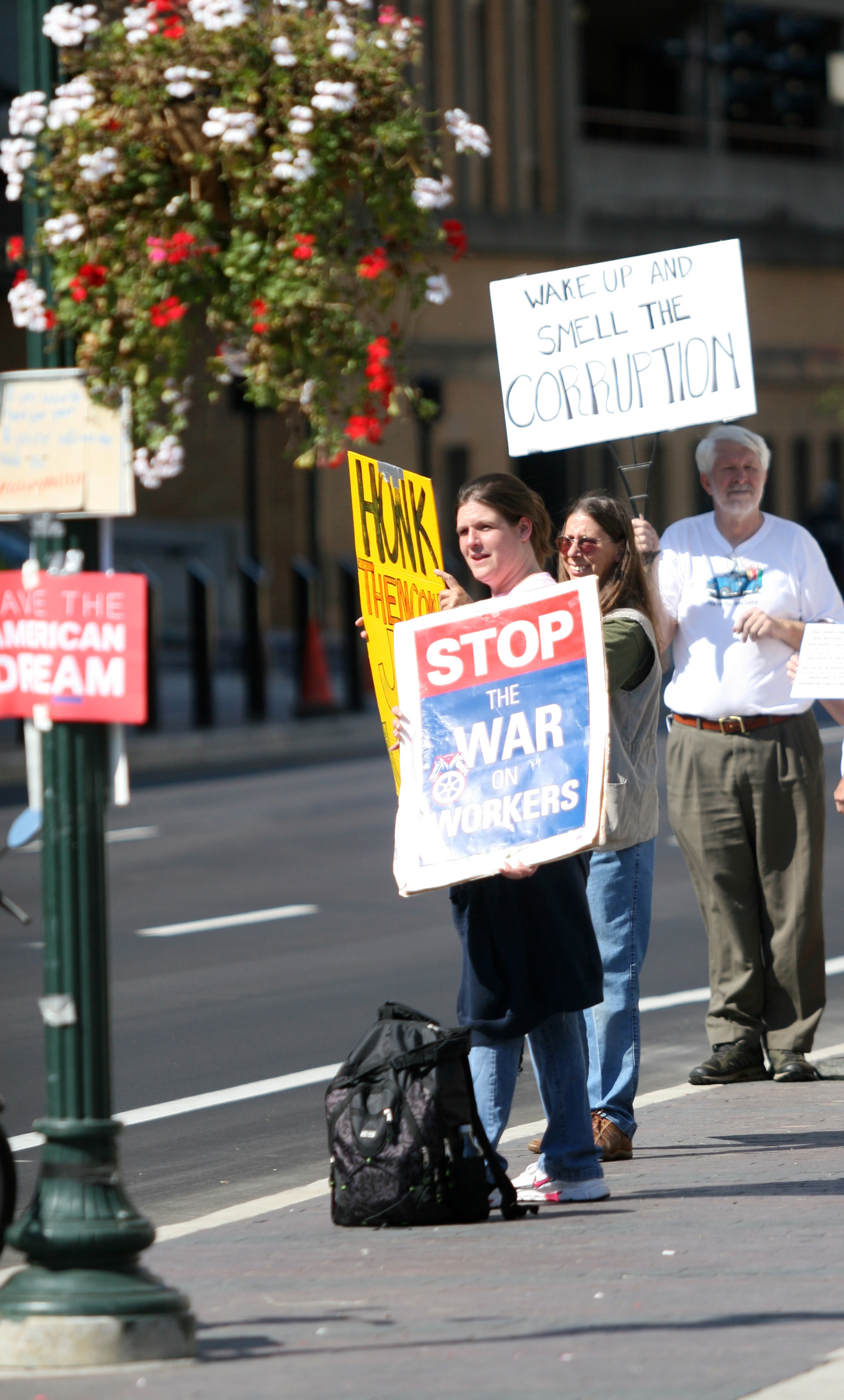 “It is organically happening, but there are definite problems that occur. We found this back in the days of the globalization movement. Unions were very supportive and provided resources, but they’re very different organizations. The real difficulty is how to work with people who are top-down and have a funding base, as it means there are things they can say in public and things they can’t, and groups where people can say whatever they want and the whole idea is to be decentralized. One problem I’ve already heard of is that people are coming in and changing the tenor of the general assemblies to speeches, and that’s not really what it’s supposed to be about. So you have to balance the aspect where you’re trying to show what direct democracy could be like and the effort to link up with groups that have a form of organization we’ve rejected,†Graeber said.
The message of decentralization certainly aligns with the core principles of the Tenth Amendment Center. After all, a powerful federal government dictating one-size-fits-all policy for the entire United States stands in direct opposition to the philosophy advocated by OWS organizers. On the other hand, direct democracy was something the founders of the United States found dangerous. James Madison wrote:
From this view of the subject it may be concluded that a pure democracy, by which I mean a society consisting of a small number of citizens, who assemble and administer the government in person, can admit of no cure for the mischiefs of faction. A common passion or interest will, in almost every case, be felt by a majority of the whole; a communication and concert result from the form of government itself; and there is nothing to check the inducements to sacrifice the weaker party or an obnoxious individual. Hence it is that such democracies have ever been spectacles of turbulence and contention; have ever been found incompatible with personal security or the rights of property; and have in general been as short in their lives as they have been violent in their deaths.Â
The good news; Shonka said many participants in Seattle expressed a basic distrust of the feds.
“I don’t have any faith, and I don’t trust the current federal government,†one OWS Seattle occupier told Shonka.
“Right there you’ve got it,†Shonka said.
But the direction the action will ultimately take remains up in the air.
“They know a few things about a few things. Enough to be dangerous, or to be our allies,†Shonka said.
The small group gathered in front of the Chase Bank building in downtown Lexington seemed completely unaware of the bigger picture, expressing a hodge podge of ideas and points of view. One young man, a self-proclaimed socialist, advocated for higher taxes on the “rich†and corporations for the purpose of wealth redistribution. When the conversation turned to constitutional restraint as a possible solution to America’s problems, he turned away in disgust.
“Oh yeah, the Constitution that enslaved black people and women. Yeah. Right.â€
But others said they simply wanted to live their lives, find decent jobs and earn a decent living. They described themselves as the “99 percent,” and although much of the discussion was tinged with class warfare rhetoric, the group seemed generally open to the message of constitutionally restrained government.
But lacking any core principles, they also seemed easily swayed and gave the impression that they would favor coercive government power if they thought it was wielded to their benefit.
After spending an hour or so with Occupy Lexington participants, I left them with a message.
“Remember, any power you give the federal government to advance your cause, whatever that may be, you grant the feds the same power to turn against you.â€
Seems a fitting message in these times.

- Thomas Jefferson’s Warnings and Predictions about the Dangers of Money-Printing - April 18, 2024
- Utah’s Step-By-Step Strategy in Support of Sound Money - April 9, 2024
- Utah’s Step-By-Step Strategy Against the Surveillance State - April 1, 2024