
What’s So Important About a Declaration of War?

  • Share on Tumblr

by Tom Mullen

Presidential hopeful Ron Paul insists that the U.S. government shouldn’t go to war without a declaration of war. His son Rand has also taken this position, as have several libertarian-leaning Tea Party candidates. According to the U.S. Constitution, the congress is invested with the power to declare war. These constitutionalists say that obtaining one should be a requirement before military action is authorized.

I’m not sure that this is resonating with those that are unfamiliar with what a declaration of war means. For most people, the declaration of war is a formality whereby the president makes sure that it is agreeable to the Congress that he utilizes the military. Some might even go so far as to say it is the president “asking permission” from the Congress to do so. By this reasoning, both Presidents Bush and Obama have complied, especially considering H.J. Res. 114 (October 16, 2002). With that resolution, Congress authorized the president to use military force in the war on terror. What is the difference between that and a declaration of war?

The answer is both intuitive and supported by history. First, a “declaration” has nothing to do with “permission.” Neither is it the same thing as creation or initiation. One can only declare something that already exists. Therefore, a declaration of war does not create a war or initiate a war. A declaration of war is a resolution passed by Congress recognizing  that the United States is already at war.

The intent of the declaration of war power is for the government to have an adjudication process for war analogous to a criminal trial for domestic crimes. Evidence must be presented that the nation in question has committed overt acts of war against the United States. The Congress must deliberate on that evidence and then vote on whether or not a state of war exists. The actual declaration of war is analogous to a conviction at a criminal trial. The Congress issues the “verdict” and the president is called upon to employ the military. To wage war without a declaration of war is akin to a lynching: there has been no finding of guilt before force has been employed in response.

Herein lies the difference between H.J. Res. 114 and a declaration of war. In order for President Bush to have obtained a declaration of war against Iraq, he would have had to present his case that Iraq had already committed overt acts of war against the United States. Like a prosecutor, he would have had to convince the “jury” (Congress) that Iraq was guilty – not of “possessing weapons of mass destruction” but of having already aggressed against the United States. Obviously, he would not have been able to do this. In fact, the absence of any overt acts of war by the nations in question is the reason that there were no declarations of war against Korea, Viet Nam, Bosnia, or any other nation that the U.S. government has waged war against since WWII.

The declaration of war power requires the government to obey the law of nature that that no individual or group mayinitiate force against another. It requires that before the executive launch a military action against another nation, that a separate body deliberate on evidence and agree that said nation has been an aggressor. Only then is waging war justified.

This interpretation is supported by every declaration of war in U.S. history. Here are two examples.

When James Polk asked Congress to declare war on Mexico in 1846, he said,

“But now, after reiterated menaces, Mexico has passed the boundary of the United States, has invaded our territory and shed American blood upon the American soil. She has proclaimed that hostilities have commenced, and that the two nations are now at war. [emphasis added]

As war exists, and, notwithstanding all our efforts to avoid it, exists by the act of Mexico herself, we are called upon by every consideration of duty and patriotism to vindicate with decision the honor, the rights, and the interests of our country. . . .

In further vindication of our rights and defense of our territory, I invoke the prompt action of Congress to recognize the existence of the war, and to place at the disposition of the Executive the means of prosecuting the war with vigor, and thus hastening the restoration of peace.”[1] [emphasis added]

After reviewing Polk’s request, Congress issued the following declaration of war,

“Whereas, by the act of the Republic of Mexico, a state of war exists between that Government and the United States: Be it enacted by the Senate and House of Representatives of the United States of American in Congress assembled, That for the purpose of enabling the government of the United States to prosecute said war to a speedy and successful termination…”[2] [emphasis added]

Note the italicized words. The state of war already exists because of the act of the Republic of Mexico.

Americans are probably most familiar with the last occasion upon which the United
States declared war. In what may have been the only constitutional act of his entire presidency, President Roosevelt asked Congress to declare war on Japan during this famous speech:

Mr. Vice President, Mr. Speaker, Members of the Senate, and of the House of Representatives:

Yesterday, December 7th, 1941 — a date which will live in infamy — the United States of America was suddenly and deliberately attacked by naval and air forces of the Empire of Japan.

The United States was at peace with that nation and, at the solicitation of Japan, was still in conversation with its government and its emperor looking toward the maintenance of peace in the Pacific…Yesterday, the Japanese government also launched an attack against Malaya. Last night, Japanese forces attacked Hong Kong. Last night, Japanese forces attacked Guam. Last night, Japanese forces attacked the Philippine Islands. Last night, the Japanese attacked Wake Island. And this morning, the Japanese attacked Midway Island. I ask that the Congress declare that since the unprovoked and dastardly attack by Japan on Sunday, December 7th, 1941, a state of war has existed between the United States and the Japanese empire.”[3] [full text of speech here]

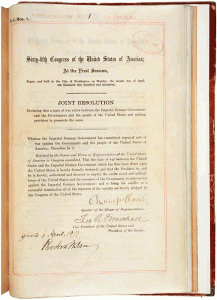
In response, Congress resolved,

“Whereas the Imperial Government of Japan has committed unprovoked acts of war against the Government and the people of the United States of America: Therefore be it Resolved by the Senate and House of Representatives of the United States of America in Congress assembled, That the state of war between the United States and the Imperial Government of Japan which has thus been thrust upon the United States is hereby formally declared; and the President is hereby authorized and directed to employ the entire naval and military forces of the United States and the resources of the Government to carry on war against the Imperial Government of Japan; and, to bring the conflict to a successful termination, all of the resources of the country are hereby pledged by the Congress of the United States.”[4]

Every other past declaration of war by the United States government follows exactly this format. The president presents evidence. The Congress votes on the validity of that evidence. It declares that war already exists. It then directs the president to use the military to end the war.

Had this constitutional process been followed, the United States would not have been involved in the wars in Korea, Viet Nam, Iraq, Somalia, Bosnia, or Afghanistan. The declaration of war power ensures that the U.S. government never initiates force, but only uses the military to defend its citizens against an aggressor.

Following the constitution on this point would have kept the United States out of every war since WWII and prevented the U.S. government from running up a large portion of its unresolvable debt. Abiding the law of nature is not only moral, but cost-effective.

The Original Constitution

Get the New Book Today!

During the South Carolina Republican Primary Debate on May 5, Herman Cain articulated his position on the government’s war powers. He stated that, as president, he would not involve the U.S. military in war unless three criteria were met. 1. There was a clear objective. 2. There was a verifiable U.S. interest in question. 3. There was a clear path to victory.

While his comments clearly titillated the audience panel interviewed after the debate, one must recognize that Adolph Hitler’s wars would have been justified on this basis. Are those the only criteria upon which the U.S. government should base its decision to go to war? How about, “they attacked us?” That should be the one and only reason.

Going to war without a declaration of war not only represents aggression against the nation in question, but against every U.S. taxpayer as well. The only argument that can be made for taxing a free people is that taxation is necessary to underwrite protection of their lives, liberties, and properties. The only way that they can be compelled to pay for a war is if a state of war exists between them and another nation. To tax them for a war fought for other reasons,including defending people other than themselves, is to aggress against them. Once the government is allowed to do that, it is time to stop calling the United States “the land of the free.”

Check out Tom Mullen’s book, A Return to Common Sense: Reawakening Liberty in the Inhabitants of America. Right Here!

Tom Mullen is a writer, musician, and self-employed business consultant. In January 2009, he published his first book, A Return to Common Sense: Reawakening Liberty in the Inhabitants of America. Tom was the opening speaker at theRevolution March in Washington, D.C. on July 12, 2008 (keynote speaker Ron Paul). In 2007, he released his first solo CD, A Glimpse of the Ether, containing 13 original compositions. Tom’s style has been described as “Powerpop with a hint of modern rock.”

Tom is originally a native of Buffalo, NY and graduate of Canisius College. He earned a Master’s Degree in English from State University of New York College at Buffalo. He now resides with his family in Tampa, FL. For more information, visit Tom’s website at www.tommullen.net.

© Thomas Mullen 2011


[1] http://www.pbs.org/weta/thewest/resources/archives/two/mexdec.htm

[2] Twenty-Ninth Congress Sess. I Ch. 16 http://www.lawandfreedom.com/site/historical/Mexico1846.pdf

[3] http://www.americanrhetoric.com/speeches/fdrpearlharbor.htm

[4] Seventy-seventh Congress Sess. 1 Ch. 561 http://www.lawandfreedom.com/site/historical/Japan1941.pdf

Enjoyed This Post?

We cannot succeed without your help, as we will never accept government grants or handouts. Please help us by investing in the Constitution and freedom today!

Enjoyed This Post?
16 comments
Jeff Matthews
Jeff Matthews

I understand your point, too, Mike. I am in agreement that the Constitution has been usurped. It is hard to believe anyone thinks it has not.

All I am saying is that the Devil is in the details. The Constitution was meant to be simple, but life is much more complicated. I think it is easy to come to consistent and clear understandings in some regards, but in many others, I think the gaps and conflicts are plainly evident. For example, compare the comity (full faith and credit) clause to the argument that marriage and divorce laws ought to be solely within the province of the various states. If State A allows gay marriage and divorce, and State B disallows it, what happens when gays are divorced in State A and one of the divorcees moves to State B to avoid a State A court's property division order? Must State B give full faith and credit to State A's property division and enforce the order against its new resident? Would your answer change if State B enacted a law that stated, "No person in this state shall be divested of his property by virtue of any order arising from the dissolution of a marriage between persons of the same sex?" Or would that law, itself, violate the full faith and credit clause?

This is but one example. There can be countless other examples spanning a vast array of subjects. And as to a great many of these, I am sure we (more or less "Originalists") would hold opinions all over the board.

We tend to focus on the more or less "obvious" issues (for good reason, since they are more or less obvious). But there is far more that remains in issue than can possibly be imagined. Our task, so far, has been relatively simple in comparison to arriving at a complete understanding of proper Constitutionalism. The Constitution was penned rather crudely. It is a nice blueprint, but it left much to be desired for the contractors and artisans who followed and who actually had the privilege of continuing to construct our Republic.

My point, in reference to the article, is that it is loaded with a fair bit of rhetoric and not a lot of guidance. If one can only declare something which already exists - i.e., war must exist before it can be declared, that does not tell us what the conditions of war are. If the President is traveling abroad and a spectator throws his shoe at him, can this suffice as a condition to declare a state of war? Most would say not. What if a rogue group from abroad send 200 kilos of opium seed into our borders illegally? Probably not. What if they come here and set off some bombs? Hmmmm. It gets more interesting. It's a rogue group, but their government did not stop it and isn't showing us they are doing all they can to prevent this sort of thing. Now, we can start arguing what is sufficient. And so, here we are..... Of what use is it to the argument to merely state, "We don't make war when we declare it; we declare it only because it exists."

Along similar lines, we see the sentence: "The declaration of war power requires the government to obey the law of nature that that no individual or group may initiate force against another." Here we go... back to the laws of nature. Who will argue that initiating this type of force is bad? Nobody. It is rhetoric. The real debate will always surround the question, "Who started it?" Right?

Jeff Matthews
Jeff Matthews

I want to make a disclaimer here. My points are not to attack Tom Mullen, the author, or his reasoning. My points are that our reasoning process is, by nature, very limited. I am not immune from the limits in the process any more than the next guy. It is what it is. I think, at some point, the merit of our movement will ultimately have to rely on emotion and sentiment. What does not impress me, though, is a claim to some invisible law or divine edicts.

Bob Greenslade
Bob Greenslade

Something missing from this discussion is the power of a State or States to engage in war independent of Congress or the President.

Article I, Section 10, Clause 3 states in part:

"No State shall, without the Consent of Congress...keep Troops...in time of Peace...or engage in War, unless actually invaded, or in such imminent Danger as will not admit of delay."

Since this clause prevents the States from maintaining a standing army, without the consent of Congress, in times of peace, the State force contemplated in Article 1, Section 10 is the State militia.

The States, under the direction of their commander in chief, the governor, have the constitutional authority to use their militia to protect their borders independent of the federal government. Thus, a State or States could be engaged in war without a congressional declaration of war.

Mexican troops aiding the drug cartels on State soil could trigger this provision if a governor had the guts to pull the switch.

The governors of Texas and Arizona, and maybe New Mexico, forget California, should send the Mexican government a little courtesy note alerting Mexico of this power with a copy to Obama. Then after the Mexican government and Obama claimed it was a bluff, send National Guard (the organized militia) troops with tanks and planes to the border.

Then when the feds opened their mouths, these States could ask Obama and his minions...what do you think of federal supremacy now bitches?

Jeff Matthews
Jeff Matthews

I don't see any requirement in the Constitution that Congress need evaluate the guilt or innocence of any other nation or people in connection with declaring war. All I see is that Congress is authorized to declare war. It doesn't limit Congress' authority to declaring only "just" or "proper" wars. Of course, when lobbying for Congress to make such a declaration, you will always see and/or hear of the evil transgressions of the enemy and that sort of thing. It's just human nature to try to justify this sort of action. But a literal reading of the Constitution, as I understand it (without going and double-checking) does not require any justification for Congress' action in declaring war.

Austin H.
Austin H.

Conducting a war counter to Natural Law (defensive in nature) was rather foreign to the founders. Charles Pickney stated: "Conquest or superiority among other powers is not or ought not ever be the object of a republican system" during the federal convention. Similar philosophies of non-intervention can be traced to men like George Washington and Thomas Jefferson. If you look at the "Guarantee Clause" in Article IV, it specifically enables the use of force against a non-republican state government, against invaders into state territory, and against domestic violence. This article obligates protection, but does not authorize the undertaking of military action for puerly offensive purposes. The declaration of war would come after the "Guarantee Clause" became necessary. The Executive would then execute the war.

You must read the Constitution as it was understood (including historical context) in the late eighteenth century, not as we may read and undestand it today.

Jeff Matthews
Jeff Matthews

Except that you must be very careful not to subject your own sentiments into the literal words of a governing document. Further, resorting to parol evidence of "the founders'" intent is a very flawed process. It assumes: (1) that all the founders had a single intent or understanding, and (2) that you are able to ascertain what that is.

As we know, the Constitution was ratified by many, and along the way, even more had differing opinions, concerns and understandings as to what some of its provisions authorized, entailed and meant. And now, over 200 years later, we have a bunch more of us with ideas and understandings of our own. Inevitably, the process of construction and interpretation require the injection of one's opinion into the issue and a pretense that the person making the contention can accurately project his views onto long-dead founders as if these founders could still talk, and presuming they could, that would all talk with a single voice..... my voice.

"Originalism" is a useful theory, but we cannot pretend it is all it is cracked up to be. It is a flawed approach, like any other.

I have no problem construing a document "as we understand it today." As long as "we" understand it in unison and agree to our understanding, then, the document, as construed, serves all of our purposes.

On a side note, "Natural Law" is a crock. It is whatever you want it to be, and for me, it is likewise, whatever I want it to be. It is as amorphous as the dictate, "Do unto thy neighbor..."

It is best to recognize the flaws in the concepts, because the more skepticism you can take to the table, the more you will be capable of ascertaining BS from the sublime. Most of it is BS, and likewise, most of us think our own BS is more infallible than that of others - me included. It's just the way the mind works.

For more on so-called "Natural Law" read about the "natural law" regarding a woman's station in life, in the age-old case of Myra Blackwell, here: http://en.wikipedia.org/wiki/Myra_Bradwell

Once you see how these "phophets" into God's will mold their arguments and can learn to spot BS, you soon come to realize that "Natural Law" is a sham, and "Originalism" a bit less profound that its disciples make it sound.

And, yes, I'm a Tenther all the way. I'm just pointing out that there is a lot of moral relativity embedded into our theories.

Jeff Matthews
Jeff Matthews

To best help you find the flaw of Lockean declarations, it is probably best to ask a few questions?

What is the right to life? Define "life." Is there any circumstance under which man is entitled to take life? If so, what are those circumstances? Self-defense? I am sure that ought to be one, but self-defense connotes the taking of the life was reasonably necessary in order to defend one's self. So, now we delve into what constitutes excessive force. So, where does this inquiry end? I suppose it has to end some place where we no longer have to use weasel words, like "reasonable" and "excessive." Otherwise, it lacks the specificity required to enable us to follow this so-called law as an absolute, moral imperative and leaves us delving into moral relativism and the constant debates over what is "right," "just" and "fair" - which is no different than the flawed process of forming and operating governments.

What is "liberty?" Certainly, we all agree liberty can be abridged. This, we say, is permitted, provided due process is followed. But what is "due process?" Does it require a trial by jury? If so, does it require 6 jurors, 12 jurors or some other number? What happens if the judge admits certain evidence in error? Does it call for automatic reversal and a new trial, or do we need to evaluate the effect of the erroneous admission of the evidence? It seems many of us would recognize that the answer depends on the type of evidence that was erroneously admitted. Was it material? Did it have a tendency to cause an improper verdict? Was it prejudicial to the objecting party? Here, once again, you can see the weasel words, "material," "improper" and "prejudicial." Where is the natural law, so we can see it and avoid human fallibility in making these decisions? There must be a universal absolute out there. After all, it is natural LAW. So, what does this law say? If only we knew, we could take judges and corruption out of the process and leave the inquiry to mere computers in order to solve the inquiry in a scientific way.

What about the right to property? Does this mean that all taxation violates this right? If so, how do we fund governments? If not, what process must a government use to take our property? Does simple majority rule? Should a super-majority be required? Or are there some cases where the protection of the individual's property is so important that not even unanimity ought to be allowed? If there are scenarios under which each of these procedures are appropriate, what distinguishes them? When you attempt to delve into this, you will find yourself resorting to more weasel words.

So, where is this natural law? Who has a superior claim to knowledge of it? If I say natural law is X, and you say it is Y, where is the natural law that lets us know which of us is correct? Supposing you claim knowledge of this latter law, what if I say you are wrong there, too? Where is the law that will, once again, tell us who is right in this latter respect? And the conundrum, you can see, may continue indefinitely.

Austin H.
Austin H.

So you are saying that 1775 Declaration of Rights and Grievances and the 1776 Declaration of Independence (both rooted in the law of nature) are not the foundations of law and the relationship between citizen and government in our republic? Or, that these documents and the Lockean view of rights did not result in the drafting of the original State Constitutions and Articles of Confederation? Natural law is BS, huh.

Locke's law of nature is also distinct from divine law in that the latter, in the Christian tradition, normally referred to those laws that God had directly revealed through prophets and other inspired writers. Natural law can be discovered by reason alone and applies to all people, while divine law can be discovered only through God's special revelation and applies only to those to whom it is revealed and who God specifically indicates are to be bound..this seems to cover your Myra Bradwell example since the justices evoke the Creator and gender versus reason. Reason eventually overcame injustice (government suppression of liberty) w/regards to gender.

When Locke emphasized the right to life, liberty, and property he was primarily making a point about the duties we have toward other people: duties not to kill, enslave, or steal. Most scholars also argue that Locke recognized a general duty to assist with the preservation of mankind, including a duty of charity to those who have no other way to procure their subsistence (see Locke's Two Treatises).

Both of those declarations cite these first principles: "the inhabitants of the English Colonies in North America...are entitled to life, liberty, and property, and they have never ceded to any sovereign power whatever, a right to dispose of either without their consent" and "We hold these truths to be self-evident, that all men are created equal, that they are endowed by their Creator with certain unalienable Rights, that among these are Life, Liberty and the pursuit of Happiness. — That to secure these rights, Governments are instituted among Men, deriving their just powers from the consent of the governed..."

You also want me to believe "we" can all agree on what the Constitution means, but it is impossible to ascertain what those who wrote and ratified it were? Documents like the two declarations noted above, the Articles of Confederation, James Madison's Notes on the Debates in the Federal Convention, the official convention notes, the Federalist Papers, the Anti-Federalist Papers, and the notes from the ratification debates in each state explaining what nearly each word was to mean lead us to understand what was accepted (through a majority vote) as the intent and authority of the U.S. Constitution. The majority vote bound the conventions. Misunderstanding the original understanding of the Constitution occurs due to a lack of education on the subject, not due to a lack of evidence.

While certainly the Constitution fell short of its grand ideals (slavery), it is clearly founded in the laws of nature. However, our founders left us w/a way tackle future issues...Article V.

Philosopherking
Philosopherking

I think this is what we should do for AQ. We can then layout some rules of how we are going to prosecute them and what kind of force we can use. Can we use military force, legal force, or civilian death squads? A declaration of war might lay out some rules that can be followed.

I thought this was a good article but I have a question. If war already exist then what would happen if you could not get a declaration of war? Do hostilities end? Is the president allowed to use force after that?

Austin H.
Austin H.

As for an alternative for AQ to U.S. military action against terrorists who have attacked the U.S. and other countries, and are threatening further attacks, is to enact Letters of Marque and Reprisal. Article I, Section 8, paragraph 11 of the U.S. Constitution authorizes Congress to "grant Letters of Marque and Reprisal, and make rules concerning captures on land and water." A "reprisal" means an action taken in return for some injury. A reprisal could be a seizing of property or guilty persons in retaliation for an attack and injury. It could include forced used against the perpetrators for the redress of grievances. A reprisal could even involve killing a terrorist who is threatening further harm and cannot be captured.

"Marque" is related to "marching" and means crossing or marching across a border in order to do a reprisal. So a Letter of Marque and Reprisal would authorize a private person, not in the U.S. armed forces, to conduct reprisal operations outside the borders of the U.S.A.

Such Letters are grantable not just by the U.S. Constitution, but also by international law, which is why it was able to be included in the Constitution. The Letters are grantable whenever the citizens or subjects of one country are injured by those in another country and justice is denied by the government of that country, as happened with the attack by persons who were in Afghanistan.

In October 2001, Ron Paul, U.S. representative from Texas, introduced bills H.R. 3074, Air Piracy Reprisal and Capture Act of 2001, and H.R. 3076, September 11 Marque and Reprisal Act of 2001, to authorize the U.S. State Department to issue such Letters. Private U.S. citizens would then be able to hunt down, attack and collect assets from terrorists who have or are planning to commit hostile acts against the U.S. and its citizens.

Austin H.
Austin H.

If you read Madison's Notes on the Debates in the Federal Convention, you will see that this question and specific verbiage was carefully considered. The Executive could only act without Congressional declaration of war if there was a sudden attack, a declaration of war would certainly follow an attack. There wasn't much thought of declaring any war unless there was an attack on the Union as a whole or an individual State...natural right of self defense. In this case, it was expected that Congress would declare war and the rest of your question would not have been thought possible. I'm not sure what you mean by "if war already existed."

"To make war"

Mr. Madison and Mr Gerry moved to insert "declare," striking out "make" war; leaving to the Executive the power to repel sudden attacks.

Mr Sharman thought it stood very well. The Executive should be able to repel and not to commence war. "Make" better than "declare" the latter narrowing the power too much.

Mr Gerry never expected to hear in a republic a motion to empower the Executive alone to declare war.

Mr. Mason was agst giving the power of war to the Executive, because not safely to be trusted with it; or to the Senate, because not so constructed as to be entitled to it. He was for clogging rather than facilitating war; but for facilitating peace. He preferred "declare" to "make".

On the Motion to insert declare--in place of Make, it was agreed to.

N. H. no. Mas. abst. Cont. no.1 Pa ay. Del. ay. Md. ay. Va. ay. N. C. ay. S. C. ay. Geo- ay. [Ayes--7; noes--2; absent--1.]

Gordon
Gordon

Excellent article. Absolutely right to point out the constitutional deficiency of Herman Cain's statements on the government's war powers. In contrast, Congressman Ron Paul's statements on the subject are constitutionally replete.
But then, should one expect anything else from an ex-Federal Reserve bank chairman?:
"Through these and other appearances on behalf of the National Restaurant Association, I began working with business leaders across all sectors of the American economy. This led to my acceptance of a position on the Board of Directors of the Federal Reserve Bank of Kansas City, and I was subsequently elected their chairman."
par. from About Herman Cain: My Story @ http://www.hermancain.com/inner.asp?z=1
Should one expect anything else from a fellow who -- not surprisingly -- supported the TARP bank bailouts?; who -- not surprisingly -- stated in early 2011 on his radio show that there was no need for an audit of the Federal Reserve?; and who -- not surprisingly -- stated in late 2010 on a radio program in late 2010: "We should have never gotten off the gold standard because when we got off the gold standard, that then allowed Congress to inflate our currency whenever they overspent. Now look at the mess that we have." -- without assigning -- not surprisingly -- even an iota of blame to the Federal Reserve for inflating U.S. currency. http://en.wikipedia.org/wiki/Herman_Cain
In contrast, Congressman Paul's stance on the Federal Reserve:
"For the past 30 years, Congressman Ron Paul has worked tirelessly to bring much-needed transparency and accountability to the secretive bank. And in 2009 and 2010 his unfaltering dedication showed astonishing results: HR 1207, the bill to audit the Federal Reserve, swept the country and made the central bankers shudder at their desks. The bill passed as an amendment both in the House Financial Services Committee and in the House itself." http://www.ronpaul.com/congress/legislation/111th...
But then, unlike Herman Cain, Congressman Paul has never worked for a Federal Reserve bank..

Mike Maharrey
Mike Maharrey

Very well thought out piece.

Here's a question. How does the U.S. handle aggression initiated by non-governmental entities, such as al qeada, that span geo-political borders? How do you wage war against an aggressor that hides behind another sovereign nation's borders? Should Congress issue a declaration of war against that group? And how do you handle waging war across another nation's borders?

Len
Len

Maybe we also don't use the CIA to commit aggressive acts in other countries?? Just a thought. Who really is committing the first wrong, the USA or these non-governmental agencies? I may be unaware, but I haven't heard of any Middle East countries overthrowing our governments. Maybe we also don't support dictators, send billions of aid, arm rebels?

David Farris
David Farris

@ Mike - "How does the U.S. handle aggression initiated by non-governmental entities, such as al qeada, that span geo-political borders?"

U.S. Constitution, Article I, Sec. 8 cl. 11:
The Congress shall have Power ... To declare War, grant Letters of Marque and Reprisal, and make Rules concerning Captures on Land and Water

A Letter of Marque & Reprisal against Al-Qaeda and specifically against Usama bin Laden (eventhough he wasn't actually wanted by the FBI for 9/11) would have been a perfectly legal method for dealing with the situation. This is especially true in the fact we sent US military assassins into a Neutral Nation to whack him, a blatant violation of the US Constitution (Due Process), US Statutory Law (no assassination), treaties the US is a party to AND International Law (assassination is a no-no as well as initiating aggressive war upon another nation).